Need help?
Do you have a question about the GB POCKIT AIR ALL-TERRAIN and is the answer not in the manual?
Instructions for unpacking and preparing the stroller for initial use.
Detailed steps for folding the stroller into its standard compact size.
Instructions for folding the stroller into its smallest, ultra-compact configuration.
Guide on how to properly secure and adjust the child's harness.
Instructions for engaging and disengaging the stroller's brake.
How to use the front wheel swivel locks for different terrains.
Procedure for removing and reattaching the stroller's fabric components.
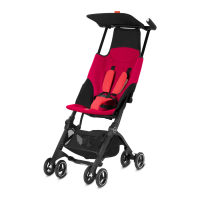
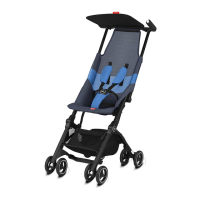
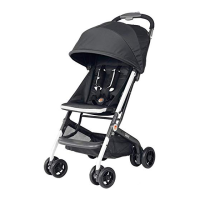
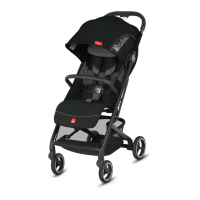
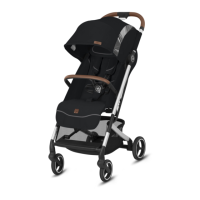
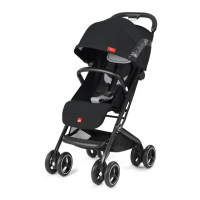
The device described in this manual is the gb Pockit Air All-Terrain stroller, designed for the "Future Perfect" series. It is a lightweight and compact stroller, emphasizing ease of use, portability, and adaptability for various terrains.
The gb Pockit Air All-Terrain stroller serves as a portable transport solution for infants and young children. Its primary function is to provide a safe and comfortable seating environment for the child while allowing parents or guardians to easily maneuver and transport them. The "All-Terrain" designation suggests enhanced wheel design or suspension for smoother rides on diverse surfaces, beyond typical smooth pavements. The stroller is designed to be highly foldable, offering both a compact and an ultra-compact fold, making it exceptionally convenient for travel, storage, and everyday use in urban or varied environments.
The manual outlines several key usage features that highlight the stroller's design for convenience and safety:
Preparation for Use: The initial steps involve unfolding the stroller from its packaged state. This process typically includes releasing a lock, extending the frame, and ensuring all components click into place, indicating a secure and ready-to-use configuration. The visual cues in the manual show the stroller being expanded from a folded state, with specific "click" indicators for secure locking of the frame and wheels. The handle is extended upwards, and the wheels are rotated into their operational position.
Compact Fold: This feature allows the stroller to be folded into a smaller, more manageable size for everyday transport and storage. The process involves collapsing the frame, often by pressing release buttons or levers, and folding the components inward. The manual illustrates a sequence where the handle is pushed down, the frame is collapsed, and a locking mechanism secures the fold. This compact fold is ideal for fitting into car trunks, overhead compartments on public transport, or tight storage spaces at home.
Ultra Compact Fold: Taking portability a step further, the ultra-compact fold reduces the stroller to its smallest possible dimensions. This is particularly useful for air travel as a carry-on item or for minimal storage requirements. The process for the ultra-compact fold is more intricate than the compact fold, involving additional steps like rotating the wheels inward and further collapsing the frame. The manual shows the wheels being rotated and locked, followed by the frame collapsing into a very small package, secured by a lock. This advanced folding mechanism is a hallmark of the Pockit series, known for its exceptional portability.
Harness System: Safety is paramount, and the stroller features a multi-point harness system to secure the child. The manual details how to use this system, including fastening and unfastening the buckles. It shows the individual harness straps clicking into a central buckle, ensuring the child is safely restrained. Adjustments to the harness length are also indicated, allowing for a snug and secure fit as the child grows. The process involves inserting the shoulder and waist straps into the central buckle until they "click," and releasing them by pressing a button on the buckle. The ability to adjust the harness height and length ensures optimal safety and comfort for children of different sizes.
Brake System: The stroller is equipped with a brake system to prevent unintended movement. The manual illustrates how to engage and disengage the brake, typically located on the rear wheels. A foot-operated lever or pedal is commonly used for this function. The visuals show a foot pressing down on a lever to "click" the brake into the locked position and lifting it to release. This feature is crucial for parking the stroller safely, especially on inclines or when stationary.
Swivel Locks: The front wheels of the stroller often have a swivel function for enhanced maneuverability, allowing for easy turning and navigation in tight spaces. However, for stability on rougher terrain or long, straight paths, the swivel function can be locked. The manual demonstrates how to engage and disengage these swivel locks, usually through a small lever or button near the front wheels. The visuals show a mechanism being pushed or pulled to lock the wheel in a straight position, providing better control over uneven surfaces.
The manual also provides instructions for maintaining the stroller, specifically regarding the fabric components:
 General
| Fold Mechanism | Two-step fold |
|---|---|
| Folded dimensions | 30 x 18 x 35 cm |
| Maximum child weight | 22 kg |
| Suspension | Front wheel suspension |
| Seat Recline | No |
| Canopy | Adjustable UPF50+ sun canopy |
| Harness | 5-point harness |

 To Next Page