I
/
I
$
Keep your detergent f~h and
dry. Under the sink isn’t a good
place to store detergent. Tbomuch
moisture. Don’t put powder
detergent into the dispenser until
you’re ready to wash dishes, either.
(It won’tbe fresh OR dry.)
If your powder detergent gets old
or lumpy, throw it away. It won’t
wash well. Old detergent often
won’tdissolve.
If you use a liquid dishwasher
detergent, these precautions are not
necessary because liquid detergents
don’t “lump” as they age or come
in contact with water.
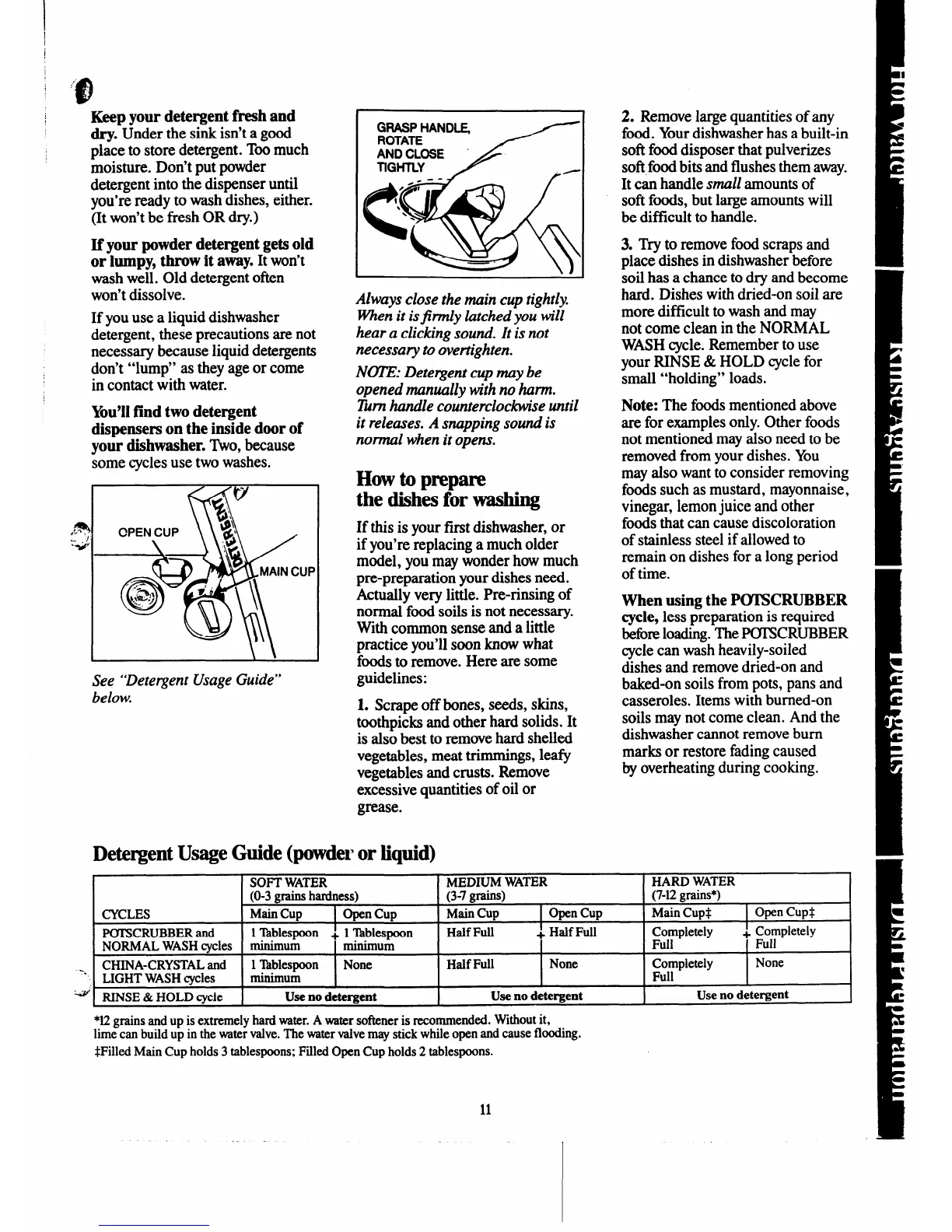
You’llfind two detergent
dispensers on the inside door of
your dishwasher. ~o, because
some cycles use two washes.
See “Detetgent Usage Guide”
below.
Always close the main cup tightly
Men it is~rmly latched you-will
hear a clicking sound. It is not
necessary to ovem”ghten.
NOTE:Deteqent cup maybe
opened manually wz”thno harm.
Turnhandle
counterclockwise until
it releases. A snapping sound is
normal when it opens.
How toplWptUR
the dishes for washing
If this is your first dishwasher, or
if you’re replacing a much older
model, you may wonder how much
pre-preparation your dishes need.
Actually very little. Pre-rinsing of
normal food soils is not necessary.
With common sense and a little
practice you’ll soon know what
fds to remove. Here are some
guidelines:
1. Scrapeoff bones, seeds, skins,
toothpicks and other hard solids. It
is also best to remove hard shelled
vegetables, meat trimmings, lea~
vegetables and crusts. Remove
excessive quantities of oil or
grease.
2. Remove large quantities of any
food. Yourdishwasher has a built-in
sofi fd disposer that pulverizes
soft food bits and flushes them away.
It can handle small amounts of
soft fds, but large amounts will
be diflicult to handle.
3. Try to remove food scraps and
place dishes in dishwasher before
soil has a chance to dry and become
hard. Dishes with dried-on soil are
more difficult to wash and may
not come clean in the NORMAL
WASHcycle. Remember to use
your RINSE & HOLD cyclefor
small “holding” loads.
Note: The foods mentioned above
are for examples only. Other foods
not mentioned may also need to be
removed from your dishes. You
may also want to consider removing
foods such as mustard, mayonnaise,
vinegar, lemon juice and other
foods that can cause discoloration
of stainless steel if allowed to
remain on dishes for a long period
of time.
When using the P(YJ13CRUBBER
cycle, less preparation is required
befbreloading.The WI’SCRUBBER
cycle can wash heavily-soiled
dishes and remove dried-on and
baked-on soils from pots, pans and
casseroles. Items with burned-on
soils may not come clean. And the
dishwasher cannot remove bum
marks or restore fading caused
by overheating during cooking.
Dete~ent Usage Guide (powderor liquid)
SOFTWATER
MEDIUMWATER HARDWATER
(O-3grains
hardness)
(3-7grains)
(7-12grains*)
CYCLES Main
@ I OpenCup
Main Cup
I Open Cup Main Cup$ I Open Cup4
IYYI13CRUBBERand 1lbblespoon ~ 1lhblespoon
Half Full
: Half Full Completely
NORMAL WASHcycles minimum
J Completely
minimum Full
Full
>. CHINA-CRYSTAL and
1‘lhblespoon
None Half Full
None
~:l~pletely
None
LIGHT WASH cycles minimum
‘4 RINSE & HOLD cycle
Usenodetergent Useno detergent
Use no detergent
*12grains and up is extremely hard water. A water softener is recommended. Wkhoutit,
lime can build up in the water valve. The water valvemay stick while open and cause flooding.
$Filled Main Cup holds 3 tablespoons; Filled Open Cup holds 2 tablespoons.
11


 To Next Page
 Loading...