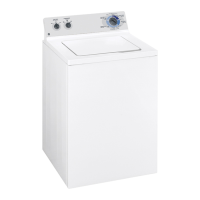
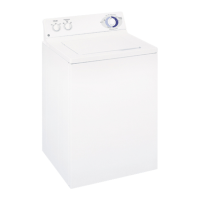
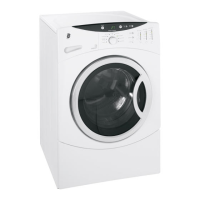
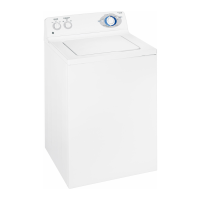
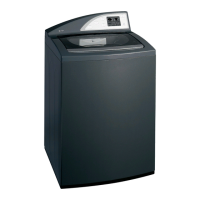
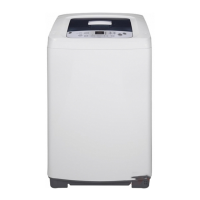
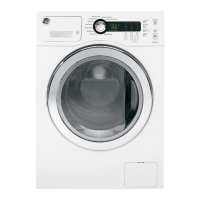
This document is an owner's manual for GE Washers, providing comprehensive information on their operation, features, maintenance, and troubleshooting.
Function Description:
The GE Washers are designed for household laundry, offering various wash cycles and settings to accommodate different fabric types and soil levels. They aim to provide efficient and effective cleaning of clothes and household linens.
Important Technical Specifications (Inferred from the manual):
- Water Temperature Range: The manual mentions a recommended house water heater temperature of 120°F-140°F (48°C-60°C) for optimal washing performance.
- Load Size: The washers support various load sizes, including Extra Small, Small, Medium, Large, Extra Large, Mini, and Super, allowing users to adjust water levels to just cover the clothes.
- Fill Hoses: The fill hoses connecting the washer to the faucet should be replaced every 5 years.
- Drain Outlet Height: The top of the drain outlet should be less than 8 ft. above the floor.
- Detergent Dispenser: The manual implies the use of liquid detergent, and some models feature a liquid bleach dispenser.
- Fabric Softener Dispenser: Some models include an automatic fabric softener dispenser.
Usage Features:
- Control Panel: The washer features a control panel with knobs for selecting Load Size, Temperature, and Wash Cycle.
- Load Size Selector: Allows users to choose the water level based on the amount of clothes, ensuring water just covers the items. Options include Extra Small, Small, Medium, Large, Extra Large, Mini, and Super.
- Temperature Selector: Provides options for wash and rinse water temperatures, such as Cold/Cold, Warm/Cold, Hot/Cold, and Warm/Warm. Users are advised to follow fabric manufacturer's care labels.
- Wash Cycle Selector: Controls the length and type of the washing process. Available cycles include:
- COTTONS REGULAR: For heavy to lightly soiled cottons, household linens, work, and play clothes.
- PERMANENT PRESS: For easy care and wrinkle-resistant items.
- KNITS: Specially designed for normally soiled knits.
- DELICATES: For lingerie and delicate fabrics with light to normal soil.
- SOAK: For heavily soiled clothes needing pre-washing. After the soak and spin, the control needs to be reset to a wash setting.
- POWER WASH: For heavily soiled and heavy-duty fabrics, offering longer agitation.
- AUTO SOAK: For heavily soiled clothes, starting with brief agitation, soaking for a specified period, then automatically proceeding through the rest of the cycle.
- EXTRA CLEANING: Provides a timed auto soak, extra rinse, and extra spin for heavily soiled clothes.
- Liquid Bleach Dispenser (on some models): Automatically dilutes liquid chlorine bleach before it reaches the wash load. Users are instructed to measure bleach carefully and avoid pouring undiluted bleach directly onto clothes or into the wash basket. Powdered bleach should be added directly to the wash basket with detergent.
- Agitator Cap / Fabric Softener Dispenser (depending on model):
- Agitator Cap: Fits into the top of the agitator.
- Fabric Softener Dispenser: Automatically releases liquid fabric softener at the proper time during the cycle. Users should use only liquid fabric softener, pour it into the dispenser up to the maximum fill line, and ensure the dispenser is securely attached. It is crucial not to stop the washer during the first spin to prevent premature emptying of the dispenser.
- Loading Instructions:
- Load dry items loosely, no higher than the top row of holes in the washer tub.
- For wet items, set the load/water level high enough for free movement.
- Detergent should be added and the washer started before adding clothes for effective cleaning.
- Avoid wrapping large items around the agitator.
- Do not wash fabrics with flammable materials.
- Agitation will not start if the lid is open.
- Safety Information: Emphasizes reading all instructions before use, especially regarding water heater safety (hydrogen gas), proper installation, keeping the laundry area clear of combustible materials, and safe operation (e.g., not reaching into a moving washer, not mixing bleach with ammonia/acids).
Maintenance Features:
- Wash Basket Care: Leave the lid open after washing to allow moisture to evaporate. Clean with a damp cloth and liquid detergent, then rinse. Avoid harsh or gritty cleaners.
- Exterior Care: Wipe off spills immediately with a damp cloth. Avoid hitting the surface with sharp objects.
- Fill Hoses: Check the condition of fill hoses regularly and replace them every 5 years to prevent leaks. Turn off water faucets when not in use to relieve pressure.
- Lint Filter: The lint filter is located under the agitator, is self-cleaning, and requires no maintenance.
- Fabric Softener Dispenser Cleaning: The dispenser can be removed and disassembled for cleaning. It should be soaked in a solution of warm water, heavy-duty liquid detergent, and bleach. Build-up can be loosened with a soft cloth.
- Moving and Storage: For moving or storing the washer in freezing temperatures, a service technician should remove water from the drain pump and hoses.
- Long Vacations: Shut off water supply at faucets and drain all water from hoses if freezing weather is expected.
- Troubleshooting Tips: The manual includes extensive troubleshooting charts to help users diagnose and resolve common issues like the washer not operating, incorrect water temperature, leaks, noise, clothes being too wet, lint/residue on clothes, colored spots, wrinkling, excessive suds, snags/holes, and grayed/yellowed clothes. These tips often suggest checking controls, water supply, load balance, detergent usage, and cycle selection.
This manual serves as a comprehensive guide for users to maximize the performance and longevity of their GE Washer.

 Need help?

 To Next Page
 General