Need help?
Do you have a question about the gefran 1000 and is the answer not in the manual?
Provides panel cut-out and mounting dimensions for the controller.
Explains how to connect sensor inputs and current transformers.
Covers power supply connection and main output relay/logic wiring.
Details parameters like Proportional Band, Cycle Time, and Soft-start settings.
Explains configuration of integral and derivative times for control loops.
Covers software protection and input/output configuration options.
Assigns functions to alarm outputs (AL1, AL2, AL3) and HB alarm.
Configures PID control types and manual/automatic switching modes.
Lists essential safety warnings and precautions for installation, connection, and use of the device.
The Gefran 1000/1001/1101 series are configurable temperature controllers designed for various industrial applications. These devices offer precise temperature control and a range of configurable features to suit different process requirements.
The controllers provide main output control with both direct (heating) and reverse (cooling) functions. They support On/Off, P, PD, and PID control actions, with parameters easily settable via the faceplate keys. The main output can be configured as a relay, logic output, or continuous output (0-10V or 4-20mA). A soft-start function allows for a gradual power ramp-up, and an Off function can deactivate the instrument entirely.
Alarm management is a key feature, with three configurable alarm limits that can be set as absolute, deviation, or symmetrical deviation compared to the setpoint. These alarms can have reversible functions (direct or reverse) and their trip points can be set across the entire selected scale. An alarm (AL1) can also be configured with PD output, allowing for a proportional band and derivative time setting. A load interrupt function (HB) can be linked to a current transformer input, enabling monitoring of load current and triggering an alarm if the current deviates from a configurable scale. The controllers also support an LBA (Loop Break Alarm) function, which detects interruptions in the control loop due to probe issues or load breaks. Alarm trip hysteresis is settable, providing flexibility in alarm triggering.
Other notable functions include a manual reset for control correction, an offset adjustment to compensate for differences between the probe reading and the controller's value, and an automatic/manual function with bumpless transfer. Serial communication is available via an optically isolated 4-wire passive current loop or RS485 interface, supporting various baud rates and the Gefran CENCAL protocol. Current transformer input options are available for 5Aac, 50/60Hz signals.
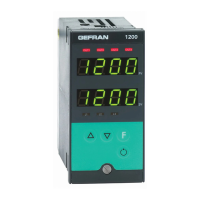
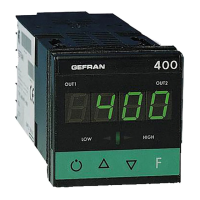
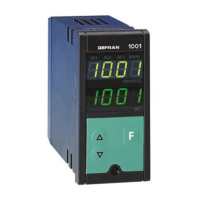
The controllers feature a clear display with two 3-digit green LEDs, with digit heights varying between 10mm, 14mm, and 20mm depending on the model. This allows for easy reading of the process variable, setpoint, and other parameters. Three mechanical keys (Raise, Lower, F) provide intuitive navigation and setting adjustments.
The work mode allows users to monitor essential process quantities such as process variable, load current, and control output power. The status of the main output and alarms is indicated by LEDs. Setpoints and alarms can be easily displayed and adjusted using the Raise and Lower keys. The F key is used to confirm settings and navigate through different work processes. If no key is pressed for 10 seconds after a change, the value is automatically confirmed, and the display returns to the setpoint value.
The device also supports self-tuning and auto-tuning functions to optimize control parameters. Self-tuning can be activated by simultaneously pressing the F and Raise keys for 3 seconds and is suitable for heating systems. Auto-tuning starts when the setpoint is reached for the first time and adjusts the proportional band. A soft-start function partializes power as a percentage of the elapsed time since instrument turn-on, providing a gentle ramp-up.
The AUTO/MAN function allows for manual control of the output, with bumpless transfer to automatic mode. In manual mode, the output power can be directly adjusted using the Raise and Lower keys. Error messages and signals, such as "Sbr" for probe input interruption, "Err" for incorrect connection, and "Lo" or "Hi" for off-scale readings, are displayed to alert users to potential issues.
For correct and safe installation, users should adhere to the warnings provided in the manual, including proper wiring, cable selection, and environmental conditions. The electronic part of the case can be easily removed by loosening the front screw, allowing access to the input, output/power, and optional boards for configuration.
Repairs should only be performed by trained and specialized personnel. Before accessing internal parts, power to the device must be cut. The case should not be cleaned with hydrocarbon-based solvents, as this can reduce the mechanical reliability of the device. Instead, a cloth dampened with ethyl alcohol or water is recommended for cleaning external plastic parts.
The device's EMC conformity has been tested with various connections, and it conforms to European Directives for electromagnetic compatibility and safety. The manual provides detailed instructions for hardware configuration, including jumper settings for enabling/disabling configuration and calibration, and for selecting alarm relay contacts (NO/NC) and serial communication types. Calibration procedures are also outlined for thermocouples, RTDs, linear inputs, and current transformer inputs, ensuring accurate measurements and control.
 General
| Output Type | Relay, SSR, Analog |
|---|---|
| Control Type | PID |
| Input Type | Thermocouple, RTD |
| Power Supply | 100-240 VAC |
| Dimensions | 48x96mm, 96x96mm |
| Communication | RS485 |
| Protection Rating | IP65 (front) |

 To Next Page