Need help?
Do you have a question about the gefran 401 and is the answer not in the manual?
Notes concerning electrical safety and electromagnetic compatibility.
Advice for correct installation for EMC.
Describes the normal absolute alarm configuration.
Describes the symmetrical absolute alarm configuration.
Describes the deviation alarm configuration.
Describes the symmetrical deviation alarm configuration.
Details current transformers used for measurement.
Describes the interface cable for GEFRAN instrument configuration.
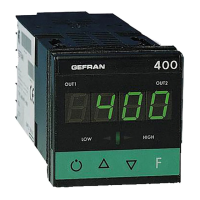
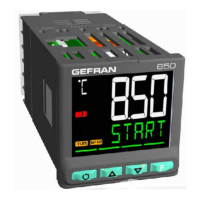
The Gefran 400/401 is a single-display microprocessor controller designed for temperature regulation, featuring a universal input for various sensor types. Manufactured using SMT technology, it offers a robust operator interface with a Lexan® membrane, ensuring IP65 faceplate protection. The device is equipped with four keys, a four-digit display, and multiple indicating LEDs (two for the 400 model, three for the 401 model, plus a three-LED bar-graph) for clear status indication.
The primary function of the Gefran 400/401 is precise temperature control. Its universal input allows connection to a wide range of sensors, including various thermocouple types (J, K, R, S, T, B, E, N), 3-wire PT100 resistance thermometers, PTC thermistors, and linear inputs (0-60mV, 12-60mV, 0-20mA, 4-20mA, 0-10V, 2-10V). This versatility eliminates the need for external shunts or adapters, as the input type is selected directly from the faceplate keys.
The controller provides two (or three for the 401 model) outputs, which can be configured as relay (5A/250Vac) or static (10Vdc/30mA) outputs. These outputs support Heat, Cool, Heat/Cool, and/or alarm functions, offering flexible control strategies. The 401 model also includes an auxiliary input for a 50mAac current transformer, enabling load current monitoring and the setting of an alarm point to detect load malfunctions.
Programming is streamlined through the grouping of parameters into functional blocks (CFG for control, Inp for inputs, Out for outputs). A simplified menu is available for frequently used parameters, and a PC programming kit (WINSTRUM) with a menu-driven configuration program and necessary cable further simplifies setup. A configurable password protection code allows restriction of editing and display levels for configuration parameters.
The device supports various control actions, including Proportional (P), Integral (I), and Derivative (D) actions, which can be combined for PID control. It also features Auto-tuning and Self-tuning functions to automatically calculate optimal PID parameters during process startup or in response to system oscillations. The Auto-tuning function continuously reads system oscillations to find PID values that reduce current oscillation, while Self-tuning calculates optimum control parameters during process startup by measuring overshoot and time to peak.
Alarm functions are comprehensive, including normal absolute alarms (low/high), symmetrical absolute alarms, deviation alarms (low/high), and symmetrical deviation alarms. These alarms can be assigned to outputs and configured with hysteresis. The HB alarm, specific to the 401 model, is conditioned by the current transformer input and signals variations in load absorption, tripping if the current falls below or exceeds a set limit for a specified duration.
The operator interface is designed for ease of use. The four keys (Man/Aut, Raise, Lower, F) allow for navigation through menus, parameter adjustment, and confirmation of changes. The display shows the process variable (PV), setpoint variable (SP), current transformer input variable (C.T. - for 401), and alarm thresholds. Deviation indicators provide visual feedback on the control performance, showing if the deviation is within acceptable limits or if it's flashing due to larger deviations.
The "Raise" and "Lower" keys facilitate numerical parameter changes, with speed proportional to key press duration. The "F" key provides access to different configuration stages and confirms parameter changes. Specific key combinations allow for quick access to level 1 display, immediate return to the previous parameter, or immediate return to the level 1 display from any menu.
A software ON/OFF switching function allows deactivating the unit while keeping the power supply connected, maintaining the process value display, and disabling all outputs and functions except switch-on and digital communication. This state is memorized even after a power failure.
The Gefran 400/401 is designed for permanent indoor installations within enclosures or panel-mounted systems, with exposed terminals on the back. It is crucial to ensure proper electrical connections, including separate power supply lines for electronic instruments and electromechanical devices, and the use of woven and screened cables for analog inputs/outputs. RC groups or diodes should be fitted in parallel with inductive loads to prevent interference.
The device is built to conform to European Directives for electrical safety and electromagnetic compatibility, adhering to generic standards for immunity in industrial environments and emission in residential environments. Proper installation, including good earth connection, voltage stabilization if mains fluctuate, and adequate mains filters in the presence of high-frequency generators, is essential for optimal performance and compliance.
The instrument's robust design and IP65 faceplate protection contribute to its durability. Regular checks for physical damage and ensuring the order code matches the required configuration are part of good maintenance practice. In case of presumed malfunction, consulting the F.A.Q. section on the Gefran website is recommended before contacting technical service. The device is designed for easy panel mounting, and a panel fixing kit and dust protection seal are included for installation.
 General
| Control Mode | ON/OFF, PID |
|---|---|
| Mounting | Panel Mount |
| Input Type | Thermocouple |
| Output Type | Relay |
| Power Supply | 24V AC/DC |
| Operating Temperature | 0°C to 50°C |
| Dimensions | 96x96 mm |


 To Next Page