Version: 2020-09-04
44
Copyright of the European Union is effective (Copyright EU) (c) 2019 GENEREX Systems GmbH, Hamburg, Germany, All rights reserved
TEL +49(40)22692910 - EMAIL generex@generex.de - WEB www.generex.de (This and all other product datasheets are available for download.)
Note:
The advantage is the fact that local connection options can be used to ensure a basic communication between a device and a
monitoring system. The focus is set on ensuring communication - the communication speed depends on the local infrastructure that is
available:
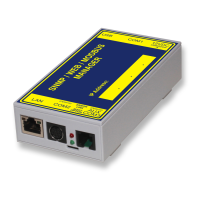
The UNMS II displays incoming information directly on arrival, but can not determine when a valid e-mail arrives from a remote system.
Modbus
Field buses are bus systems that connect field devices like sensors or actuators to communicate with a parent automation device.
If several communication participants send their information through the same line, it is necessary to determine who (identifier)
will send what (measure, command) at a specified time (initiative). To ensure this communication, standardized protocols will be used.
The Modbus protocol was launched in 1979 by Gould-Modicon for communicating with their own programmable logic controllers, and
has become an unofficial standard in the industry due to the fact it is an open protocol.
Since 1999, fieldbuses have been standardized worldwide in the IEC 61158 standard (Digital data communication for measurement and
control - Fieldbus for use in industrial control systems). The second generation of fieldbus technology is based on real-time Ethernet.
Note:
For further information, please refer to the Modbus manual, downloadable from the GENEREX website, visit www.generex.de.
Modbus providing devices
Modbus is a protocol for serial communication. The data is transmitted using 16-bit registers (integer) or data byte status information.
Using Modbus has many advantages:
- The basic structure of Modbus has never really changed to ensure best compatibility over the years. The number of unified
devices provides a stable platform for integration, maintenance and configuration.
- This open protocol has been established as an unofficial standard in many industrial machines worldwide. As soon as a
device supports Modbus, it can usually be integrated into an existing Modbus network.
Modbus can be used as single-master protocol
The master controls the entire transmission and monitors accidental occurring timeouts. The connected slave devices may only send
telegrams if requested by the master. For remote control and monitoring of equipment, the Modbus interface in each CS141 can read
measuring’s, events, status information and other things within the master-slave protocol.
Note:
If you do not find readings you are looking for, do not assume this could be an error. As an example, if you are looking for rare or
custom UPS functions, it is possible that the according UPS communicates this to the CS141 via SNMP, but the manufacturer does not
store a Modbus address for these readings.
As a consequence, the CS141 will show it with its own web interface, but cannot serve your Modbus query.
Difference between CS141 Modbus and CS141 Professional
Each device of the CS41 family is capable to handle Modbus over IP.
The Modbus devices have an RS485 interface instead of the standard
mini-DIN connector for sensors, specially designed for Modbus
infrastructures.
Modbus Pin assignment
As a default, a Modbus plug is installed od delivery. The plug can be
removed and later simply assembled to ensure a fast and intuitive
wiring procedure.
Please note the plug alignment:
Before wiring, ensure the terminal strips are at top of the cable slots - not below them.
By doing so, the following PIN assignment can be used:


 To Next Page
 Loading...