The BLC-015 is a Secure Relay Controller designed for use with Virdi terminals, featuring a built-in battery monitoring and protection circuit. This device acts as a crucial component in access control systems, ensuring secure and reliable operation, even during power outages.
Function Description:
The primary function of the BLC-015 is to provide a secure relay control for Virdi access control terminals. It integrates with these terminals to manage door access and offers a backup power solution. The controller is designed to enhance the security and reliability of access control systems by providing a robust interface for various lock types and communication protocols. Its built-in battery monitoring and protection circuit ensure continuous operation and safeguard the backup battery from over-discharge or over-charge. The device also incorporates error detection capabilities, specifically designed to identify network errors, thus improving system diagnostics and maintenance.
Important Technical Specifications:
- Status Indicator: The device features a 3-colour high luminance LED, which provides visual feedback on the operational status of the controller. This indicator helps in quick diagnosis and monitoring of the device's state.
- Sensor Input: It is equipped with 3 sensor input ports, allowing for the connection of various sensors such as door status sensors, inside open sensors, and lock status sensors. These inputs are crucial for monitoring the state of the access point and providing feedback to the access control system.
- Relay Output: The BLC-015 includes 1 relay output port, which is used to control the connected locks. This single relay output can be configured to operate different types of locks, including dead-bolt, strike, and EM locks, in either fail-safe or fail-secure configurations.
- Applicable Locks: The controller is compatible with DC12V locks, with a maximum current capacity of 1A. This specification ensures that it can power and control a wide range of standard access control locks.
- Battery Life: In the event of a power outage, the backup battery can sustain operation for up to 2 hours. This feature is critical for maintaining security and access control functionality during temporary power disruptions.
- Power: The device operates on a DC12V power supply.
- Power Consumption: The typical power consumption of the BLC-015 is 80 ± 15mA. This low power consumption contributes to energy efficiency and extends the life of the backup battery during power outages.
- Dimensions: The physical dimensions of the controller are 260 × 200 × 60 mm, making it a compact unit suitable for various installation environments.
- Communication: The BLC-015 supports both RS485 and Wiegand communication protocols. This dual-protocol support allows for flexible integration with a wide array of Virdi terminals and other access control devices. The RS485 interface is used for data communication and control, while the Wiegand interface is typically used for reader input.
- In / Out: The device provides multiple input/output options, including Door Access, RS485, Wiegand, and Battery In/Out. These I/O options facilitate comprehensive integration within an access control ecosystem.
Usage Features:
- Built-iLock Controller Compatibility: The BLC-015 is designed to be fully compatible with iLock controllers and various access control terminals, ensuring seamless integration into existing Virdi-based systems.
- Backup Battery Availability: A key feature is the provision for a backup battery, which automatically takes over in case of a power outage. This ensures uninterrupted operation of the access control system, maintaining security and accessibility.
- Error Detection: The controller is capable of detecting network errors, providing an early warning system for communication issues. This feature is crucial for maintaining the integrity and reliability of the access control network.
- Status Indication: The 3-colour high luminance LED provides clear visual feedback on the device's operational status, simplifying troubleshooting and monitoring.
- Flexible Communication: With support for both RS485 and Wiegand, the BLC-015 offers versatile communication options, allowing it to interface with different types of readers and control panels.
- Multiple Input/Output Ports: The device's multiple input ports (3 sensor inputs) and a relay output provide comprehensive control over door status, lock status, and the actual locking mechanism.
- RS-485 ID Setting: The device allows for configuration of its RS-485 ID using a DIP switch (SW1). This is essential for addressing individual controllers in a multi-device RS-485 network. The ID can be set from 0 to 3, using two switches (1 and 2) in OFF/ON combinations.
- Lock Open Duration Setting: The BLC-015 provides configurable lock open durations, ranging from 0.2 seconds to 5 seconds. This setting is controlled via DIP switches (SW1, switches 3, 4, and 5), allowing administrators to fine-tune the unlock time based on specific security requirements and door types. This flexibility ensures that doors remain unlocked for the appropriate duration, enhancing user convenience while maintaining security.
- Wiring Flexibility: The manual provides detailed schematics for connecting various types of door locks, including Dead-Bolt Type (Fail Safe), Strike Type (Fail Safe), and EM Type (Fail Safe) locks, as well as Auto-Door (Contact Control) systems. This comprehensive guidance simplifies installation and ensures correct wiring for different access control scenarios.
- Power Connection: The device includes dedicated terminals for 12V IN, GND, 12V OUT, and a backup battery interface (BAT(-) and BAT(+)), ensuring a robust and reliable power supply.
Maintenance Features:
- User Manual: The availability of a user manual with detailed instructions and diagrams facilitates proper installation, configuration, and troubleshooting.
- Status Indicator: The 3-colour LED status indicator aids in quick visual inspection and diagnosis of operational issues, reducing the time required for maintenance.
- Error Detection: The network error detection capability helps in proactively identifying and addressing communication problems, preventing potential system failures.
- Modular Design: The clear labeling of connectors (J101 for 12V In/Out, Wiegand, RS-485, and J51 for Battery IN/Input Port/Lock Control) simplifies wiring and component replacement, making maintenance more straightforward.
- DIP Switches for Configuration: The use of DIP switches for RS-485 ID and lock open duration settings allows for easy and reliable configuration changes without requiring complex software tools. This physical configuration method is robust and less prone to software-related issues.
- Reference Diagrams: The inclusion of detailed board feature and connector descriptions, along with schematic diagrams for door lock interfaces and RS-485 connections, provides essential visual aids for maintenance personnel to understand the device's internal layout and wiring.

 Need help?
 General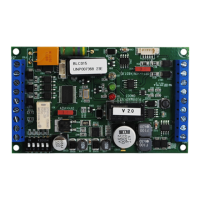

 To Next Page