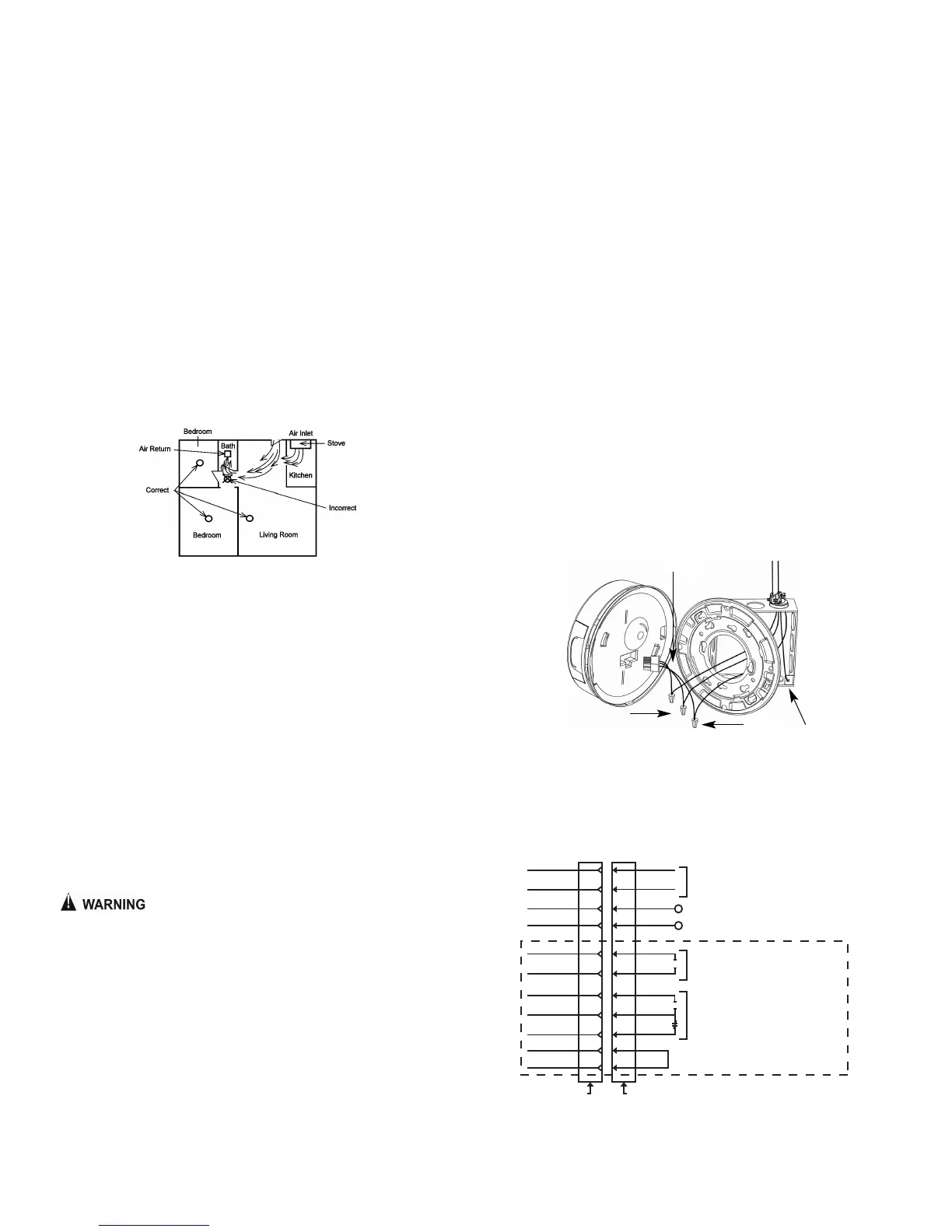
FIGURE 7
INSTALLATION S1209 SERIES
NOTICE: NEW CONSTRUCTION: DO NOT ATTACH SMOKE ALARM HEAD UNTIL
AFTER SANDING, PAINTING, AND OTHER DUST CREATING SITUATIONS ARE
FINISHED AND CLEANED UP.
WIRING/GENERAL
1. Use ANSI/UL Listed cable with Class 1 insulation.
2. Observe local code requirements. Use box connector to anchor cable to outlet
box.
3. Metal outlet boxes must be grounded to earth ground.
NOTICE: USE ONLY DURACELL® MN 1604 BATTERY WITH THE S1209 SERIES
SMOKE ALARMS. AVAILABLE AT MANY RETAIL STORES.
CAUTION: Turn off electricity to prevent SHOCK and damage to smoke alarm. Be
sure the power line to the smoke alarm is not controlled by any on/off switch, or other
type of switch, other than a fuse or circuit breaker.
IMPORTANT: Ensure that all fluorescent lighting fixtures are properly grounded.
NOTICE: THE WIRING TO BE USED SHALL BE IN ACCORDANCE WITH THE
PROVISIONS OF ARTICLE 210 OF THE NATIONAL ELECTRICAL CODE, NFPA 70.
WIRE INSTALLATION SHOULD BE PERFORMED ONLY BY A LICENSED
ELECTRICIAN.
MOUNTING OUTLET BOX
Use a 2" x 3" switch box or a 4" square or octagon junction box. Mount a box for each
smoke alarm. If wall mounting is desired, be sure the box screws are oriented to
upper right and lower left corners. Be sure to use supplied Mounting Plate.
WIRING ONE ALARM
1. Run a minimum of 16 gauge, 2-conductor cable, plus ground (3 wires) to the
junction box from a power supply. Smoke alarms shall be connected to their own
dedicated circuit. Use ANSI/UL Listed Class 1 wire.
NOTICE: THE WIRING TO BE USED SHALL BE IN ACCORDANCE WITH THE
PROVISIONS OF ARTICLE 300.3(B) 210 OF THE NATIONAL ELECTRICAL CODE,
ANSI/NFPA 70 AS WELL AS ARTICLE 210.
2. Make wire connections to the supplied plug-in connector as follows: black to black,
white to white, and connect the ground wire to the metal outlet box.
w In damp or very humid areas, or next to bathrooms with showers. The moisture
in humid air can enter the sensing chamber as water vapor, then cool and
condense into droplets that cause a nuisance alarm. Install smoke alarms at
least 36 inches (910mm) away from bathrooms.
w In very cold or very hot environments, or in unheated buildings or outdoor
rooms, where the temperature can go below or above the operating range of the
smoke alarm. Temperature limits for proper operation are 40° to 100°F (4.4° to
37.8°C).
w In very dusty or dirty areas. Dust and dirt can build up on the smoke alarm's
sensing chamber and can make it overly sensitive, or block openings to the
sensing chamber and keep the smoke alarm from sensing smoke.
w Near fresh air inlets, returns or excessively drafty areas. Air conditioners,
heaters, fans, fresh air intakes and returns can drive smoke away from smoke
alarms, making the devices less effective.
w In dead air spaces at the top of a peaked roof or in the corners between
ceilings and walls. Dead air may prevent smoke from reaching a smoke alarm.
See FIGURES 5 and 6 for recommended mounting locations.
w In insect-infested areas. If insects enter a smoke alarm's sensing chamber, they
may cause a nuisance alarm. Get rid of the bugs before installing smoke
alarms where bugs are a problem.
w Near fluorescent light fixtures. Electrical "noise" from nearby fluorescent light
fixtures may cause a nuisance alarm. Install smoke alarms and fluorescent
lights on separate electrical circuits.
550-0008
Pg. S-4
w Never disconnect an AC smoke alarm to silence a nuisance alarm. Open a
window or fan the air around the device to remove the smoke. The alarm
will automatically turn off when the smoke in the air is completely gone.
Do not stand close to the device. The sound produced by the smoke alarm
is loud because it is designed to awaken you in an emergency. Prolonged
exposure to the horn at a close distance may be harmful to your hearing.
w This smoke alarm is designed for use inside a single or multi-family dwelling.
It is not meant to be used in common lobbies, hallways, or basements of
multi-family buildings unless working alarms are also installed in each family
living unit. Smoke alarms in common areas may not be heard from inside
individual family living units.
w This smoke alarm is not a suitable substitute for complete detection systems
in places which house many people like hotels or dormitories, unless a
smoke alarm is also placed in each unit.
w DO NOT use this smoke alarm in warehouses, industrial or commercial
buildings, special-purpose non-residential buildings or airplanes. This
smoke alarm is specifically designed for residential use and may not provide
adequate protection in non-residential applications.
NOTICE: RED-YELLOW WIRE AND BROWN-YELLOW WIRE: THE RED-YELLOW
WIRE AND BROWN-YELLOW WIRE FROM THE SMOKE ALARM IS FOR TANDEM
CONNECTION ONLY. DO NOT USE, AND DO NOT REMOVE INSULATION CAP
UNLESS CONNECTING ANOTHER SMOKE ALARM, SMOKE/CO ALARM OR CO
ALARM.
FIGURE 8
RED-YELLOW OR
BROWN-YELLOW WIRE
UNINSULATED WIRE
EARTH GROUND - FOR
METAL BOXES ONLY
3-WIRE CABLE AND
GROUND 120VAC
BLACK
WHITE
WHERE ALARMS SHOULD BE INSTALLED IN MOBILE HOMES
In mobile homes built after about 1978 that were designed and insulated to be
energy-efficient, smoke/alarms should be installed as described in the section above.
In older mobile homes that have little or no insulation compared to today's
standards, uninsulated metal outside walls and roofs can transfer heat and cold from
outdoors, making the air right next to them hotter or colder than the rest of the inside
air. These layers of hotter or colder air can prevent smoke from reaching a smoke
alarm. Therefore, install devices in such units only on inside walls, not more than 12
inches (30 cm) from the ceiling. If you are not sure about the insulation level in your
mobile home, or if you notice that the walls or ceiling are unusually hot or cold, install
the device on an inside wall.
Minimum protection requires one smoke alarm as close to the sleeping area as
possible. For better protection, install one device in each room, but first read the
"LOCATIONS TO AVOID."
LOCATIONS TO AVOID
Nuisance alarms are caused by placing smoke alarms where they will not operate
properly. To avoid nuisance alarms, do not place smoke alarms:
w In or near areas where combustion particles are normally present such as
kitchens; in garages where there are particles of combustion in vehicle exhausts;
near furnaces, hot water heaters, or gas space heaters. Install smoke alarms
between 10 feet (3 meters) and 20 feet (6 meters) away from kitchens and other
areas where combustion particles are normally present.
w In air streams passing by kitchens. FIGURE 7 shows how a smoke alarm can
be exposed to combustion particles in normal air movement paths, and how to
correct this situation.
PLUG SMOKE
ALARM
BLK
WHT
RED / YEL
VIO
VIO / BLK
BLU
ORN
YEL
GRAY
GRAY
HOT
NEUT
POWER
TANDEM - LEGACY
ALARM
CONTACTS
ACCESSORY
ALARM
CONTACTS
INTERNAL
JUMPER
BRN / YEL
TANDEM
ADDITIONAL
WIRES FOR
S1209F MODEL
RELAY CONTACTS
RATED LOAD RESISTIVE
2.0 AMP @ 30 VDC MAX
0.5 AMP @ 125 VAC MAX
S1209 / S1209F WIRING DIAGRAM


 To Next Page
 Loading...