Appendix D How to Use PLC Function
VFD-E Series
Revision August 2006, 01EE, SW--PW V1.03/CTL V2.03 D-17
X0
X10
Y0
Y0
1
2
Y0 is repeated
The output of Y0 will be decided by circuit
Ϥ
2
, i.e. decided by On/Off of X10.
D.6.4 Value, constant [K] / [H]
K Decimal
K-32,768 ~ K32,767 (16-bit operation)
K-2,147,483,648 ~ K2,147,483,647 (32-bit
operation)
Constant
H Hexadecimal
H0 ~ HFFFF (16-bit operation)
H0 ~ HFFFFFFFF (32-bit operation)
There are five value types for DVP-PLC to use by the different control destination. The following is
the explanation of value types.
1. Binary Number (BIN)
It uses binary system for the PLC internal operation or storage. The relative information of binary
system is in the following.
Bit : Bit is the basic unit of binary system, the status are 1 or 0.
Nibble : It is made up of continuous 4 bits, such as b3~b0. It can be used to represent
number 0~9 of decimal or 0~F of hexadecimal.
Byte : It is made up of continuous 2 nibbles, i.e. 8 bits, b7~b0. It can used to represent
00~FF of hexadecimal system.
Word : It is made up of continuous 2 bytes, i.e. 16 bits, b15~b0. It can used to represent
0000~FFFF of hexadecimal system.
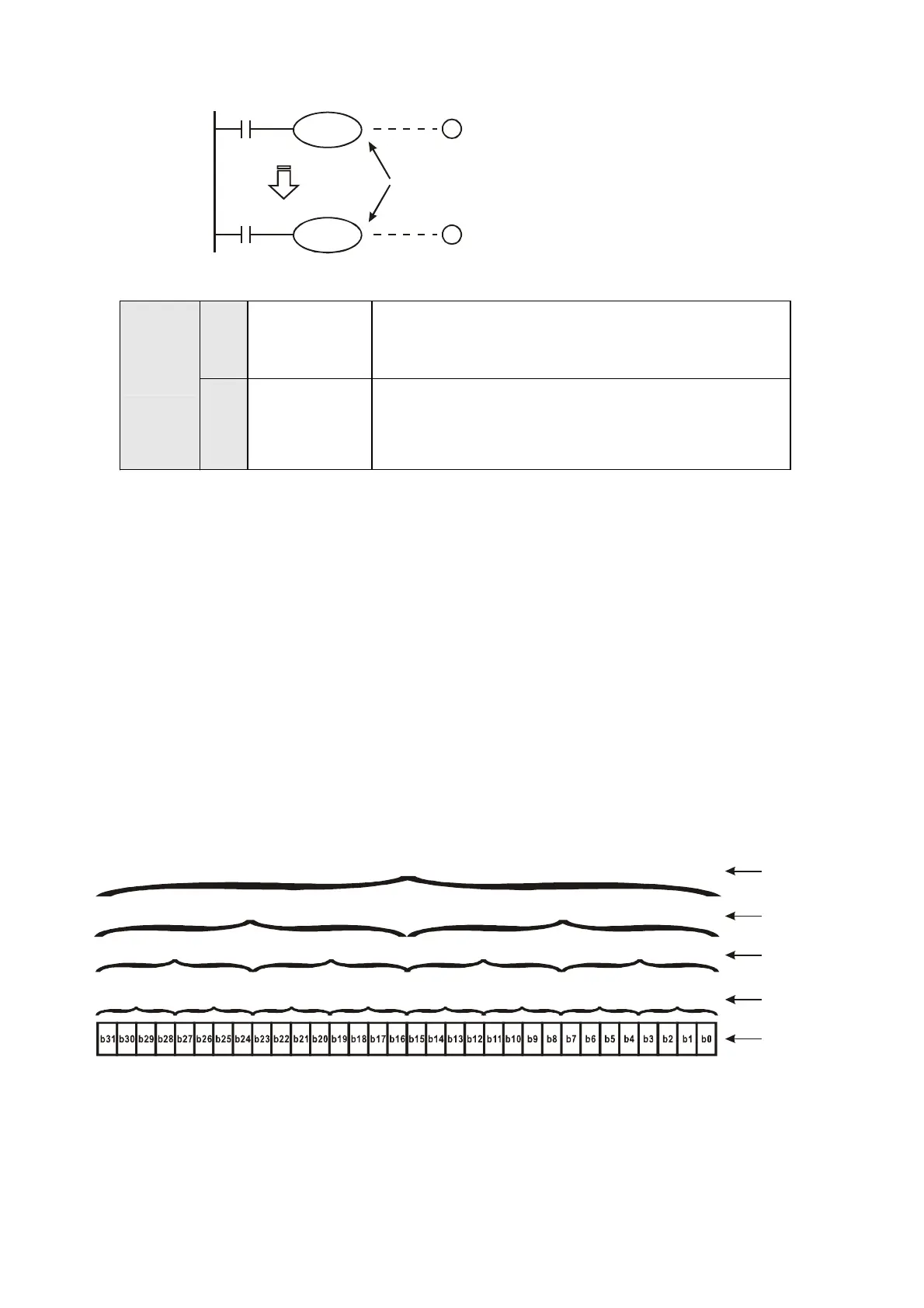
The relations among bit, nibble, byte, word, and double word of binary number are shown as follows.
NB0NB1NB2NB3NB4NB5NB6NB7
BY3 BY2 BY1 BY0
W1
DW
W0
Double Word
Word
Byte
Nibble
Bit
2. Octal Number (OCT)
The numbers of external input and output terminal of DVP-PLC use octal number.
Example:
External input: X0~X7, X10~X17Ξ(device number)


 To Next Page
 Loading...
