Appendix D How to Use PLC Function
VFD-E Series
Revision August 2006, 01EE, SW--PW V1.03/CTL V2.03 D-47
Operands:
S
1
: Multiplicand S
2
: Multiplier D: Multiplication result
Explanations:
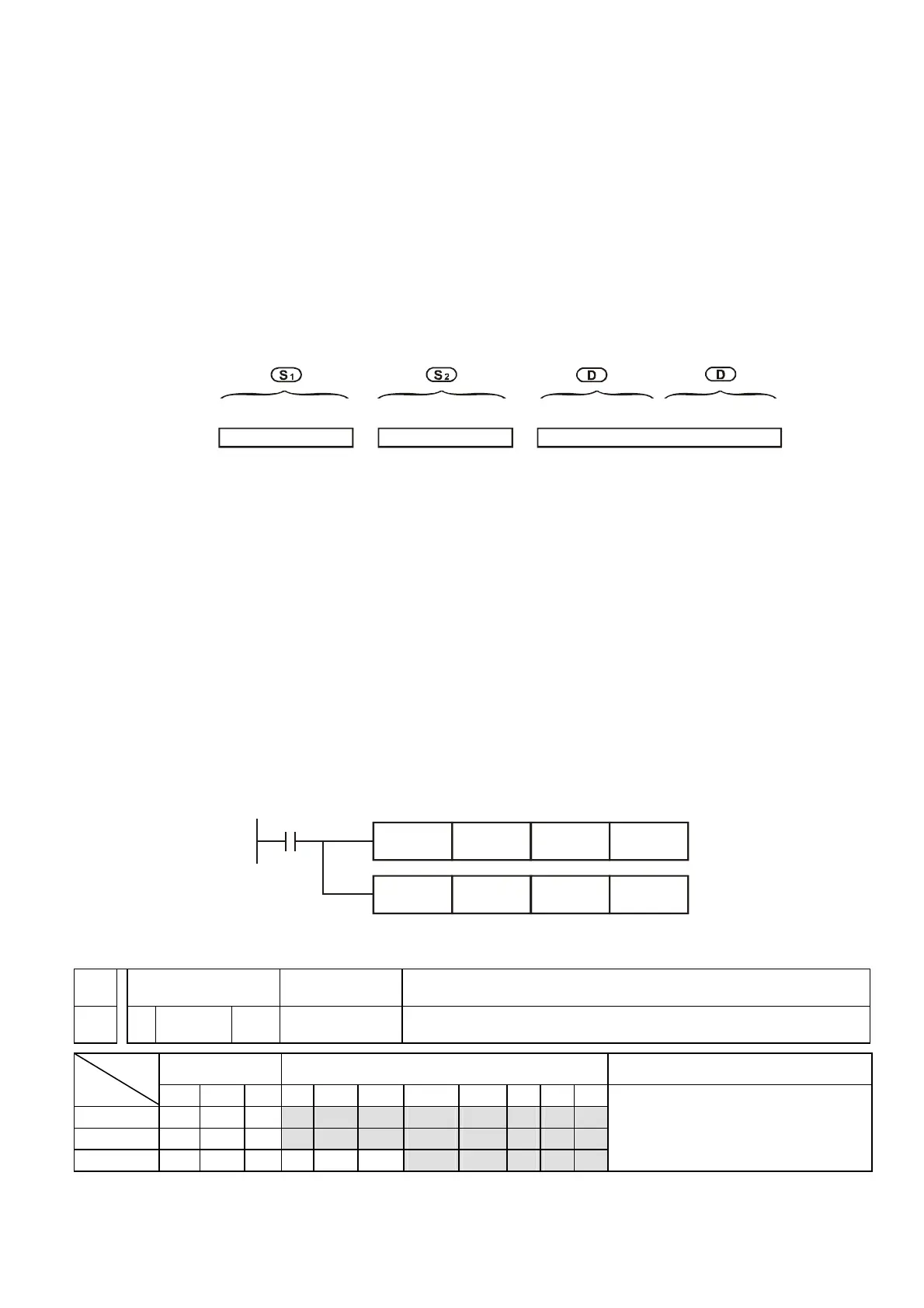
1. In 16-bit command, operand D occupies 2 continuous devices.
2. S1 u S2 D. Performs the Multiplication of BIN data S1 and the BIN data S2, and stores
the multiplication result into the device D. Please pay careful attention to the polarity
display of the operation result of S1, S2 and D in the 16-bit command.
16-bit command:
b15................ b00
X
=
b15................ b00 b31............ b16 b15.............b00
+1
b15 is a symbol bit b15 is a symbol bit
b31 is a symbol bit D+1)ERI
b15=0,S is a positive value
1
b15=1,S is a negative value
1
b15=0,S is a positive value
2
b15=1,S is a negative value
2
b31=0,S is a positive value
2
b31=1,S is a negative value
2
When D is bit device, it can specify K1~K4 and produce a 16-bit result. Then, the flag M1067,
M1068 will be On and D1067 record error code “0E19”.
Program Example:
16-bit command:
A 16-bit data source, D10 is multiplied by another 16-bit data source, D20. The upper 16-bit data is
stored in D21 and the lower one is stored in D20. The polarity of the result is indicated by the
OFF/ON of the most significant bit. OFF indicates the value of positive 0 and ON indicates the value
of negative 1.
X0
MUL D0 D10 D20
MUL D0 D10 K8M0
(D0) u (D10) (D21, D20)
API Mnemonic Operands Function
23 DIV P S
1
, S
2
, D Division
Bit Devices Word devices Program Steps
Type
OP
X Y M K H KnX KnY KnM T C D
S
1
* * * * * * * *
S
2
* * * * * * * *
D * * * * *
DIV, DIVP: 7 steps


 To Next Page
 Loading...
