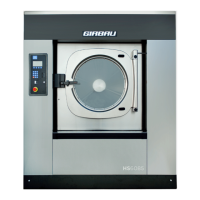
This document provides instructions for replacing the bearings on Girbau HS-5008 and H5020 washing machines. It covers two main variants of bearing boxes: those without a drainage outlet and those with a drainage outlet, with specific procedures for each. The manual emphasizes safety precautions throughout the process.
Function Description:
This manual details the procedure for replacing the bearings in Girbau commercial washing machines, specifically models HS-5008 and H5020. Bearings are critical components that allow the drum to rotate smoothly and efficiently. Over time, bearings can wear out due to constant use, leading to noise, vibration, and potential damage to other machine parts if not replaced. The replacement process involves disassembling various parts of the washing machine, removing the old bearings, preparing the bearing box and outer drum, installing new bearings and seals, and reassembling the machine. The instructions are designed to ensure proper installation and maintain the machine's operational integrity.
Important Technical Specifications:
The manual specifies different procedures based on the machine's serial number, indicating variations in the bearing box design.
- Machines without drainage outlet: Manufactured with serial numbers before 887034 (Continental models: before 1343435). These machines require following the steps indicated in Chapter 2.
- Machines with drainage outlet: Manufactured with serial numbers from 887034 (Continental models: from 1343435). These machines require following the steps indicated in Chapter 3. A plastic tube in the lower part of the bearings' box identifies machines with drainage.
The manual provides a comprehensive list of tools required for disassembly and assembly:
- Screwdrivers: TORX 20, TORX 25, 5mm flat screwdriver.
- Wrenches: Wrench for opening the control panel, 10mm wrench, two open wrench 13mm, 17mm key, 13mm tube wrench, two wrench 13mm.
- Pliers: Lock grip pressure-type pliers.
- Hammers: Nylon-headed hammer (approx. 4.5lb/2kg).
- Threaded rod: M10 threaded rod (approx. 6 inch / 150mm) with M10 washers and nut.
- Metallic round or similar item: For striking out bearings (Ø 1 inch / 25mm; length: 12 inch / 300mm).
- Bearing introducers: UM-500 tool (front bearing), UM-542 centering tool, UM-499 tool (rear bearing).
Pieces and Materials:
The manual lists specific parts and materials needed for the replacement, with quantities varying slightly between machine types:
- Bearings: 6207 Bearing (1), 6206 Bearing (1).
- Separator: (1).
- Washers: Ø39xØ30 Washer (1).
- Joints: Ø83xØ71x4 Joint (1), Flat joint (1 for machines with drainage).
- V-rings: V-ring 65 (1), V-ring 45 (1).
- Grease: SKF LGWA2 grease (200 gr. approx.). This is a watertight grease recommended by the manufacturer. Other lubricants may not be compatible.
- Sealant: Silicon (any non-acid silicon sealant with a fine mouth applicator).
- Lubricant: Vaseline (any industrial or sanitary vaseline).
Usage Features (related to maintenance):
The manual outlines a detailed step-by-step process for bearing replacement, emphasizing precision and adherence to specific instructions:
- Preparation: Includes identifying the bearing box variant, gathering tools and materials, emptying residual water, and disassembling covers, front panel, outer drum front, and the drum itself.
- Disassembly of Bearings' Box: Involves noting the position of the level sensor tube, screws, and washers for correct reassembly. Screws (A and B) fastening the bearing box to the outer drum are removed.
- Changing the Bearings: Bearings are struck out from inside the box using a metallic round item. The bearing box is cleaned thoroughly. New bearings are introduced using specific tools (UM-500 for front, UM-499 for rear) and centered with the UM-542 tool. A separator is placed between the bearings.
- Preparing the Outer Drum: The friction area of the seals on the back of the outer drum is cleaned of detergent, fabric remains, rubber adherence (with solvent), and lime (with anti-lime liquid). Superficial scratches can be smoothed with a fine-grain polishing pad. A fine circular string of silicon is applied to the joint of the central fastening disk and the back of the outer drum, then spread to seal the joint, and a flat joint is placed on top (for machines without drainage). For machines with drainage, a silicon string is applied to seal the drainage outlet, ensuring it does not obstruct the outlet.
- Assembling the Bearings' Box: The bearing box is positioned against the rear side of the outer drum, aligning fastening points. Screws (A and B) are fastened, with central screws tightened first, then peripheral ones. The level sensor tube must not be pressed. For machines with drainage, the drainage tube is fastened with clamps without deforming it.
- Changing the Seals: Old seals are removed, and their housing is cleaned. The inner seal is mounted, pressing its base against the housing. A very fine string of silicon is spread inside the housing of the outer seal, which is then mounted, pressing its base in a circular direction. The seals' lips are lubricated with Vaseline. It is crucial to strongly press the seals against the shaft base immediately before assembling the drum to prevent incorrect positioning.
- Assembly and Verification: The drum is introduced into the outer drum, centering the axle with bearings. The pulley is mounted and tightened. If the drum does not fully enter the housing, a threaded rod and M10 nut can be used to complete its introduction. The drum should rotate freely. The belt is mounted. The outer drum front panel is positioned, aligning the arrow symbol with the welding of the outer drum. The union gasket and fastening ring are mounted. The front panel of the washing machine is assembled, fitting the door lock device and door joint. Finally, all covers are reassembled, paying attention to cables and connectors.
- Checking the Machine: After full assembly, the drainpipe outlet is checked. Manual water supply valves are opened, and the machine is connected to the electric supply. A washing program (preferably high temperature) is run with clothes. During the cycle, it's checked for alarms or malfunctions. After the cycle, the electric supply is disconnected, water valves closed, and covers removed to check for dryness at the machine's base and any bath loss at joints (front panel, door joint, bearings' box, drainage tube). If no anomalies are found, covers are replaced, valves opened, and electric supply connected. The manual also mentions accelerating programs in LOGI Control machines and using DEMO programs in COIN machines for testing.
Maintenance Features:
- Safety First: The manual begins with prominent safety warnings, emphasizing complete disconnection from power, waiting at least five minutes before starting work due to high-powered charges, and closing/interlocking water supply valves. Failure to comply can result in serious injury.
- Authorized Service: Operations described are restricted to authorized service personnel.
- Cleaning: Thorough cleaning of the bearings' box and the outer drum's friction area is repeatedly stressed to ensure proper sealing and longevity of new components.
- Lubrication: Specific instructions for using SKF LGWA2 watertight grease for bearings and Vaseline for seal lips are provided. It explicitly warns against lubricating seal housings and using incompatible lubricants.
- Precision: Emphasis on noting positions of components (level sensor tube, screws, washers) for correct reassembly, and using specific tools for bearing introduction to ensure proper fit and alignment.
- Sealing: Detailed steps for applying silicon sealant to ensure watertight joints, particularly for the drainage outlet and between the bearing box and outer drum.
- Post-Maintenance Check: A comprehensive verification process is outlined to ensure the machine operates correctly and without leaks after bearing replacement. This includes visual inspections and running a test program.

 Need help?

 To Next Page


 General