TRANSMISSION LINE
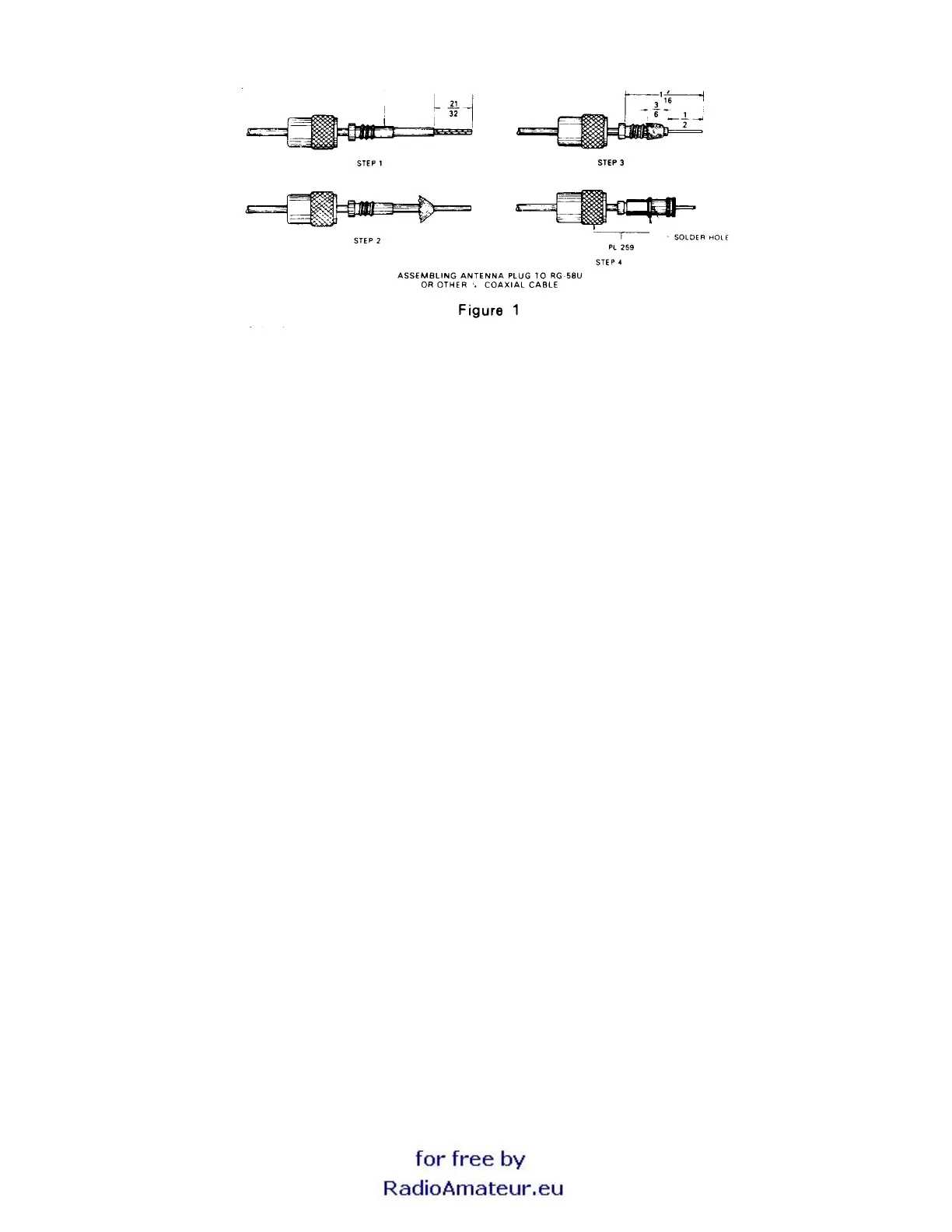
To connect an antenna to the transceiver, a 52-ohm coaxial transmission line is required. [See Figure 1 for assembling connector to
RG-58/U coaxial cable.]
INSTALLATION ADJUSTMENTS
The output circuit of the SIMBA SSB transmitter has been factory adjusted to operate into any good 52-ohm antenna. No attempt
should be made to tune the transmitter to the antenna. Instead, the antenna should be adjusted to present the lowest possible SWR
(Standing Wave Ratio). A very low SWR means that the antenna is operating at maximum efficiency and will also mean that it is
adjusted to 52 ohms. An improperly adjusted antenna causes standing waves to appear on the feed line. Since this feed line is a fixed
52 ohms, and cannot be adjusted, this mismatch appears at the transmitter. If the transmitter is adjusted to compensate for this
mismatch, both it and the antenna will no longer be operating at peak efficiency. Since the transmitter has already been adjusted for
52 ohms output and the coaxial feed line has a fixed 52-ohm value, the only remaining element to be adjusted to this value is the
antenna itself. When received, the antenna is probably cut as near as is possible to this value. The mounting location on the vehicle or
building and surrounding objects affect the antenna however, and requires that it be adjusted to compensate for them.
Many of the newer Citizens Band antennas provide means of adjusting them for lowest SWR. Instructions for doing so are included
with the antenna. For such antennas as the full quarter wave length whip, it is nec
essary to carefully vary the length until the lowest SWR is obtained. For The built-in SWR bridge is ideal for this type of adjustment.
The SIMBA SSB will work into an antenna system having an SWR as high as 3: 1. For best communications, you will want this figure
as near I : I as possible so that the antenna will be operating at its best efficiency.
NOISE SUPPRESSION
The
SIMBA SSB
contains a automatic noise limiter on AM and noise blanker on AM and SSB, and input power filtering. In most
vehicular installations, the noise suppression for the entertainment radio will be sufficient. Vehicles and boats not having this
suppression may require that it be installed. In most cases, installation of distributor suppressors and generator condensers will be
sufficient. In severe cases, the service of aqualified technician may be required. See your PEARCE-SIMPSON dealer for advice.
WARNING
Operation of this equipment requires a valid station license issued by the Federal Communications Commission. Do Not transmit with
your equipment until you have received your license. Illegal operation can result in severe penalties. Be certain that you have read Part
95 of the FCC Rules and Regulations before operating your station.
License applications are to be made on FCC Form 505 available from your nearest FCC field office. (A copy of this form is included
with your new transceiver.)
You are required to maintain a current copy of Part 95 of the FCC Rules as a part of your station records. Copies of Part 95 are
available from: Superintendent of Documents GPO Washington, DC, 20402, for a fee of $3.50.
Your station license is to be posted in accordance with paragraph 95.101 of the Rules and an executed Transmitter Identification Card
(FCC Form 452-C) is to be attached to each transmitter. (A copy of this form is included with your new transceiver.)


 To Next Page
 Loading...