SECTION 3
OPERATING INSTRUCTIONS
Your SIMBA SSB operates on sixty-nine different channels. There are 23 AM channels, 23 upper sideband and 23 lower sideband.
When in the AM mode, the SIMBA SSB will hear only signals being transmitted on double sideband with full carrier (AM). The unit may
also receive SSB signals when on the AM mode but you will not be able to understand them. When operating in either of the
SSB
modes,
strong AM signals may also be 'heard. It is recommended that you return to the AM mode if you wish to listen to these signals.
So that you will better understand the difference between AM, upperside band and lower sideband, a simplified explanation of their
characteristics is in order.
An AM signal consists of a carrier frequency and two sidebands, an upper and lower. Each sideband is an exact duplicate of the other.
An AM receiver, when it detects an AM signal, filters out the carrier so that you hear only the intelligence on the sideband. If you listen
to an AM signal when your receiver is in the sideband mode, the receiver will not reject the carrier frequency (unless the clarifier is
tuned exactly right) and a steady tone will be heard as well as the intelligence. Therefore, for best reception of AM, your mode selector
should be in the AM position.
When transmitting on single sideband, no carrier and only one sideband, either upper or lower, is being transmitted. When on AM,
your receiver cannot take just this one sideband and change it into usable intelligence. You can recognize a-sideband signal coming in
on AM by its fluttering characteristic and its unintelligible sound. A signal transmitted on upper sideband can only be properly heard by
a receiver tuned to the upper sideband.
When listening to a sideband signal on the proper mode, it may sound either too high pitched or too low pitched. The reason for this is
that your receiver may not be tuned to the exact same frequency as the transmitter it is listening to. For this reason, SIMBA SSB is
equipped with a Clarifier. By turning this Clarifier, you slightly change the frequency of both your transmitter and receivers (within legal
limits)
so
that reception will be in a normal tone.
CHANNEL SELECTOR
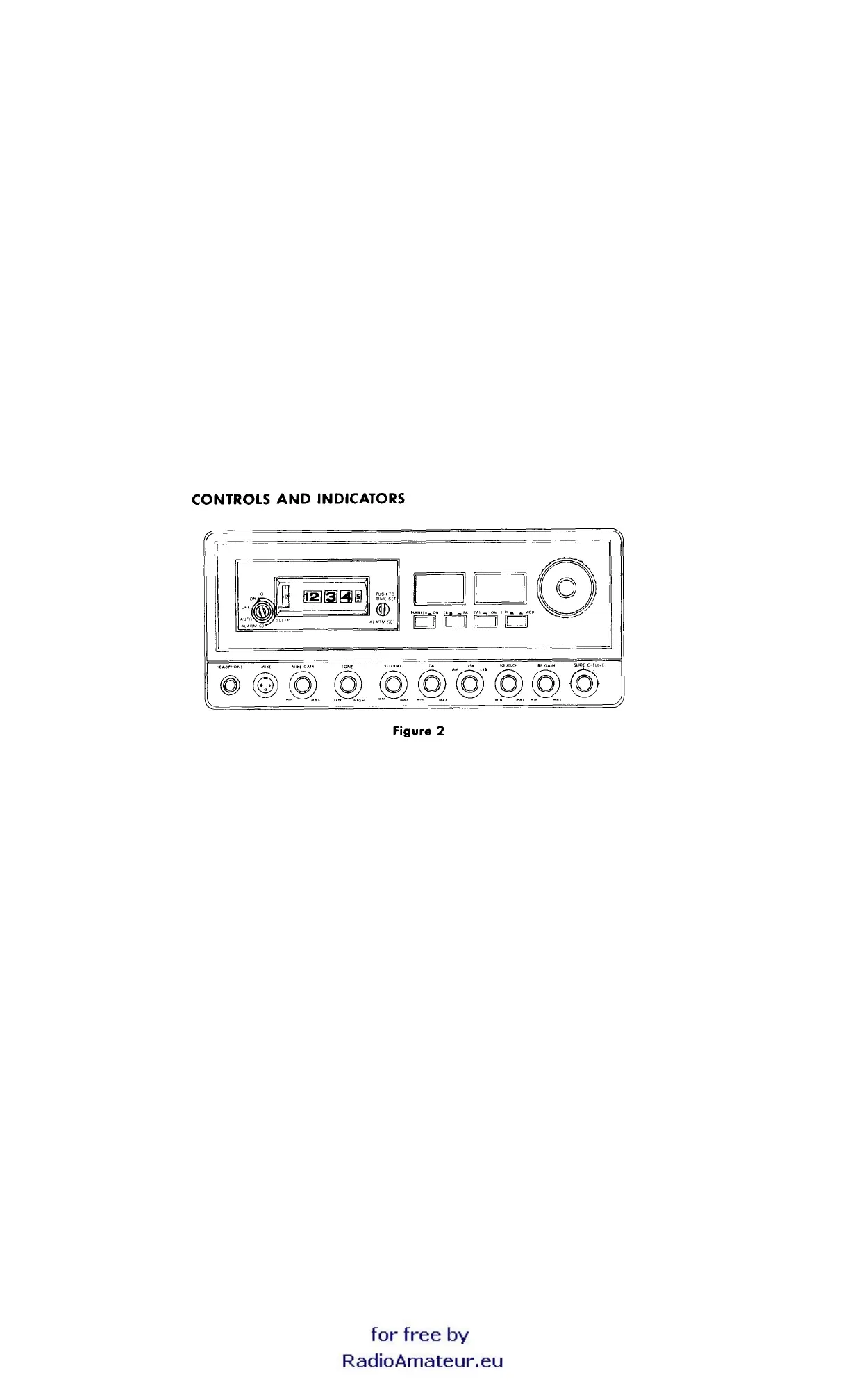
The channel selector switch has 23 operating positions. This switch sets both transmit and receive frequencies simultaneously by
switching the proper crystals into the
PEARCE-SIMPSON
HetroSyncTM circuit for any of the 23 CB channels.
MODE SELECTOR
This selector enables you to select either of SSB modes (upper sideband or lower sideband) or
AM.
This switch changes both
transmitter and receiver simultaneously on each mode.
VOLUME CONTROL AND ON-OFF SWITCH
This control turns the power
ON
and OFF, and adjusts the loudness of received signal.
RF GAIN CONTROL
This control adjusts the strength of incoming signal. If too strong signal comes in, turn it counterclockwise. If you are listening to a
weak signal, turn it clockwise for a desired listening level.
SQUELCH CONTROL
The Squelch Control is used to silence background noise (atmospheric or man-made noise) in the absence of a received radio signal.
In the full counterclockwise position, the radio is unsquelched (no noise silencing at all). In the fully clockwise position, the unit is
squelched for very strong signals.


 To Next Page
 Loading...