Need help?
Do you have a question about the Glunz & Jensen HDX 85 and is the answer not in the manual?
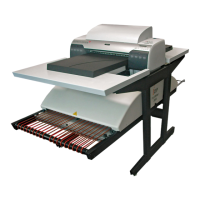
The Glunz & Jensen HDX 85/125/165 Thermal is a processor designed for daily use in a professional environment, as indicated by the "User's Guide" title and the emphasis on regular operation. The manual, published on February 12th, 2024, by Glunz & Jensen A/S, is provided in English (en-us) as the original version, with additional language support for German, French, Spanish, Italian, and Chinese, suggesting a broad international market for the device. The manual explicitly states the importance of keeping it with other equipment documentation for future reference, highlighting the need for users to consult it for safe and effective operation and maintenance.
The HDX 85/125/165 Thermal is a thermal processor, likely used in graphic arts or printing for processing plates or films. The manual uses various symbols to denote different functions and processes, providing a clear visual guide for users. Key operational stages include:
The device features both manual and automatic processes. The "Manual action" symbol (a hand pressing a button with "1") suggests user-initiated steps, while the "Automatic process" symbol (a gear with "A") indicates automated operations. This combination allows for flexibility in operation, catering to both routine automated tasks and specific manual interventions.
While specific numerical specifications like dimensions, weight, or power consumption are not detailed in the provided pages, the manual does give important temperature ranges for certain operations. The "Temperature" symbol (a thermometer) is associated with a range of 35° - 60°C (95° - 140°F). This temperature range is crucial for the chemical processes involved, ensuring optimal performance and quality of the processed material. The presence of an "Alarm" symbol (a bell) suggests that the device is equipped with a system to alert users to critical conditions, potentially including temperature deviations or other operational issues.
The manual emphasizes user safety and proper operation. It strongly advises users to always read the "Safety Instruction Manual part No. 21741" before starting the equipment and to keep all manuals with the equipment for reference. This highlights the importance of safety protocols and proper training for operators.
The device appears to have a user-friendly interface, likely a touchscreen, as suggested by the illustrations showing finger taps and menu navigation. The interface allows users to:
The illustrations show the process of loading and unloading materials, as well as the placement of chemical containers. The device is designed to accommodate multiple chemical containers, suggesting a capacity for various processing solutions. The presence of a "Developer" symbol with a number "3" next to it, and another "Waste" symbol with a number "3", implies a system for managing chemical supply and waste disposal.
Maintenance is a critical aspect of the HDX 85/125/165 Thermal, with dedicated sections and symbols for cleaning and maintenance. The manual provides specific recommendations for cleaning agents:
Crucially, the manual includes strong warnings regarding cleaning practices:
The illustrations demonstrate several maintenance procedures:
Overall, the Glunz & Jensen HDX 85/125/165 Thermal is a sophisticated thermal processor designed for efficient and reliable operation, with a strong emphasis on user safety, clear operational guidance, and structured maintenance procedures to ensure longevity and optimal performance.
 General
| Brand | Glunz & Jensen |
|---|---|
| Model | HDX 85 |
| Category | Printer |
| Language | English |


 To Next Page