ENGLISH
TECHNICAL SPECIFICATIONS
This equipment uses RF energy only for
internal functions. However,its
emissions are too low and it's unlikely to
cause any interferenceinthe
equipments next to it.
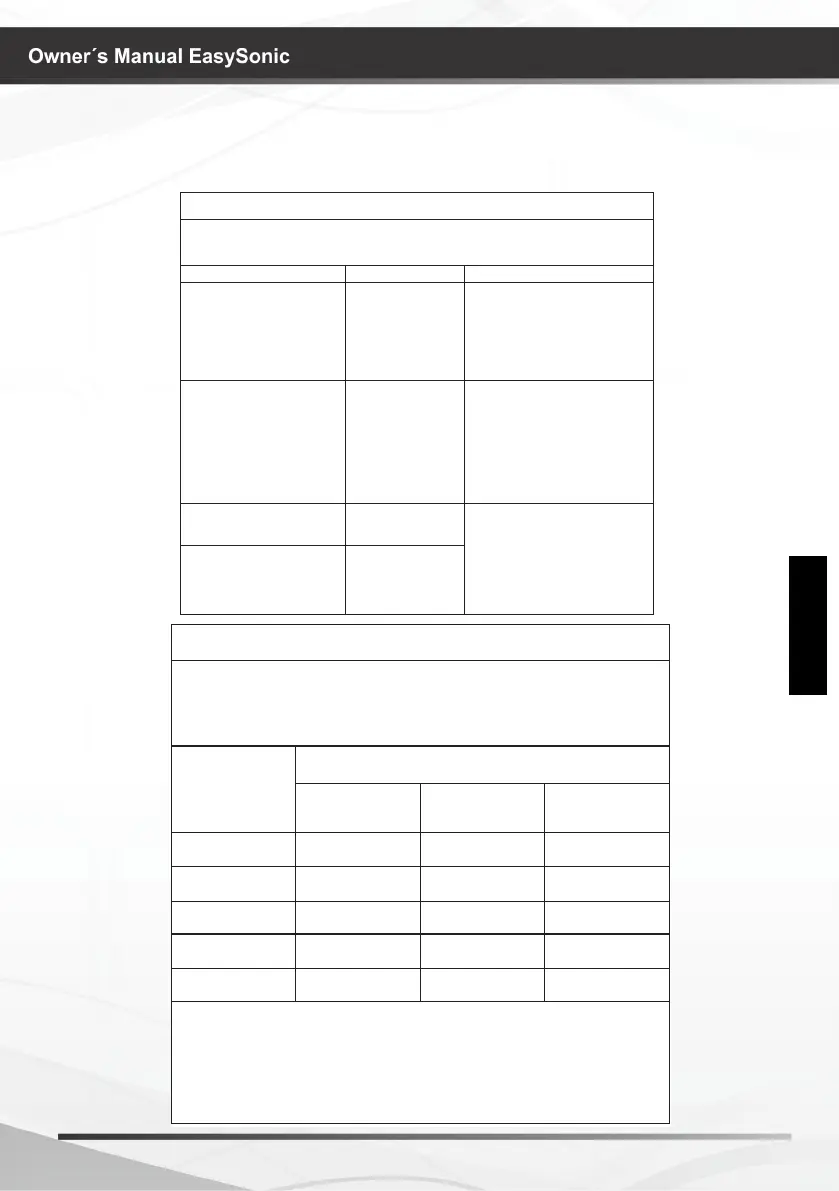
The is made to be used in the electromagnetic environments specified below. The
client or the user of the must be sure that it is used in such environment.
equipment
equipment
Eletromagnetic emissions
Emission test
Compliance
Eletromagnetic environment - Guide
RF emissions
ABNT NBR IEC CISPR 11
RF emissions
ABNT NBR IEC CISPR 11
Emissions of harmonics
IEC 61000-3-2
Fluctuation of Voltage /
Emissions of flicker
IEC 61000-3-3
Group 1
Class B
N/A
N/A
This equipment is proper to be used in
all establishments; including domestic
settings and those directlyconnecttoa
public low voltage distribution whic h
feeds domestic buildings.
Power <75W
See EMC
5.1.1- 61000-3-2
5.1.2- 61000-3-3
Electromagnetic emissions
34
Recommended distances between portable and mobile RF
communication equipments and the equipment
The is made to be used in an electromagnetic environment in which RF
disturbances are controlled. The client or the user of the may help preventing
electromagnetic interference by keeping a minimal distance between mobile and portable RF
communication equipment (transmitters) and the ,as recommended below,in
accordance with the maximal voltage output of the communication equipment.
equipment
equipment
equipment
Transmitter Maximum
Output (W)
0,01 0,12 0,12 0,23
0,1 0,38 0,38 0,73
1 1,2 1,2 2,3
10 3,8 3,8 7,3
100 12 12 23
150 kHz to 80 MHz
d= 1,2 p
√
80 kHz to 800 MHz
d= 1,2 p
√
800 kHz to 2,5 GHz
d= 2,3 p
√
For transmitters withamaximum nominal output power not listed above, the recommended d separation
distance in meters (M) can be determined using an equation applicable to the frequency of the transmitter,
where Pis the transmitter maximum nominal output in watts (W) according to the transmitter
manufacturer.
At 80 MHz and 800 MHz, is applied the separation distance for the higher frequency range.
These guidelines may not apply to all situations. The absorption and reflection from structures,
objects and people affect the electromagnetic propagation.
NOTE 1
NOTE 2
Separation distance according to transmitter frequency (M)



 To Next Page