10
AIRFLOW C ONSIDERATION
Airflow demands are managed differently in a fully communi-
cating system than they are in a legacy wired system. The
system operating mode (as determined by the thermostat)
determines which unit calculates the system airflow demand.
If the indoor unit is responsible for determining the airflow
demand, it calculates the demand and sends it to the ECM
motor. If the outdoor unit or thermostat is responsible for de-
termining the demand, it calculates the demand and trans-
mits the demand along with a fan request to the indoor unit.
The indoor unit then sends the demand to the ECM motor.
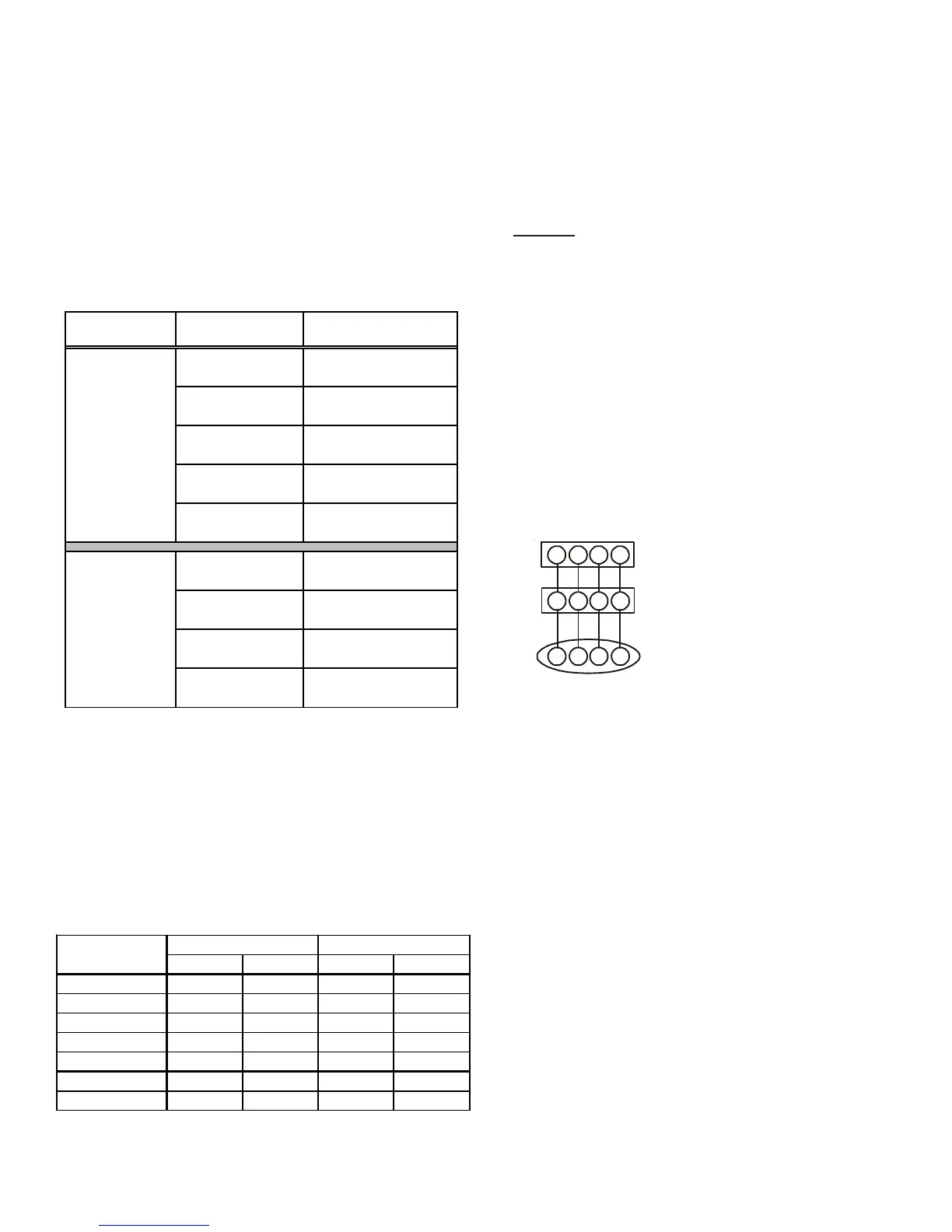
The table below lists the various ComfortNet systems, the
operating mode, and airflow demand source.
System
System
Ope rating M ode
Airflow Dem and
Source
Cooling Heat Pump
Heat Pump Heating
Only
Heat Pump
HP + Electric Heat
Strips
> of Heat Pump or Air
Handler Demand
Electric Heat Strips
Only
Air Handler
Continuous Fan Thermostat
Cooling Heat Pump
Heat Pump Heating
Only
Heat Pump
Auxiliary Heating Furnace
Continuous Fan Thermostat
Heat Pump + Air
Handler
Heat Pump +
Furnace
For example, assume the system is a heat pump matched
with an air handler. With a call for low stage cooling, the
heat pump will calculate the system’s low stage cooling air-
flow demand. The heat pump will then send a fan request
along with the low stage cooling airflow demand to the air
handler. Once received, the air handler will send the low
stage cooling airflow demand to the ECM motor. The ECM
motor then delivers the low stage cooling airflow. The follow-
ing table lists the nominal high and low stage airflow for the
ComfortNet™ heat pumps.
High Low High Low
*SZC160241 800 600 800 600
*SZC160361 1200 800 1200 800
*SZC160481 1550 1100 1550 1100
*SZC160601 1800 1210 1800 1210
*SZC180361 1250 850 1250 850
*SZC180481 1750 1210 1750 1210
*SZC180601 1750 1210 1750 1210
Cooling Heating
Models
CTK0*AA WIRING
NOTE: Refer to section Electrical Connections - High Voltage
Connections for 208/230 volt line connections to the air
conditioner or heat pump.
NOTE: A removable plug connector is provided with the
control to make thermostat wire connections. This plug may
be removed, wire connections made to the plug, and replaced.
It is strongly recommended that multiple wires into a single
terminal be twisted together prior to inserting into the plug
connector. Failure to do so may result in intermittent
operation.
Typical 18 AWG thermostat wire may be used to wire the
system components. However, communications reliability
may be improved by using a high quality, shielded, twisted
pair cable for the data transmission lines. In either case, 150
feet is the maximum length of wire between indoor unit and
outdoor unit, or between indoor unit and thermostat.
FOUR-WIRE INDOOR AND OUTDOOR WIRING
Typical wiring will consist of 4 wires between the indoor unit
and outdoor unit and between the indoor unit and thermo-
stat. The required wires are: (a) data lines, 1 and 2; (b) ther-
mostat “R” (24 VAC hot) and “C” (24 VAC common).
12RC
12RC
CTK0*AA
Thermostat
CT Compatible
Air Handler/Furnace/Modular Blower
Integrated Control Module
CT Compatible AC/HP
Integrated Control Module
12RC
System Wiring Using Four-Wires
TWO-WIRE OUTDOOR, FOUR-WIRE INDOOR WIRING
Two wires only may be utilized between the indoor and outdoor
units. For this wiring scheme, only the data lines, 1 and 2, are
required between the indoor and outdoor units. A 40VA, 208/
230 VAC to 24 VAC transformer must be installed in the out-
door unit to provide 24 VAC power to the outdoor unit’s elec-
tronic control. The transformer is included with the CTK0*AA
kit. See kit instructions for mounting and wiring instructions.
Four wires are required between the indoor unit and thermo-
stat.
NOTE: Use of the CTK0*AA transformer is recommended if
installing a dual fuel system. Failure to use the transformer in
the outdoor unit could result in over loading of the furnace
transformer.



 To Next Page