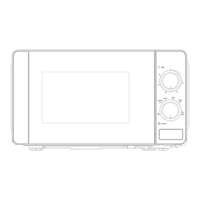
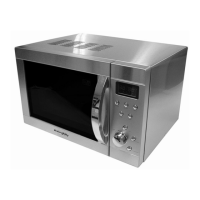
This document describes the Goodmans Microwave Oven, models 305820, 305821, and 305822.
Function Description
The Goodmans Microwave Oven is designed for cooking and heating food using microwave energy. It offers various cooking functions including microwave cooking with different power levels, defrosting, and auto cooking menus for common food types. The microwave operates by generating high-frequency electromagnetic waves that cause water molecules in food to vibrate, producing heat. The oven is equipped with a control panel for setting cooking parameters and a turntable system to ensure even cooking.
Important Technical Specifications
- Model Numbers: 305820/305821/305822
- Power Consumption: 220-240V~50Hz, 1150W (Microwave)
- Output: 700W
- Operation Frequency: 2450MHz
- Oven Capacity: 20 Litres
- Product Dimension: 256(H) x 451(W) x 361(D) mm
Usage Features
In The Box:
The product package includes the microwave oven, a glass turntable, a turntable roller, a Safety & Guarantee booklet, and an Instruction Manual.
Description Of Parts:
The microwave oven consists of several key parts:
- Safety interlock latches: Ensure the door is securely closed during operation.
- Oven Window: Allows visibility into the oven cavity.
- Glass turntable: Rotates food for even cooking.
- Turntable ring: Supports the glass turntable.
- Turntable coupling: Connects the turntable to the motor.
- Control panel: Used to select cooking functions and set time/weight.
- Plastic Waveguide cover: Allows microwave energy to pass through to the food.
Control Panel:
The control panel features a display, a Time/Weight knob, and buttons for Start and Pause/Cancel.
- Before Cooking: When plugged in, the LED flashes 3 times, then shows "0:00". If no input is received for 2 minutes, it returns to standby.
- Time/Weight Knob: Used to increase or decrease cooking time or weight, and for navigation during operation.
- Pause/Cancel:
- At initial or input stage: Press once to cancel input programs and return to initial stage.
- During cooking: Press once to stop operation, twice to cancel cooking programs.
- Auto Reminder: After cooking, the LED displays "End" and three beeps sound. If no action is taken, beeps will sound every 3 minutes.
Microwave Cooking:
This function uses microwave power for cooking and heating. The Menu Selector allows selection of different power levels:
- High power (100%): For quick and thorough cooking.
- Medium High power (80%): For medium express cooking.
- Medium power (60%): For steaming food.
- Medium Low power (40%): For defrosting food.
- Low power (20%): For keeping food warm.
- Maximum cooking time: 60 minutes.
- Caution: Never operate the oven empty. If food is turned during operation, press Start to continue. If food is removed before time, turn the timer anti-clockwise to 0 to prevent empty operation. At maximum power, the oven may automatically lower power to extend service life.
Defrost Function:
Used for defrosting food. Turn the Menu Selector to "Defrost".
- Weight range: 0.1 kg to 2.0 kg.
- Process: Set defrost weight using the Time/Weight knob, then press Start. During defrosting, 3 beeps will sound twice to prompt turning the food over. Open the door, turn the food, close the door, and press Start again to continue.
- Cautions: Turn food over for uniform effect. Defrosting takes longer than cooking. Defrosting is complete when food can be cut by knife. Microwave penetrates about 4cm. Consume defrosted food as soon as possible; do not refreeze.
Auto Cooking:
The oven has default cooking menus for simple operation. In standby, turn the Menu Selector to "Auto cooking", then use the Time/Weight knob to select a menu.
- Menu options (examples):
- A.1 Popcorn (0.1kg)
- A.2 Reheat (0.1-0.5Kg)
- A.3 Beverage (1cup, 2cups, 3cups)
- A.4 Pizza (1 share, 2 share)
- A.5 Potato (0.45, 0.65Kg)
- A.6 Vegetable (0.1-0.5Kg)
- A.7 Meat (0.1-0.5Kg)
- A.8 Fish (0.1-0.5Kg)
- Cautions: Food temperature (20-25°C) affects cooking time. Weight, shape, and temperature significantly influence cooking. Adjust time for best results if deviations from menu factors are observed.
Child Lock Function:
Locks the control panel to prevent unsupervised use or accidental operation during cleaning.
- Set child lock: Hold Pause/Cancel button for approximately 3 seconds.
- Cancel child lock: Hold Pause/Cancel button for approximately 3 seconds.
Microwave Cooking Principles:
Microwaves are high-frequency electromagnetic waves. They cause water molecules in food to vibrate, generating heat. Microwaves do not remain in the air or food after cooking. The oven uses a magnetron to convert electrical energy into microwaves. Metal cookware and utensils should not be used as microwaves cannot pass through metal. The oven interior is metal-lined, and the door has a fine metal mesh to contain microwaves.
Installation:
- Placement: Countertop use only; not for built-in or enclosed cupboard use. Place on a horizontal, stable surface strong enough to support the oven's approx. 10.5kg weight.
- Ventilation: Ensure sufficient airflow. Maintain minimum clearances: 30cm above, 7.5cm behind, 7.5cm on one side (the other side should be kept open). Do not block air vents.
- Location: Avoid placing directly over a cooker or other heat-producing appliance. Place away from radios and TVs to minimize interference.
- Power: Plug into a suitable 13 amp mains socket. Ensure voltage matches the rating label. Do not use extension cables or adaptors.
Turntable Installation:
- Before first use, remove any securing tape from the glass tray and turntable ring.
- Ensure parts are not restricted from rotating.
- Never place the glass tray upside down.
- Always place food on or in suitable microwaveable cookware, not directly on the glass tray.
- If food/cookware stops the turntable, reposition and restart.
- Allow hot glass turntable to cool before cleaning to prevent cracking.
- Use only the specifically designed glass turntable for this oven.
Utensils Guide:
Test dishes for microwave suitability if not stated.
- Test method: Fill a microwave-safe measuring jug with 300ml cold water. Place it next to (or inside) the dish to be tested. Heat on full 100% power for 1 minute. If the dish remains cool while the water warms, it is suitable. If the dish warms, it is absorbing microwave energy and should not be used. This test does not apply to metal or plastic containers.
- Glassware: Heat-resistant glass (e.g., Pyrex®) is ideal. Do not use lead crystal.
- China & ceramic: Normal glazed china, porcelain/ceramic plates, bowls, and cups may be used if heat-resistant. Avoid fine bone china for long periods. Do not use items with metal decoration or glued handles.
- Pottery: Use only completely glazed pottery dishes. Partially or unglazed stoneware can absorb water and crack/burn.
- Foil/metal containers: Do not use on microwave-only setting. Can be used on grill-only setting. Remove metal twist-ties.
- Cast iron cookware: Not suitable for microwave use.
- Plastic containers: Most are suitable, but check before use. Avoid for high-sugar/fat foods or long cooking times. Do not use Melamine (absorbs microwave energy) or yogurt/margarine cartons (will melt).
- Paper: Greaseproof paper can line dishes or cover food. Plain white absorbent kitchen paper towel can be used for short periods. Ensure it does not contain manmade fibers and is not recycled paper. White paper plates for reheating for short periods. Plastic/wax coated paper cups are not suitable.
- Wood, wicker & straw: Not suitable; can ignite.
- Thermometers: Use only microwave-approved thermometers.
- Utensils: Do not heat up plates or cooking utensils.
- Bottles: Do not cook or reheat in containers with restricted openings (e.g., bottles) as they may explode. Remove teats from baby bottles before heating.
Standing Guidelines:
Dense foods (jacket potatoes, meat, cakes) require standing time after cooking to allow heat to conduct to the center.
- Defrosting: Includes standing time for full defrosting. Check with a skewer.
- Jacket potatoes: Stand 5 mins. wrapped in aluminum foil (do not cook in foil).
- Meat joints: Stand 15 mins. wrapped in aluminum foil (do not cook in foil).
- Fish: Stand 2-3 mins.
- Egg dishes: Stand 1-2 mins.
- Vegetables: Most types can be served immediately, except boiled potatoes (1-2 mins standing).
- Convenience packaged food: Stand 1-2 mins. or follow packaging guidelines.
- Home cooked plated meals: Stand 1-2 mins.
- Dense heavy cakes: Stand 15-20 mins.
- Light cakes: Stand 5 mins. before removing from dish.
Maintenance Features
Cleaning And Maintenance:
- Importance: Keep the microwave clean, especially after each use, wiping any moisture or liquid under the turntable. Failure to do so can lead to deterioration of surfaces, affecting the microwave's life and potentially creating a hazardous situation.
- Before Cleaning: Turn off and unplug the oven.
- Interior: Wipe with a damp cloth. Use mild detergents for stubborn dirt. Avoid sprays or harsh cleaners.
- Waveguide Cover: Located on the right-hand side wall. Keep clean by wiping with mild detergent and water, then dry.
- Exterior: Clean with a damp cloth. Prevent water from seeping into ventilation openings.
- Door & Window: Wipe both sides, door seals, and adjacent parts frequently with a damp cloth. Do not use abrasive cleaner.
- Control Panel: Clean with a soft, damp cloth. Keep the oven door open to prevent accidental turn-on.
- Odour Removal: Combine a cup of water with the juice and skin of one lemon in a microwaveable bowl. Microwave for 5 minutes, then wipe and dry thoroughly.
- Steam: If steam builds up inside or around the door, wipe with a soft cloth. This is normal in humid conditions.
- Glass Turntable: Clean regularly, or immediately after spills. Wash in warm soapy water. Allow hot turntable to cool before cleaning.
- Cavity Floor & Turntable Roller: Clean regularly with mild detergent and water. Wash turntable roller in mild soapy water and dry thoroughly.
- Turntable Roller Replacement: Ensure it is properly replaced, with the flat side matching the circular hole in the microwave center, and wheels flush with the floor.
- Steam Cleaners: Do not use steam cleaners on any part of the microwave.
- Air Vents: Keep clear and clean. Regularly check for dust or blockages.
- Sharp Metal Scrapers: Do not use on any surface of the microwave (walls, floor, door) as they can scratch and damage the appliance.
Troubleshooting:
- TV Interference: Normal. Move TV/radio away from the microwave.
- Microwave not working: Check if mains plug is secure, circuit fuse/breaker. Test socket with another appliance.
- Microwave power not working: Check if timer is set and door is securely closed.
- Warm air from vents: Normal, caused by food heating. Vents should not be covered.
- Odour in microwave: Place a cup of water with lemon juice and skin in a deep microwave bowl. Microwave for 5 minutes, then wipe and dry.

 Need help?
 General

 To Next Page