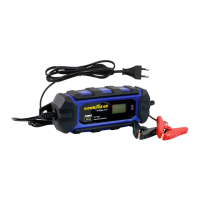
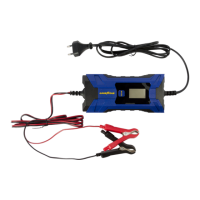
The charging time depends on the charge status of the battery. If the battery is fully
discharged, the approximate charging time up to approx. 80% charged can be calcu-
lated using the following formula:
5.5 Fault indicator (Fig. 2 / Item G)
5.4 Calculating the charging time (Fig. 3)
џ Check the acid level in the battery. If necessary, top up the battery with distilled
water (if possible). Important! Battery acid is aggressive. Rinse off any acid splashes
thoroughly with lots of water and seek medical advice if necessary.
џ If there is a short-circuit between the two terminal clamps (the metal parts of the
clamps come into contact with each other). The protection against short-circuits
ensures that the battery and charger do not get damaged.
џ Release or remove the battery stoppers (if tted) from the battery.
џ When “FUL' appears in the LCD display (and all increments Fig. 2/Item K), charging
has been completed. The charger holds the battery at 95% - 100% available battery
capacity using pulsed charging. If the charger shows this after just a few minutes,
this indicates that the battery capacity is low. The battery needs replacing.
џ After the battery has been connected to the charger, you can connect the charger to
a socket (see Technical Data). You can now change the charging settings (see
section 5.2).
џ If the terminal clamps are connected to the battery terminals with the wrong
polarity. The protection against swapped poles ensures that the battery and charger
do not get damaged. Remove the charger from the battery and start the charging
process from the beginning again. Caution! Protection against swapped poles is not
available when the SUPPLY program is used.
џ First connect the red charging cable to the positive pole of the battery. Then connect
the black charging cable to the negative pole of the battery.
The fault indicator will ash (light up) in the following cases:
5.3 Charging the battery:
џ Important! Charging may create dangerous explosive gas and therefore you should
avoid spark formation and naked ames whilst the battery is charging. There is a risk
of explosion! It is essential that you ventilate the rooms well.
џ If the voltage of the battery is less than 3.5 V or more than 15 V. The battery is either
unsuitable for charging or is defective. It is also possible that other battery errors or
faults can mean that the battery cannot be charged.
Charging time/h =
Amp. (charging current)
Battery capacity in Ah



 To Next Page