EasyManua.ls Logo

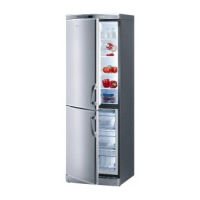
Gorenje K287MLB - User Manual

Gorenje K287MLB
8 pages
Print Icon
To Next Page IconTo Next Page
Loading...
Instructions for Use
9
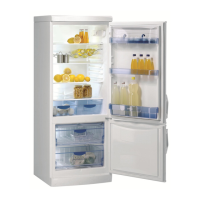
Refrigerator - Freezer GB
Thank you for your trust and for buying this appliance. We hope it will successfully serve the purpose for
many years.
Refrigerator with freezer is for domestic use only.
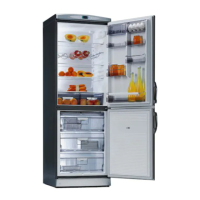
The upper part of the appliance is refrigerator and is used
for storing fresh foods at the temperature of 0°C and higher.
The lower part is freezer and is used for freezing fresh foods
and storing frozen foods for longer periods of time (up to one
year, depending on the kind of foods you store). The
compartment is marked with four stars.
Before Putting Into Use.................................................. 9
Instructions for Use
We Care for the Environment
Tips for Energy Savings
Important ........................................................................ 9
Placing and Installation ............................................... 10
Choosing the Right Place
Placing the Appliance
Connection to Power Supply
Description of the Appliance ....................................... 11
Refrigerator (A)
Freezer (B)
Operation Control.........................................................12
Temperature Selection
Use ..................................................................................12
Storing Fresh Foods
Freezing Fresh Foods
Storing Frozen Foods
Ice Making
Changing the Direction of Opening the Door.............14
Maintenance and Cleaning...........................................15
Manual Defrosting of the Freezer
Cleaning the Appliance
Trouble-Shooting Guide ...............................................16
Before Putting Into Use
Before connecting the appliance to the mains supply, leave it
stand for about 2 hours, which will reduce a possibility of
malfunctions in the cooling system due to transport handling.
Clean the appliance, and be thorough, especially in the
interior (See Cleaning and Maintenance).
In case the interior accessories are not correctly placed,
rearrange them as described in chapter "Description of the
Appliance".
Instructions for Use
These instructions for use are intended for the user. They
describe the appliance and its correct and safe use. They were
prepared for various types/models of appliances therefore you
may find in it description of some functions and accesories that
your appliance does not have.
We Care for the Environment
Our products use environmentally friendly packaging, which
can be either recycled or disposed of in an environmentally
friendly manner. To this end, individual packaging materials
are clearly marked.
These instructions are printed either on recycled paper or
chlorine free bleached paper.
When your appliance finally wears out, please try not to
burden the environment with it; call your nearest authorised
service agent. (See Disposing of the Worn Out Appliance)
Tips for Energy Savings
This is especially important if you have an upright model.
Every now and then check if the appliance is sufficiently
ventilated (adequate air circulation behind the appliance).
Set thermostat to lower settings as soon as possible
(depends on the amount of food loaded, ambient
temperature etc).
Before loading the appliance with packages of fresh foods,
make sure they are cooled to ambient temperature.
Ice and frost layer increase energy consumption, so do
clean the appliance as soon as the layer is 3-5 mm thick.
If the gasket is damaged or if it turns out that the sealing is
poor, the energy consumption is substantially higher. To
restore efficiency, replace the gasket.
The condenser on the rear wall should be always clean, free
of dust or any impurities.
Always consider instructions stated in sections Positioning
and Energy Saving Tips, otherwise the energy consumption
is substantially higher.
Important
If you have bought this appliance to replace an old one
equipped with a lock that cannot be opened from inside
(lock, bolt), make sure that the lock is broken. This will make
it impossible for children to lock themselves inside the
appliance and suffocate.
The appliance must be correctly connected to the mains
supply. (see: Connecting to the Mains Supply).
Do not touch the cooled surfaces while the appliance
operates, especially not with wet hands, because the skin
may stick to the cold surfaces.
Do not freeze bottles containing liquid, especially not soft
drinks, such as mineral water, sparkling wine, beer, cola
etc., because liquid expands during freezing and the glass
bottle is very likely to blow up.
Do not eat frozen food (bread, fruit, vegetables), because
you can get frostbites.
If the food has strange smell or color, throw it away, because
it is very likely that it is spoiled and therefore dangerous to
eat.
Disconnect the appliance from the power supply before
repairing it (only a qualified technician should repair it),
before cleaning and before replacing the light bulb.
Do not defrost the appliance with other electric appliances
(as for example with hair dryer) and never scrape the frost
layer with sharp objects. Use only enclosed tools or tools
recommended by the manufacturer.
For the sake of environment protection - be careful not to
damage the rear wall of the appliance (the condenser unit or
the tubes - for example when moving the appliance) or any
part of the refrigerating system inside the appliance.
The refrigerating system of the appliance is filled with
refrigerant and oil, so when the appliance is damaged,
handle it with care and dispose it of in compliance with

Questions and Answers

Summary

Before Putting Into Use

Instructions for Use

We Care for the Environment

Tips for Energy Savings

Provides advice on reducing energy consumption and maintaining appliance efficiency.

Placing and Installation

Choosing the Right Place

Details on selecting a suitable location based on ambient temperature and ventilation.

Placing the Appliance

Instructions for positioning the appliance on a stable base and ensuring proper spacing.

Connection to Power Supply

Guidance on connecting the appliance safely to the mains supply.

Description of the Appliance

Refrigerator (A)

Details the components and features of the refrigerator compartment.

Freezer (B)

Details the components and features of the freezer compartment.

Operation Control

Temperature Selection

Explains how to set the thermostat for optimal temperature control.

Use

Storing Fresh Foods

Guidance on proper packing and placement of fresh foods.

Freezing Fresh Foods

Explains the process and considerations for freezing fresh foods.

Storing Frozen Foods

Guidance on storing pre-frozen items and commercially frozen foods.

Ice Making

Instructions on how to make ice cubes using the provided tray.

Changing the Direction of Opening the Door

Maintenance and Cleaning

Automatic Defrosting of the Refrigerator

Explains the automatic defrosting mechanism for the refrigerator.

Manual Defrosting of the Freezer

Details the procedure for manually defrosting the freezer compartment.

Cleaning the Appliance

Instructions for cleaning the interior and exterior of the appliance.

Trouble-Shooting Guide

Overview

This document describes a refrigerator-freezer appliance designed for domestic use. The upper part functions as a refrigerator for storing fresh foods at 0°C or higher, while the lower part is a freezer for freezing fresh foods and storing frozen foods for up to one year, depending on the food type. The freezer compartment is marked with four stars.

Function Description:

  • Refrigerator (A): Stores fresh foods for a few days.
    • Shelf (1): Number depends on the model. Shelves can be placed on guides, are protected against pulling out, and can be removed by lifting the back part. Quickly perishable food should be stored at the back, the coldest part of the shelves.
    • Bottle rack: (Only some models) Intended for storing bottles. It has two installation positions (horizontal or lifted in the front) and is protected against pulling out.
    • Fruit and Vegetable Container (3): Located at the bottom under the glass shelf, it's used for storing fruits and vegetables, providing adequate humidity to reduce dehydration.
    • Fan: (Certain models only) Distributes inside temperature evenly and reduces dew on storage shelf surfaces. It stops when the refrigerator door is opened. Recommended to switch on when ambient temperature is above 30°C or during summer with increased humidity. Switching the fan on increases energy consumption.
    • Defrost Water Outlet (2): The refrigerator interior is cooled by a plate in the rear wall. Under the plate, there's a channel and an outlet for defrost water. This outlet should be regularly checked and cleaned to prevent clogging.
    • Door Liner: Consists of various shelves and holders for storing eggs, cheese, butter, yogurt, small packages, tubes, and cans. The lower shelf is for bottles.
    • Illumination: The interior light turns on when the door is opened, independent of the thermostat knob position.
  • Freezer (B): Used for freezing fresh foods and storing already frozen foods.
    • Freezing Compartment (4): Specifically for freezing fresh foods.
    • Storing Basket (5): For storing packages of frozen foods.
    • Defrost Water Outlet (6): (See Cleaning and Maintenance).
    • Cold accumulators (7): (Some models only) Two cold accumulators in the upper part of the freezing compartment. They maintain uniform temperature of frozen foods, ensuring higher quality and reduced energy consumption. They can also be used for freezing fruits, making ice, or maintaining lower temperatures for foods and bottles during trips.
    • Bottle stopper (8): (Some models only) Prevents bottles from moving in the door rack.

Important Technical Specifications:

  • Ambient Temperature Classes:
    • SN (subnormal): +10°C to +32°C
    • N (normal): +16°C to +32°C
    • ST (sub-tropical): +16°C to +38°C
    • T (tropical): +16°C to +43°C
  • Power Supply: Connects to a grounded socket outlet. Nominal voltage and frequency are on the rating plate. The appliance tolerates temporary voltage fluctuations of -6% to +6%.
  • Freezing Capacity: The amount of fresh foods that can be loaded in the freezer within 24 hours is indicated on the rating plate.
  • Light Bulb: E14, max. 15 W.

Usage Features:

  • Before First Use: Leave the appliance standing for about 2 hours after transport to reduce cooling system malfunctions. Clean thoroughly, especially the interior. Ensure interior accessories are correctly placed.
  • Placement: Place in a dry, regularly ventilated room, away from heat-emitting devices (cooker, radiator, water heater) and direct sunlight. Maintain at least 3 cm from electric/gas cookers and 30 cm from oil/coal stoves, or use insulation. Ensure free space of at least 200 cm² behind and 5 cm above for adequate condenser ventilation. Place firmly on a solid base; some models have adjustable feet for leveling. Two spacers on the upper edge of the condenser prevent installation too close to the wall.
  • Operation Control: Controlled by a thermostat knob in the right upper part of the refrigerator. Turning clockwise from STOP (0) to 7 increases coldness. Medium setting is recommended for normal ambient temperatures.
  • Storing Fresh Foods: Pack foods properly in airtight bags/sheets or covered containers to prevent moisture/odor mixing. Remove excessive packaging. Pack systematically, ensuring adequate air circulation. Do not store flammable, volatile, or explosive substances. Store high-alcohol beverages in tightly sealed bottles, vertically. Food should not touch the rear wall. Cool foods before storing. Store crispy/delicate foods in the coldest parts. Avoid frequent door opening.
  • Freezing Fresh Foods: Select adequate quality foods. Use airtight packaging to prevent vitamin loss and dehydration. Mark packages with food type, amount, and loading date. Freeze quickly; use smaller packages and cool before loading. Do not exceed 24-hour freezing capacity.
  • Freezing Procedure:
    • Without integrated intensive cooling switch: Turn thermostat to 4-6 position 24 hours before loading. Load freezer shelf with fresh food packages. After 24 hours, return thermostat to operating position.
    • With integrated intensive cooling switch: Switch on 24 hours before loading and turn thermostat to 4-6. Load fresh food packages. After 24 hours, switch off and return thermostat to required position.
  • Storing Frozen Foods: Store in baskets or directly on cooling shelves if baskets are removed. Do not place food above the indicated line (some models) to allow cool air circulation.
  • Commercially Frozen Foods: Follow manufacturer's instructions for storage time and temperature. Buy adequately packed foods stored at -18°C or lower. Avoid packages with frost layer, indicating prior thawing.
  • Ice Making: Recommended thermostat position is middle setting. Fill two-thirds of ice tray with water/liquid. Insert into guides or on cooling plate. Takes 2-6 hours to form. Empty by turning tray and twisting slightly.
  • Changing Door Opening Direction: Instructions provided for unscrewing hinges, changing their position, and reattaching the door. Includes steps for handles and ensuring gasket seals well.

Maintenance Features:

  • Automatic Defrosting (Refrigerator): Ice on the inner back wall defrosts automatically. Water collects and drains through an outlet into a pan above the compressor, where it evaporates.
  • Manual Defrosting (Freezer): Defrost when frost/ice layer is 3-5 mm thick. Set thermostat to 7 for a few hours before defrosting, then to STOP (0) and disconnect power. Empty freezer, keeping packages frozen. Insert enclosed pipe into groove at bottom and place a vessel underneath to collect water. Defrosting is accelerated by leaving the door open. Avoid defrosting sprays and sharp objects.
  • Cleaning: Disconnect power supply before cleaning. Do not use coarse or aggressive cleaning agents. Remove any cleanser residue. Clean exterior with water and detergent. Clean varnished surfaces with soft cloth and alcohol-based cleaner. Clean stainless steel parts with special agents and soft cloth. Remove and clean detachable accessories with water and liquid detergent. Wash interior with lukewarm water and vinegar. Wipe condenser on rear wall with soft non-metal brush or vacuum cleaner. Clean defrost water receptacle above compressor.
  • Switching Off When Not In Use: For longer periods, set thermostat to STOP (0), disconnect power, remove food, defrost, and clean. Leave door slightly open.
  • Trouble-Shooting Guide: Provides solutions for common issues like appliance not operating, continuous operation, ice formation on inner rear wall, water leaking, hard-to-open freezer door, and unusual noise.
  • Bulb Replacement: Disconnect power. Press cover at rear (arrow 1) and remove plastic cover (arrow 2). Replace with new E14, max. 15 W bulb. Dispose of old bulb as non-organic waste. Light bulb consumption is not covered by warranty.

Gorenje K287MLB Specifications

General IconGeneral
BrandGorenje
ModelK287MLB
CategoryRefrigerator
LanguageEnglish

Related product manuals