EasyManua.ls Logo

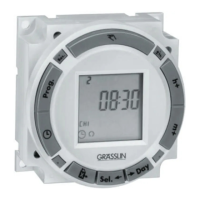
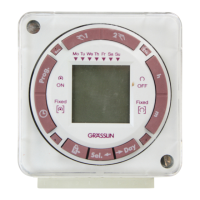
Grasslin V 86/1 digi 16 M2 - User Manual

Grasslin V 86/1 digi 16 M2
2 pages
Print Icon
To Next Page IconTo Next Page
Loading...
Operating
Instructions
V
86/1
digi
16
M2
V
86/2
digi
32
M2
WA-EKF
1801/10.92/30/S:Mo/D:Ko/80.
1
0.0530.7
1.
General
The
use
of
modern
components
and
proven
software
allows
simple
and
logical
operation.
This
means
that
you
can
program
this
digital/electronic
time
switch
almost
in
your
usual
“handwriting”.
Before
connecting
the
time
switch
and
putting
it
into
operation,
you
should
carefully
read
the
operating
instructions
to
be
able
to
make
optimum
use
of
all
functions.
The
instructions
below
apply
equally
to
the
1-channel
and
2-channel
versions.
2.
Putting
into
operation
Electrical
units
may
be
installed
only
by
a
skilled
electrician
(the
definition
of
skilled
electrician
can
be
found
in
VDE
0105).
Note:
This
device
contains
highly
complex
electronic
circuitry.
This
electronic
circuitry
is
largely
protected
against
outside
interference.
However,
it
must
be
noted
that
the
mains
voltage
(depending
on
installation
site)
may
be
subject
to
strong
superimposed
interference
voltage
peaks.
Disturbance
also
occurs
when
contactors
are
switched
and
this
disturbance
can
affect
an
electronic
device
despite
all
internal
protective
measures.
in
order
to
ensure
the
greatest
possible
degree
of
operational
safety,
please
follow
the
details
below
when
connecting
the
unit:
a)
On
large
systems,
it
is
necessary
to
suppress
the
interference
voltage
on
contactor
coils
which
are
switched
directly
by
the
time
switch
using
a
suitable
varistor
or
RC
element.
b)
If
inductive
DC
loads
are
switched,
it
is
necessary
to
install
a
suppressor
diode.
c)
Inductive
loads,
particularly
fluorescent
lamps,
represent
a
particularly
heavy
strain
for
output
contacts.
Here,
it
is
necessary
to
install
an
isolating
relay
or
a
contactor.
1Kanal
2Kanal
CH1
CH
1
CH
2
oe)
fd
3.
LCD
display-unit
The
display
contains
a
multitude
of
elements
in
order
to
clearly
show
the
various
data
and
information.
1st
example:
Day
of
the
week
Fago
N
5
:
MO
TU
WE
THFR
SA
SU
ummer
time
"non
Hour
and
minute
identifier
et
g
a]
display
O
t
cH2
©
ON
ON
Channel
status
ON
in
clock
operation
(CH
1/CH
2)
2nd
example:
Day
of
the
week
R
MO
TU
WE
THFR
SA
SU
Ap-AB
CHI
ON
Hour
and
minute
:
Switching
time
display
Channel
status
ON
when
proarammina
ee
ee
Es
eee
Eg,
RL
a
ee
ee
a
CR
LES
MO
TU
WE
TH
FR
SA
SU
Time
identifier.
fas
O-
|
ha
and
minute
Shans
AM/PM
version
pope
prey
time
Ht
CH2
DON
bri
Circuit
preselection
ON
Continuous
operation
OFF
for
channel
1
for
channel
2
4.
Data
management
within
the
time
switch
a)
Blocks
The
time
switch
is
designed
as
a
weekly
clock,
switching
times
can
be
assigned
to
single
days
as
well
as
to
blocks
of
days.
If
switching
should
take
place
at
the
same
time
on
different
days
of
the
week,
this
can
be
achieved
with
the
following
weekday
blocks:
Monday
~
Sunday
(Mo
....
Su)
Monday-Friday
{Mo
....
Fr)
Saturday
-
Sunday
(Sa
+
Su}
Single-day
programming
is,
of
course,
possible.
Note:
if
both
channels
should
be
switched
at
the
same
time
(ON
or
OFF},
these
switching
times
are
to
be
entered
individually
per
channel.
b)
Memory
space
The
memory
capacity
is
16
spaces
per
channel.
8
switching
pairs
being
available
per
channel
in
each
case
(8
ON
and
8
OFF).
c)
Carrying
out
the
switching
commands
Whenever
the
program
or
time
(e.
g.
summer/winter
time
switchover)
is
altered
or
in
the
event
of
manual
intervention,
all
memory
locations
are
“interrogated”
and
the
processor
establishes
the
circuit
state
which
corresponds
to
the
“current
status”
in
accordance
with
the
program.
5.
Description
of
keyboard-functions
In
order
to
enter
the
current
time,
the
corresponding
keys
must
be
pressed
in
combination
with
the
©
key.
©
+
Day
+
h
+
mw
The
relevant
keys
are
always
only
pressed
individually
for
all
further
entries
or
for
scanning
the
programmed
switching
times.
for
entering
the
current
day
of
the
week
for
entering
the
current
time
(hours)
for
entering
the
current
time
(minutes)
©
for
selecting
the
standard
display
(current
status)
Day
for
selecting
the
relevant
day
of
the
week
for
switching
times
h+
for
entering
the
hours
for
switching
times
m+
for
entering
the
minutes
for
switching
times
CH
1
for
selecting
the
relevant
memory
space
per
channel
CH
2
when
programming
switching
times
-
ON
or
OFF
-
and
transfer
to
the
memory
Di
for
manual
alteration
of
the
relay
conditions
of
the
S2
relevant
channel
©
ON
—>
S
OFF
>{ON]>
[OFF]
>
©
OFF
—>
S
ON
+1h
for
selecting
summer
time
or
winter
time
Res.
for
deleting
all
stored
switching
times
and
the
current
time
in
the
display
and
memory
6.
Entering
the
current
time
it
must
be
assumed
that
the
battery
of
the
time
switch
is
empty
when
it
is
put
into
operation.
It
can
take
up
to
2
minutes
before
the
va-
rious
segments
in
the
display
light
up
(battery
charging
procedure).
Question and Answer IconNeed help?

Do you have a question about the Grasslin V 86/1 digi 16 M2 and is the answer not in the manual?

Summary

General Information

Putting Into Operation

Installation and Safety Precautions

Notes on suppressing interference voltage, using suppressor diodes, and employing isolating relays for inductive loads.

LCD Display Unit

Data Management

Blocks and Day Assignment

Programming switching times using weekday blocks or single days.

Memory Space

Details on the 16 memory spaces per channel (8 ON/8 OFF).

Switching Command Execution

How the processor establishes the circuit state based on program or manual changes.

Keyboard Functions

Entering Current Time

Programming Switching Times

Managing Programmed Times

Reading Switching Times

Step-by-step reading of programmed ON/OFF switching times.

Changing Switching Times

Correcting and transferring modified switching points to memory.

Deleting Switching Times

Making specific time entries ineffective via partial deletion.

Resetting the Device

Deleting all stored switching times and current time using the 'Res' key.

Manual Channel Switching

Technical Data

Overview

This document describes the operating instructions for the GRASSLIN V 86/1 digi 16 M2 and V 86/2 digi 32 M2 digital/electronic time switches. These devices are designed for simple and logical operation, allowing users to program them in a straightforward manner. The instructions apply to both the 1-channel and 2-channel versions of the time switch.

Function Description

The GRASSLIN time switch functions as a weekly clock, enabling users to assign switching times to single days or blocks of days. It features a memory capacity of 16 spaces per channel, with 8 switching pairs (8 ON and 8 OFF) available per channel. The device's electronic circuitry is designed to be highly resistant to external interference, though users are advised to take precautions against strong superimposed interference voltage peaks, especially when switching contactors.

The time switch supports various weekday blocks for programming: Monday-Sunday (Mo....Su), Monday-Friday (Mo....Fr), and Saturday-Sunday (Sa + Su). Single-day programming is also possible. If both channels are intended to switch at the same time (ON or OFF), these switching times must be entered individually for each channel.

A key feature of the time switch is its ability to manage switching commands dynamically. Whenever the program or time (e.g., summer/winter time switchover) is altered, or if there is manual intervention, the processor interrogates all memory locations to establish the circuit state that corresponds to the current status according to the program.

Usage Features

Installation and Safety: Installation of the time switch must be carried out by a skilled electrician, in accordance with VDE 0105. To ensure optimal operational safety, specific connection guidelines must be followed. For large systems, it is necessary to suppress interference voltage on contactor coils switched directly by the time switch, using a suitable varistor or RC element. If inductive DC loads are switched, a suppressor diode must be installed. For inductive loads, particularly fluorescent lamps, which place a heavy strain on output contacts, an isolating relay or a contactor should be used.

Display and Indicators: The LCD display unit provides a comprehensive overview of various data and information. It includes a time identifier, AM/PM version, hour and minute display, current time or switching time, circuit preselection ON for channel 1, and continuous operation OFF for channel 2. During normal operation, a colon flashes between the hour and minute display. The display also shows the day of the week, summer time identifier, and channel status (ON/OFF) for both clock operation and programming.

Setting Current Time: Upon initial operation, the time switch battery may be empty, and it can take up to 2 minutes for the display segments to light up as the battery charges. To enter the current time, users must press the "clock" key in combination with the "Day," "h+," and "m+" keys. The "Day" key is used for entering the current day of the week, "h+" for hours, and "m+" for minutes. The entry of day, hour, and minute can be made in any sequence. If the current time falls within the 6 months of summer, pressing the "+1h" key will advance the time by 1 hour, and the identifier "+1h" will appear on the display. If the "h+" and "m+" keys are pressed for longer than 2 seconds, a fast-forward (roll mode) is initiated.

Programming Switching Times: Switch-on and switch-off times for each channel are initiated and concluded using the CH 1 and CH 2 keys. Pressing these keys alternately displays the memory space for an ON command followed by the memory space for an OFF command. After individual switching times are entered, they are transferred to memory using the CH 1, CH 2, or "clock" key. The corresponding switch-off times are programmed in the same manner. If the programming procedure is interrupted for approximately 1 to 2 minutes, the display reverts to the current time, and the display contents are automatically stored in memory. Partial entries, such as only hours, are transferred to memory but are not effective as a switching command.

Manual Switching of Channels: Channels can be manually switched using the 1 and 2 buttons. Pressing once toggles between [ON] or [OFF]. Subsequent presses will cycle through [ON] and [OFF] states, eventually returning to automatic operation. A channel manually set to ON or OFF will automatically revert to automatic operation at the next scheduled switching time. The status [ON] and [OFF] can only be reset to automatic operation by pressing the "clock" button.

Maintenance Features

Reading, Changing, Deleting, and Resetting:

  • Reading: Programmed switching times can be "read" for each channel step-by-step using the CH 1 or CH 2 key. Each display content corresponds to one memory space.
  • Changing: A command called up with CH 1 or CH 2 can be changed (corrected) directly in the display by simply overwriting the data. Pressing the "clock" button will transfer the new switching point to memory, and the display will then show the clock status.
  • Deleting: To render an entered switching time ineffective, it is sufficient to delete a part of the entry (e.g., 06:--; or --:30; or --:--). Entries are deleted by increasing the hours over 23 (using h+) or the minutes over 59 (using m+).
  • Resetting: The complete memory contents, including the time, are deleted when the "Res" key is pressed.

Summer/Winter Time Switchover: The device supports summer/winter time switchover, which can be selected using the "+ 1 h" key.

Sealing: The device is designed to be sealable, which can be important for tamper prevention or regulatory compliance.

Grasslin V 86/1 digi 16 M2 Specifications

General IconGeneral
Operating Voltage230 V AC
Number of Channels1
Memory Locations16
Number of Programs16
Battery BackupYes
Protection ClassIP20
TypeDigital Time Switch
Frequency50 Hz
Contact TypeSPDT
Mounting TypeDIN Rail
Switching Capacity16A
Program TypeWeekly

Related product manuals