
 Need help?
Do you have a question about the GREAT PLANES Cherokee .40 ARF and is the answer not in the manual?
Covers material and workmanship defects. Liability limited to original cost.
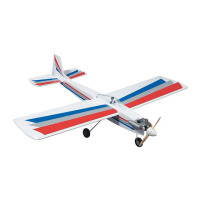
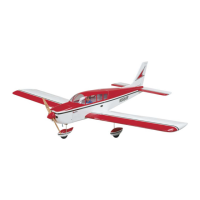
Overview of the Cherokee .40 ARF and encouragement to join AMA.
Key choices regarding radio and power system before building.
Requirements for the radio system, including channels and servos.
Suggested engines and motors for the Cherokee .40 ARF.
Lists of necessary hardware, adhesives, and building supplies.
Recommended propeller sizes for glow and electric power systems.
Specifications for LiPo batteries and chargers.
Tips and advice for successful model construction.
Information on how to obtain replacement parts for the kit.
Glossary of common terms and abbreviations used in the manual.
Conversion factors between inches and millimeters.
Procedure for checking kit contents and part quality before assembly.
Initial steps before starting the main assembly process.
Instructions for assembling the wing structure.
Steps for installing servos and control linkages in the wing.
Instructions for assembling the main body of the aircraft.
Attaching the horizontal stabilizer and vertical fin.
Connecting servos and pushrods to the tail control surfaces.
Procedure for installing a glow engine and related components.
Procedure for installing a brushless motor and ESC.
Steps for attaching the main and nose landing gear.
Final assembly steps to complete the model.
Mounting the radio receiver and related components.
Attaching the engine cowling, spinner, and propeller.
Securing the wing and canopy to the fuselage.
Instructions for applying the model's decals for finishing.
Steps to prepare the model for its first flight.
Connecting and securing the battery pack for brushless power.
Important guidelines for connecting and charging LiPo batteries.
Verifying correct response of control surfaces to transmitter inputs.
Adjusting the range of motion for control surfaces.
Critical procedure for setting the Center of Gravity for stable flight.
Ensuring the model is balanced evenly side-to-side.
Balancing propellers to prevent vibration damage.
Essential checks and procedures before the first flight.
Labeling the model with owner's identification information.
Proper procedures for charging transmitter and receiver batteries.
Verifying engine operation and system integrity on the ground.
Testing the operational range of the radio control system.
Safety guidelines for handling engines and fuel.
Critical safety instructions for LiPo batteries.
Key safety rules from the Academy of Model Aeronautics.
Safety rules and operational guidelines for radio control systems.
A comprehensive list of pre-flight checks to ensure readiness.
General advice and procedures for flying the model.
Tuning the engine fuel mixture for optimal performance and cooling.
Instructions and tips for performing a safe takeoff.
Guidance on general flight characteristics and handling.
Techniques and considerations for a successful landing.
How and when to use the model's flaps for flight control.
 General
| Weight | 5.5 - 6 lb (2.5 - 2.7 kg) |
|---|---|
| Radio System | 4-channel |
| Skill Level | Intermediate |
| ARF | Yes |
| Construction | Balsa and plywood |
| Covering | MonoKote |
| Engine Size | .40-.46 cu in (6.5-7.5 cc) 2-stroke or .52-.61 cu in (8.5-10 cc) 4-stroke |



 To Next Page