Need help?
Do you have a question about the Green Cell 5902719422201 and is the answer not in the manual?
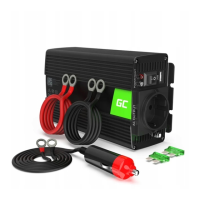
This document describes a power inverter, a device designed to convert DC power from a battery into AC power for various electronic devices. The manual provides comprehensive instructions for safe operation, technical specifications, usage, and maintenance.
The power inverter serves as a portable power source, converting 12V or 24V DC battery power into 230V AC power, suitable for powering a wide range of household and electronic appliances. It features multiple output ports, including AC sockets and USB ports, allowing for versatile connectivity. The inverter is equipped with safety mechanisms to protect against common electrical issues such as overvoltage, undervoltage, overload, and short circuits. It also includes a cooling fan to prevent overheating during operation. The device is designed for both automotive and marine applications, with specific instructions for connecting to vehicle batteries or boat grounding systems.
The inverter supports both 12V and 24V DC input, with corresponding maximum power outputs. For 12V inputs, devices with a maximum power of 150W are recommended when using the cigarette lighter cable. For 24V inputs, the maximum recommended power is 300W. The inverter provides a 230V AC output and includes USB ports for charging smaller electronic devices. It is crucial to ensure that the total power consumption of connected devices does not exceed the inverter's rated output to prevent damage. The device operates within a temperature range of up to 40°C. It is equipped with internal fuses for protection, which can be replaced following specific instructions in the manual. The inverter's housing is designed to dissipate heat, but proper ventilation with at least 5 cm of clearance on all sides is required.
Before use, the inverter must be correctly connected to a DC power source (battery or cigarette lighter socket) using the provided cables. For battery connections, the red terminal (+) of the inverter should be connected to the positive (+) terminal of the battery with the red cable, and the black terminal (-) of the inverter to the negative (-) terminal of the battery with the black cable. When connecting to a cigarette lighter socket, the appropriate cable should be used, ensuring the black cable connects to the black terminal and the red cable to the red terminal. All DC terminals should be tightened securely. An earthing wire (heavy-duty, insulated) should be connected from the inverter's rear terminal to an earthed electrical outlet or vehicle chassis/boat grounding system. The inverter is turned on by switching the button from 0 to 1. A green LED indicator will illuminate when the device is ready for use. If multiple devices are connected, they should be started one by one with short intervals. After use, the inverter should be disconnected from the power supply. For continuous operation, it is recommended to use 85% of the maximum power to extend the device's lifespan. If a "low battery voltage" alarm sounds, the inverter should be immediately turned off. The inverter can be reused once the battery is fully charged. When using the inverter with a vehicle, the engine must be running each time the inverter is used.
Regular maintenance primarily involves fuse replacement. To replace a fuse, the inverter must first be disconnected from its power source, turned on, and allowed to fully discharge until the indicator lights turn off. Four screws on the inverter cover need to be removed to access the internal components. Fuses are located in slots on the motherboard and can be removed by pulling them upwards. New fuses should be inserted, the cover replaced, and the four screws tightened. Special care should be taken when restarting the device after fuse replacement. For INVGC series models, which may have fuses located within the device housing, the front and rear panels, followed by the bottom panel, must be unscrewed to access the fuses. The manual emphasizes that any damage caused by reverse polarity connection (positive to negative) will void the warranty, as it can damage the inverter's fuse. The device should not be opened or repaired by unauthorized personnel. At the end of its lifespan, the inverter should be disposed of separately from household waste at designated collection points for proper treatment, recovery, and recycling, in compliance with local regulations and the WEEE symbol.
 General
| Brand | Green Cell |
|---|---|
| Model | 5902719422201 |
| Category | Inverter |
| Language | English |

 To Next Page