
 Need help?
Do you have a question about the GREEN LOO GT 120 and is the answer not in the manual?
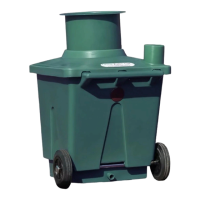
Details the space needed for installing and maintaining the composting container and vent piping.
Explains how vertical loops add to the total lift capacity of the system, affecting performance.
Illustrates suction and lift parameters with diagrams and notes on optimal generator placement for efficiency.
Recommends avoiding pumping sewage upwards from the vacuum flush unit to prevent stagnant sewage.
Details the best and poor locations for holding tanks relative to the vacuum pump for system efficiency.
Explains that elbows and bends on the vacuum side do not significantly impact flushing efficiency.
Advises using generous bend radii to prevent hose kinks for optimal performance and system longevity.
Lists recommended piping materials and their minimum inside bend radii for proper installation.
Provides instructions and tips for making secure hose connections, including using liquid soap for ease.
Details the steps for solvent bonding rigid pipes and fittings using cleaner and cement for durable joints.
Offers crucial tips for hose connections: double clamping, correct fittings, and proper insertion depth.
Compares different through-floor installation options, highlighting the most commonly used type.
Details the side and rear discharge pedestal options, noting joints requiring solvent bonding.
Specifies requirements for the incoming water line: cold water, ½” ID, flow rates, and shut-off valve.
Guides on connecting 24V power and signal wires to the pedestal, including plug modifications.
Details the installation of the flush control panel and connecting it to the pedestal via an Ethernet cable.
Instructions for connecting the pipe work from the toilet pedestal to the vacuum flush unit.
Instructions for connecting the pipe work from the vacuum flush unit to the composting container.
Emphasizes the importance of supporting vacuum hoses to prevent leaks by pulling fittings out of seals.
Guides connecting 24V power, signal wire, and electrical bridge to the vacuum flush unit.
Details installing the ventilation system, including pipe, fan, Y-joiner, cap (moisture trap), and vent cowl.
Explains preparing the absorption trench and connecting the excess liquids drain from the composting container.
Instructs on preparing the composting container by adding layers of pine bark and peat before use.
Lists essential checks for system components, connections, hoses, and secure mounting before powering on.
Details steps for pressurizing water, energizing vacuum, charging the pump, and checking for leaks.
Guides on flushing the system with fresh water and then adding antifreeze to protect against freezing.
Provides instructions for draining water from the water valve and inlet lines for winterization.
Explains how to test toilet paper for suitability and what to do in case of blockages.
Describes how to switch between Normal flush (0.95L) and Dry Bowl flush (0.5L) modes.
Advises on adding covering material and compost bacteria weekly for nitrogen/carbon balance.
Covers adding covering material, checking the fan, and container exchange frequency.
Details the process of exchanging and emptying composting containers, including safety precautions.
Outlines guidelines for burying or disposing of composted material, including distance requirements.
States that composting occurs between 5-50°C, and the unit must be protected from frost.

 To Next Page
 General