Need help?
Do you have a question about the GREISINGER G 1690 and is the answer not in the manual?
Introduction to the document and its importance for product operation.
Information on manufacturer liability, warranty, and document usage restrictions.
Details on software version and how to find the product name.
Defines DANGER, CAUTION, and NOTE symbols used in the manual.
Details incorrect applications and potential consequences of product misuse.
Provides critical safety warnings for handling oxygen and device components.
Specifies the device's exclusive purpose for measuring oxygen concentration and MOD calculation.
Defines requirements for personnel operating and maintaining the device.
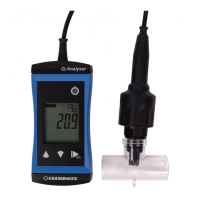
Visual overview of the G 1690 device, front view, and sensor.
Describes the function of the battery indicator, unit display, main display, and auxiliary display.
Explains the function of the On/Off, Up/Down, and Function buttons.
Instructions on how to access and navigate the device's configuration menu.
Procedure for calibrating the sensor using ambient air.
Explains the relationship between oxygen sensor output and partial pressure.
Defines partial pressure, Dalton's law, and oxygen concentration in air.
Details the calculation and use of MOD for NITROX diving.
General care instructions for the device and sensor to ensure proper function.
Information on battery status indicators and replacement.
Step-by-step instructions for safely replacing the device batteries.
Contact information for GHM Messtechnik GmbH, the manufacturer.
List of spare parts and further accessories for the G 1690/G 1690T device.
This document serves as a quick reference guide for the GREISINGER G 1690 and G 1690T O2-Analyser / oxygen meter, providing essential information for its safe and effective operation, maintenance, and basic understanding of its measurement principles. Users are strongly advised to read this document carefully and familiarize themselves with the product before use. It should be kept readily accessible for reference. The manufacturer's liability and warranty are voided in cases of misuse, disregard for safety notices, use by inadequately qualified personnel, or unauthorized modifications.
The GREISINGER G 1690 and G 1690T devices are designed exclusively for measuring oxygen concentration in gas mixtures and air. The measurement is performed at the sensor opening. The G 1690T model offers an additional feature: it can display the calculated maximum operational depth (MOD) based on the measured oxygen concentration. This MOD function is specifically designed for recreational diving with NITROX mixtures, within a range of 20.9 to 36.0 vol. % O2. It is crucial to understand that this device is not a substitute for necessary calculations and adherence to safety rules for dive planning and execution according to NITROX training. It is not intended for "tech-diving" or other gas mixtures like NITROX50 or TRIMIX, and any such use requires appropriate training and additional safety measures. The device is not suitable for underwater use (rebreather) or as the sole measuring device for controlling submersible gas mixtures. It should not be used in explosion-prone areas or for diagnostic/medical purposes on patients.
The device features a clear LCD display with a main display for the current measured value and an auxiliary display. On the G 1690T, the auxiliary display can show the MOD value with additional unit text (in meters or feet of seawater). The display orientation can be rotated 180° for overhead viewing by pressing the Up/Down buttons simultaneously.
Operating Elements:
Configuration Menu: To open the configuration menu, press the Function button for 2 seconds until "Conf" appears. Parameters include:
Calibration: Regular calibration is essential for accurate readings. The device must be calibrated in fresh air (20.95% vol.-% O2). For higher oxygen values, a "bump test" with a known gas concentration (e.g., pure oxygen, NITROX50) is recommended. Before calibration, the current air pressure must be entered in the P.AbS parameter in hPa without a decimal place. After calibration, the device displays a sensor evaluation in 10% steps; if below 30%, the sensor should be replaced. To perform calibration, press the Function button for approximately 5 seconds until "CAL" appears, then release. "CAL Air" will appear, followed by the sensor evaluation.
Operating and Maintenance Notices:
Battery: The device uses 2 AA batteries.
Disposal: Device components and packaging must be separated for material recycling according to regional statutory regulations and directives. The device should not be disposed of with household waste; it should be returned to the manufacturer for proper and environmentally friendly disposal. Empty batteries should be disposed of at designated collection points.
 General
| Resolution | 0.1 °C |
|---|---|
| Power Supply | 9V battery |
| Dimensions | 142 x 71 x 26 mm |
| Display | LCD |
| Accuracy | ±0.5 °C |

 To Next Page