OPD EQUIPPED CYLINDER HOSE & REGULATOR
OVERFILL PREVENTION DEVICE
Effective January 1, 1998, the standard for outdoor gas
appliances, ANSI Z21.58/CAN/CGA-1.6, requires that
appliances are to be used with cylinders equipped with an
Overfill Prevention Device (OPD).
The OPD is designed to reduce the potential for the
overfilling of propane cylinders, thus reducing the
possibility of relief valve discharges of raw propane. The
new OPD causes a slower purge/fill operation. Some
consumers have been advised by filling stations that these
cylinders are “defective”. This is not a defect. Some
propane filling stations may not be aware of this new
device and its effect on the purge/fill operation.
New OPDs coming onto the market have new technology
that allows for much greater BTU outputs which will
decrease the amount of time it takes to purge a cylinder.
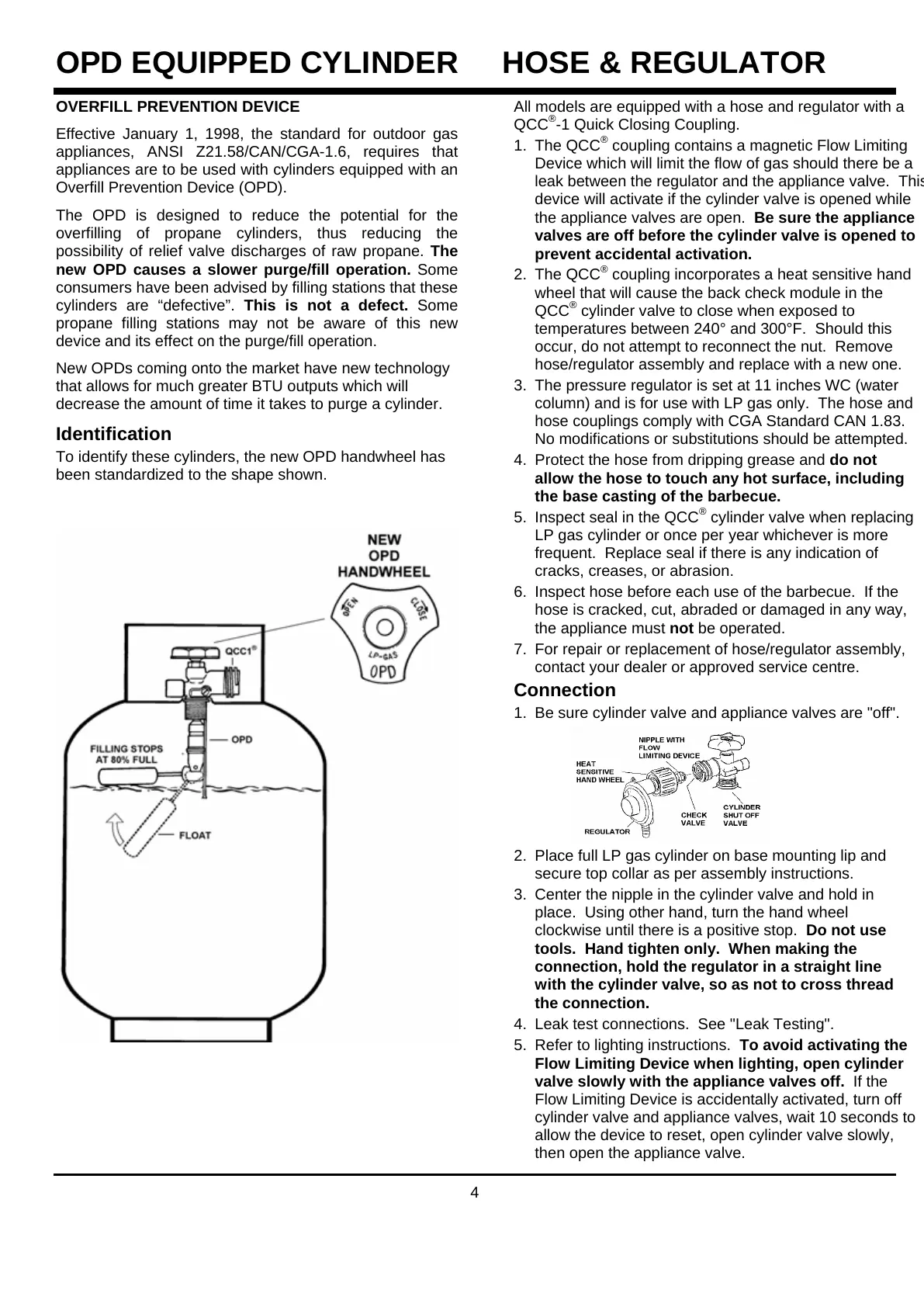
Identification
To identify these cylinders, the new OPD handwheel has
been standardized to the shape shown.
All models are equipped with a hose and regulator with a
QCC
®
-1 Quick Closing Coupling.
1. The QCC
®
coupling contains a magnetic Flow Limiting
Device which will limit the flow of gas should there be a
leak between the regulator and the appliance valve. This
device will activate if the cylinder valve is opened while
the appliance valves are open. Be sure the appliance
valves are off before the cylinder valve is opened to
prevent accidental activation.
2. The QCC
®
coupling incorporates a heat sensitive hand
wheel that will cause the back check module in the
QCC
®
cylinder valve to close when exposed to
temperatures between 240° and 300°F. Should this
occur, do not attempt to reconnect the nut. Remove
hose/regulator assembly and replace with a new one.
3. The pressure regulator is set at 11 inches WC (water
column) and is for use with LP gas only. The hose and
hose couplings comply with CGA Standard CAN 1.83.
No modifications or substitutions should be attempted.
4. Protect the hose from dripping grease and do not
allow the hose to touch any hot surface, including
the base casting of the barbecue.
5. Inspect seal in the QCC
®
cylinder valve when replacing
LP gas cylinder or once per year whichever is more
frequent. Replace seal if there is any indication of
cracks, creases, or abrasion.
6. Inspect hose before each use of the barbecue. If the
hose is cracked, cut, abraded or damaged in any way,
the appliance must not be operated.
7. For repair or replacement of hose/regulator assembly,
contact your dealer or approved service centre.
Connection
1. Be sure cylinder valve and appliance valves are "off".
2. Place full LP gas cylinder on base mounting lip and
secure top collar as per assembly instructions.
3. Center the nipple in the cylinder valve and hold in
place. Using other hand, turn the hand wheel
clockwise until there is a positive stop. Do not use
tools. Hand tighten only. When making the
connection, hold the regulator in a straight line
with the cylinder valve, so as not to cross thread
the connection.
4. Leak test connections. See "Leak Testing".
5. Refer to lighting instructions. To avoid activating the
Flow Limiting Device when lighting, open cylinder
valve slowly with the appliance valves off. If the
Flow Limiting Device is accidentally activated, turn off
cylinder valve and appliance valves, wait 10 seconds to
allow the device to reset, open cylinder valve slowly,
then open the appliance valve.
4


 To Next Page
 Loading...