COOKING TECHNIQUES
GRILL COOKING
6. Grilling with the cover closed on low heat will
enhance the "smoked" flavour.
7. After cooking, close the cover and turn burners to
"HIGH" for approximately 10 minutes to burn off any
residue on the grids and briquets.
8. For additional heat adjustment use two position
cooking grid to raise and lower cooking surface.
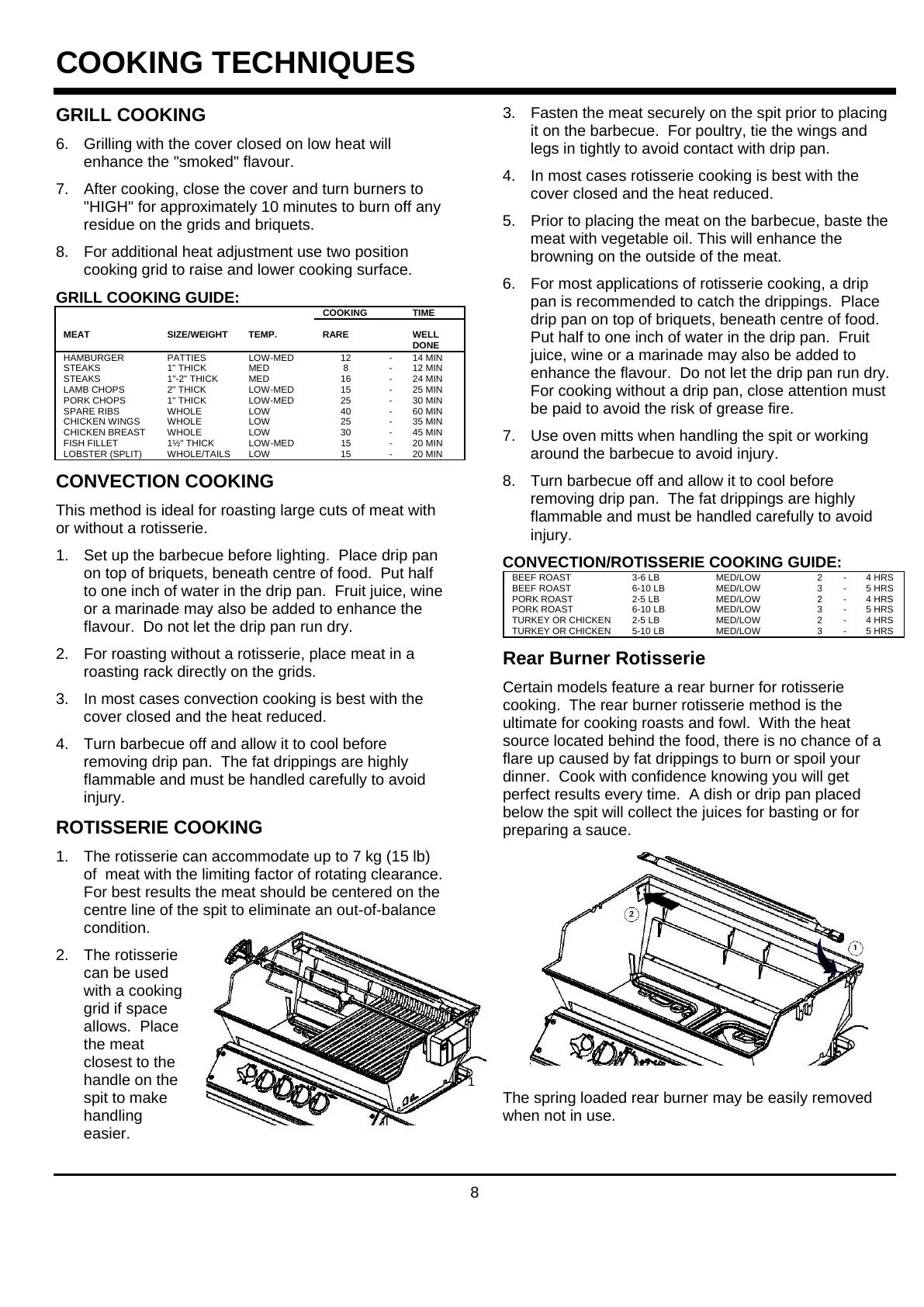
GRILL COOKING GUIDE:
COOKING TIME
MEAT SIZE/WEIGHT TEMP. RARE WELL
DONE
HAMBURGER PATTIES LOW-MED 12 - 14 MIN
STEAKS 1" THICK MED 8 - 12 MIN
STEAKS 1"-2" THICK MED 16 - 24 MIN
LAMB CHOPS 2" THICK LOW-MED 15 - 25 MIN
PORK CHOPS 1" THICK LOW-MED 25 - 30 MIN
SPARE RIBS WHOLE LOW 40 - 60 MIN
CHICKEN WINGS WHOLE LOW 25 - 35 MIN
CHICKEN BREAST WHOLE LOW 30 - 45 MIN
FISH FILLET 1½" THICK LOW-MED 15 - 20 MIN
LOBSTER (SPLIT) WHOLE/TAILS LOW 15 - 20 MIN
8
CONVECTION COOKING
This method is ideal for roasting large cuts of meat with
or without a rotisserie.
1. Set up the barbecue before lighting. Place drip pan
on top of briquets, beneath centre of food. Put half
to one inch of water in the drip pan. Fruit juice, wine
or a marinade may also be added to enhance the
flavour. Do not let the drip pan run dry.
2. For roasting without a rotisserie, place meat in a
roasting rack directly on the grids.
3. In most cases convection cooking is best with the
cover closed and the heat reduced.
4. Turn barbecue off and allow it to cool before
removing drip pan. The fat drippings are highly
flammable and must be handled carefully to avoid
injury.
ROTISSERIE COOKING
1. The rotisserie can accommodate up to 7 kg (15 lb)
of meat with the limiting factor of rotating clearance.
For best results the meat should be centered on the
centre line of the spit to eliminate an out-of-balance
condition.
2. The rotisserie
can be used
with a cooking
grid if space
allows. Place
the meat
closest to the
handle on the
spit to make
handling
easier.
3. Fasten the meat securely on the spit prior to placing
it on the barbecue. For poultry, tie the wings and
legs in tightly to avoid contact with drip pan.
4. In most cases rotisserie cooking is best with the
cover closed and the heat reduced.
5. Prior to placing the meat on the barbecue, baste the
meat with vegetable oil. This will enhance the
browning on the outside of the meat.
6. For most applications of rotisserie cooking, a drip
pan is recommended to catch the drippings. Place
drip pan on top of briquets, beneath centre of food.
Put half to one inch of water in the drip pan. Fruit
juice, wine or a marinade may also be added to
enhance the flavour. Do not let the drip pan run dry.
For cooking without a drip pan, close attention must
be paid to avoid the risk of grease fire.
7. Use oven mitts when handling the spit or working
around the barbecue to avoid injury.
8. Turn barbecue off and allow it to cool before
removing drip pan. The fat drippings are highly
flammable and must be handled carefully to avoid
injury.
CONVECTION/ROTISSERIE COOKING GUIDE:
BEEF ROAST 3-6 LB MED/LOW 2 - 4 HRS
BEEF ROAST 6-10 LB MED/LOW 3 - 5 HRS
PORK ROAST 2-5 LB MED/LOW 2 - 4 HRS
PORK ROAST 6-10 LB MED/LOW 3 - 5 HRS
TURKEY OR CHICKEN 2-5 LB MED/LOW 2 - 4 HRS
TURKEY OR CHICKEN 5-10 LB MED/LOW 3 - 5 HRS
Rear Burner Rotisserie
Certain models feature a rear burner for rotisserie
cooking. The rear burner rotisserie method is the
ultimate for cooking roasts and fowl. With the heat
source located behind the food, there is no chance of a
flare up caused by fat drippings to burn or spoil your
dinner. Cook with confidence knowing you will get
perfect results every time. A dish or drip pan placed
below the spit will collect the juices for basting or for
preparing a sauce.
1
The spring loaded rear burner may be easily removed
when not in use.


 To Next Page
 Loading...