EasyManua.ls Logo

Grundig TK 245 - Initial Setup; Switching On; Loading the Tape; Counter Function

Grundig TK 245
15 pages
Print Icon
To Next Page IconTo Next Page
To Previous Page IconTo Previous Page
Loading...
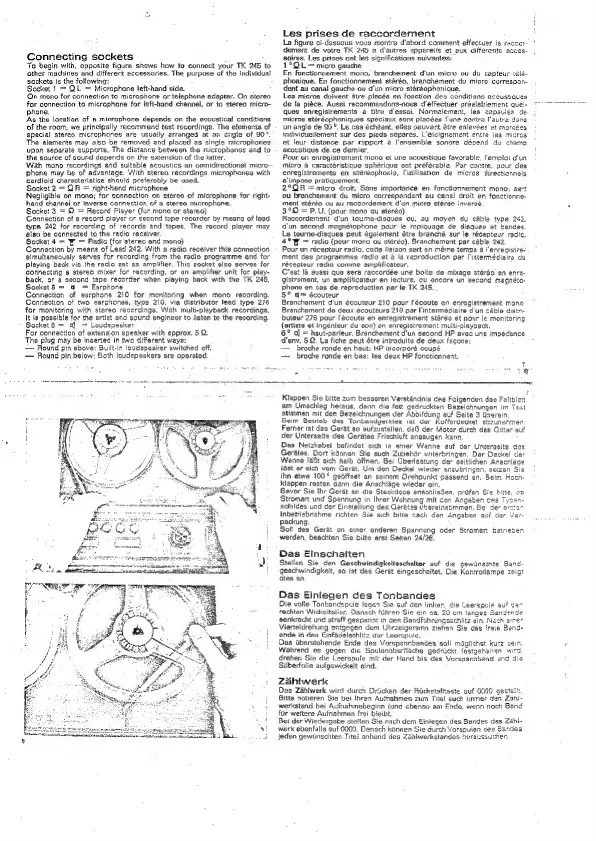
Connecting
sockets
To
begin
with,
opposite
figure
shows
how
to
connect
your
TK
245
to
other
machines
and
different
accessories.
The
purpose
of
the
individual
sockets
1s
the
following:
Socket
1
=
QL
=
Microphone
left-hand
side.
On
mone
for
connection
to
microphone
or
telephone
adapter.
On
stereo
for
connection
to
microphone
for
left-hand
channel,
or
to
stereo
micro
phone,
As
the
location
of
a
microphone
depends
on
the
ecoustical
conditions
of
the
room,
we
principally
recommend
test
recordings.
The
elements
of
special
stereo
microphones
are
usually
arranged
at
an
engie
of
90°,
The
elements
may
also
be
removed
and
pisced
as
single
microphones
upon
separate
supports.
The
distance
between
the
microphones
and
to
the
source
of
sound
depends
on
the
extension
of
the
iatter.
With
mono
recordings
and
suitable
acoustics
an
omnidirectional
micro
phone
may
be
of
advantage.
With'stereo
recordings
microphones
with
Sardioid
characteristics
should
preferably
be
used.
Socket
2
=
OR
=
right-hand
microphone
Negligible
on
mono;
for
connection
on
stereo
of
microphone
for
right-
hand
channel
or
inverse
connection
of
a
stereo
microphone.
Socket
3
=
©
=
Record
Player
(for
mono
or
stereo)
Connection
of
a
record
player
or
second
tape
recorder
by
means
of
lead
type
242
for
recording
of
records
and
tapes.
The
record
player
may
also
be
connected
ta
the
radio
receiver.
Socket
4
=
W
=
Radio
(for
stereo
and
mono)
Connection
by
means
of
Lead
242.
With
a
radio
recelver
this
connection
simultaneously
serves
for
recording
from
the
radio
programme
and
for
playing
back
vie
the
radio
set
as
amplifier.
This
eocket
also
serves
for
connecting
@
stereo
mixer
for
recording,
or
an
amplifier
unit
for
play-
back,
or
a
second
tape
recorder
when
playing
back
with
the
TK
245,
Socket
5
=
a
=
Earphone
Gonnection
of
earphons
210
for
monitoring
when
mono
recording.
Connection
of
two
earphones,
type
210,
via
distributor
lead
type
276
for
monitoring
with
stereo
recordings.
With
roulti-playback
recordings,
it
is
possible
for
the
artist
and
sound
engineer
to
listen
to
the
recording.
Socket
6
=
a}
=
Loudspeaker
For
connection
of
extension
speaker
with
approx.
5
Q.
The
plug
may
be
inserted
in
two
different
ways:
+
Round
pin
above:
Built-in
loudspeaker
switched
off.
Round
pin
below:
Both
loudspeakers
are
operated.
Les
prises
de
raccordement
La
figure
ci-desscus
vous
montre
d'abord
comment
effectuer
rscce!
dement
de
votre
TK
245
a
d'autres
appareifs
et
eux
différents
ecces-
soires.
Les
prises
ont
ies
significations
suivantes:
1°OL=
micro
gauche
En
fonctionnement
mono,
branchement
d'un
micro
ou
du
capteur
1élé-
phonique.
En
fonctionnement
stéréo,
branchement
du
micro
correspon
dent
au
canal
gauche
ou
d'un
micro
stéréophonique.
Les
micros
doivent
étre
placés
en
fonction
des
conditions
acoustiques
de
fa
pice.
Aussi
recommandons-nous
d’effectuer
préalablement
quei-
Ques
enregisirements
a
titre
d'essai.
Normalement,
les
capsules
de
micros
stéréophoniques
spéciaux
sont
placées
l'une
contre
Mauire
dans
un
angle
de
96°
Le
cas
échéant,
elfes
peuvent
étre
enlevees
at
moniées
individuellement
sur
des
pieds
séparés.
L'élsignement
entre
les
micros
et
leur
distance
par
rapport
@
l'ensemble
sonore
dépend
du
champ
acoustique
de
ce
dernier.
Pour
un
enregistrement
mone
et
une
acoustique
favorable,
l'emploi
d'un
micro
a
caractéristique
sphérique
est
préférable.
Par
contre,
pour
des
enregistrements
en
stéreophorie,
l'utilisation
de
micros
directionneis
‘s'impose
pratiquement.
2°QR
=
micro
droit.
Sans
importance
en
fonctionnement
mono;
set
su
branchement
du
micro
correspondant
au
canal
droit
en
fonctionre-
ment
stéréo
ou
au
raccordement
d'un.
micra
stéréo
inverse.
3°O
=P.
U.
(pour
mono
ou
steréo)
Raccordement
d'un
tourne-disques
ou.
au
moyen
du
cable
type
242,
d'un
second
magnétophone
pour
le
repiquage
de
disquee
et
bandes.
Le
tourne-disques
peut
également
étre
branché
sur
le
récepteur
radio,
4°W
=
radio
(pour
mono
ou
stéréo).
Branchement
par
cable
242,
Pour
un
récepteur
radio,
cette
liaison
sert
en
méme
temps
4
Her
ment
des
programmes
radio
et
a
la
reproduction
par
l'intes
récepteur
radio
comme
amplificateur.
C'est
[a
aussi
que
sera
raccordée
une
boite
de
mixage
stéréo'en
enre-
gistrement,
un
amplificateur
en
lecture.
cu
encore
un
second
magnéto-
phone
en
cas
de
reproduction
par
le
TK
245.
a=
écouteur
Branchement
d'un
écouteur
210
pour
I'écoute
en
enregistrement
mona
Branchement
de
deux
scouteurs
210
par
intermédiaire
d'un
cable
distri-
buteur
276
pour
I'écoute
en
enregistrement
stéreo
et
pour
le
monitoring
(artiste
et
ingénteur
du
son)
en
enregistrement
muiti-playback.
dl
=
heut-parieur.
Branchement
d'un
second
HP
avec
une
impedance
d'env.
5@.
La
fiche
peut
étre
introdulte
de
deux
fagons:
broche
ronde
en
haut:
HP
incorporé
coupé
—-
broche
ronde
en
bas:
les
deux
HP
fonetionnent.
gistres
ire
du
meee
Nae
ok
eerste
sr
ee
Klappen
Sie
bitte
zum
besseren
Verstandnis
des
Foigenden
das
Feltblext
am
Umschlag
hereus,
denn
die
fett
gecruckten
Bezeichnungen
im
Text
stimmen
mit
den
Bezeichnungen
ver
Abbildung
auf
Seite
3
Uberein,
Beim
Betrieb
des
Tonbandgerétes
ist_der
Kofferdeckel
ebzunshmen
Ferner
ist
das
Gerat
so
aufzustelien.
dab
der
Motor
durch
das
Gitter
auf
der
Unterseite
des
Gerates
Frischluft
ansaugen
kann,
Das
Netzkabel
befindet
sich
in
einer
Wanne
auf
der
Unterseite
des
Gerates.
Dort
kdnren
Sie
auch
Zubehér
unterbringen.
Der
Deckel
cer
Wanne
[aBt
sich
halb
offnen,
Bei
Gberlastung
der
seitlichen
Anscnidae
lost
er
sich
vor:
Gerat.
Um
den
Deckel
wieder
anzubringen,
serzen
Sie
ihn
etwa
100°
gedffnet
an
seinem
Drehpunkt
passend
an.
Beim
Hoch-
Klappen
rasten
dann
die
Anschiage
wieder
ein,
Bevor
Sie
thr
Gerat
an
die
Steckdose
anscilie@en,
prifen
Sie
6:
oD
Stromart
und
Spannung
in
Ihrer
Wohcung
mit
cen
Angaben
cee
Tyner
schildes
und
der
Einsteilung
des
Gerates
CLereinstimmen.
Be:
der
=
Inbetriebnahme
richten
Sie
sich
bitte
mack
den
Angaben
aui
cer
Ver
packung,
Soff
des
Gerat
an
einer
anderen
Spanrung
oder
Stromart
betrieben
werden,
beachten
Sie
bitte
erst
Seiten
24/26.
Das
Einschalten
Stellen
Sie
den
Geschwindigkeitsschalter
auf
die
gewanschte
Sand-
geschwindigkeit,
so
ist
das
Gerét
eingeschaitet,
Die
Kontroflampe
zeigt
dies
an.
Das
Einlegen
des
Tonbandes
Die
volte
Tanbandsouie
leaen
Sis
auf
den
linker,
die
Leerspuie
rechten
Wickeltelier.
Danach
fuhren
Sie
ein
ca.
20
cm
langes
Sandend:
senkrecht
und
straff
gespannt
in
cen
Bandfuhrungsschlitz
ein.
N.
Vierteldrehung
entgegen
dem
Uhrzeigersinn
ziehen
Sie
das
freie
Bend-
ende
in
den
Einfadelschlitz
der
Leerspule,
Des
aberstehende
Ende
des
Vorspannbandes
soll
méglichst
kurz
sein.
Wahrend
es
gegen
die
Soulensberfléche
gedrickt
festgehaiten
wird.
drehen
Sie
die
Leerspule
mit
der
Hand
bis
des
Vorspannband
und
dis
Silberfolie
aufgewickelt
sind.
Zahiwerk
Das
Zahtwerk
wird
durcis
Dricken
der
Rackstelttaste
auf
0000
ge
Bitte
notieren
Sie
bei
Ihren
Aufnahmen
zum
Titel
euch
immer
den
Zani-
werkstand
bei
Aufnahmebeginn
(und
ebenso
am
Ende,
wenn
nock
Band
far
weitere
Aufnahmen
frei
bleibt.
Bei
der
Wiedergabe
stellen
Sie
nach
dem
Einlegen
des
Sendes
das
werk
ebenfalls
euf
0009.
Danach
konnen
Sie
durch
Vorsputen
des
Barides
jeden
gewimschten
Titel
anhand
des
Zahiwerkstandes
Aeravesuchen.

Related product manuals