Instructing the Patient
Try to put the patient at ease before beginning the procedure. Explain to the patient:
How the test will be administered.
What he or she should be listening for; explain that the sounds may be different; some may be
soft, some loud.
The purpose of the test is to find the softest tone which can be heard and it is important to
listen carefully. Explain that he or she should respond by raising a finger or hand, or by
pressing the handswitch, as soon as the tone is heard. As soon as the tone is no
longer heard, the finger/hand should be lowered or the handswitch should be released.
Inform the patient that each ear will be tested separately, unless otherwise instructed.
Placement of the Earphones
Prior to positioning the earphones on the patient’s head, inspect the ear canals for any blockage
due to cerumen or foreign objects. Recognize that soft-walled ear canals may collapse under
the earphones and this may lead to incorrect threshold levels. Insert phones might be used in
these cases. Eliminate all obstructions, such as glasses, hair, or hearing aid, between the
earphone and the patient.
Center the earphone over both ears and adjust the headband so that it rests solidly on the
crown of the head and exerts pressure on both ears. Place the earphone with the red connector
over the patient’s right ear and the earphone with the blue connector over the left ear.
Placement of the Insert Phone
If insert phones are used, push the correctly sized eartip onto the earphone and then place the
insert phone securely into the patient’s ear. When using the paired E•A•R insert phones,
follow the manufacturer’s recommended procedure for eartip placement and insertion.
Placement of the Bone Vibrator
The bone vibrator may be placed on the promontory of the mastoid process or on the forehead,
whichever has been selected for calibration.
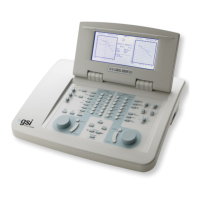
Grason-Stadler GSI
61 CLINICAL AUDIOMETER
Patient Instructions
Noise Recovery Period
Exposure to high levels of sound - unmuffled lawn mowers, many power tools, motorcycles,
rock music, gunfire - tends to create a temporary threshold shift (TTS) which diminishes with
time after exposure. Any patient tested soon after such exposure will manifest a hearing loss
that does not accurately reflect the normal hearing threshold. It is important that the testing
procedure prescribe some time interval, usually 16 hours, between the high level sound
exposure and the actual hearin
test.
a
.
b
.
c
.
d
.
1761-0100 Rev. B 3-2


 To Next Page
 Loading...