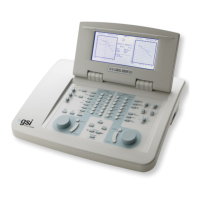
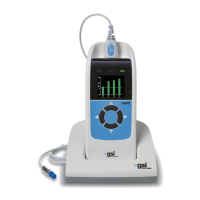
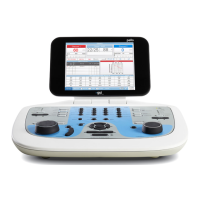
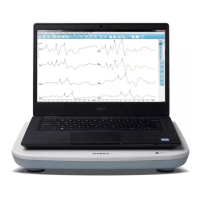
The following procedures are in compliance with the current ANSI and ISO recommendations
for Manual Pure Tone Threshold Audiometry.
Preliminary
Turn on the instrument and allow it to come to operating temperature.
Check that the transducers and other system components are operating properly.
Seat the patient comfortably in the test area.
Explain the test procedure.
Assist the patient with the earphones or bone vibrator placement.
Patient Familiarization
Select the proper output transducer routing to the desired ear.
Demonstrate the 1000 Hz tone at 40 dB HL (or at a level estimated to evoke a prompt and clear
response) to the patient. The tone duration should be between one and two seconds.
Set the Channel 1 attenuator to -10 dB.
Practice: beginning with the tone continuously on, gradually increase the intensity by rotating
the Channel 1 attenuator until a response occurs. Switch the tone off for at least 2 seconds,
then present the tone again at the same level. If there is a second response, proceed with a
threshold measurement. If the second response does not occur, repeat this step.
Threshold Determination (Pure Tone): Modified Hughson-Westlake
The level of the first presentation should be 10 dB below the level at which the patient
responded during the familiarization session. Present the tone for a period of one to two
seconds. The time between presentations can be varied, but should not be shorter than the
test tone itself. After each failure to respond to the signal, the level is increased by 5 dB until
the first response is given. After the response, the intensity is decreased 10 dB and another
ascending process is begun.
The threshold is considered to be the minimum intensity setting at which a response has
occurred two out of three times at a single level. Record this setting by pressing the Save
pushbutton or by making a notation on an audiogram form.
3-3
Chapter 3 - Operation
Routine Test Procedures
a
.
b.
c
.
d
.
e
.
a
.
b.
c
.
d
.
a
.
b.
1761-0100 Rev. B


 To Next Page
 Loading...