Need help?
Do you have a question about the Guild PSJ700G and is the answer not in the manual?
Explains the meaning of various warning symbols used in the manual to ensure safe operation.
Comprehensive safety guidelines for operating power tools, covering work area, electrical safety, and personal protection.
Specific safety instructions for holding the jigsaw and avoiding electric shock during operation.
Recommends wearing a dust mask as an additional safety measure for jigsaw operation.
Lists and labels all the main parts of the Guild 710W Jigsaw for user identification.
Details the accessories provided with the Guild 710W Jigsaw, such as parallel guide and Allen key.
Instructions on how to start and stop the jigsaw using the main power switch.
Guide on engaging the lock-on button for continuous operation and how to disengage it.
Explains how to adjust the speed using the thumb-wheel for different materials and cutting tasks.
Information on where the Allen key is stored on the power cable sheath for easy access.
Step-by-step guide on how to safely and correctly install a saw blade into the jigsaw.
Ensuring the blade runs smoothly in the roller guide for proper pendulum function and blade support.
Instructions for attaching and positioning the parallel guide for accurate cutting distances.
How to adjust the pendulum action for cutting efficiency and its effect on blade movement.
How to adjust the base plate for bevel cutting and the importance of firm contact.
Detailed steps for setting precise bevel angles using the base plate and allen key.
Guide on mounting the dust tube for effective dust extraction during operation.
Details the location and purpose of finger protection to prevent accidental contact with the moving blade.
Importance of keeping the dust blower air hole clean for dust removal from the cutting area.
How to use the integrated work light to illuminate the cutting area, with a caution about direct viewing.
Advice on preventing motor overheating, especially at low speeds, by adjusting speed and running without load.
General advice on blade selection, workpiece securing, speed control, and cut quality.
Specific technique for cutting laminates to minimize edge chipping using waste wood.
Guidance on avoiding pendulum action when cutting tight circles or angles.
Instructions for performing plunge cuts on soft materials using appropriate saw blades.
Tips for cutting metal, including blade selection, clamping thin sheets, and reducing heat.
Guidelines for cleaning, storing, and maintaining the jigsaw, emphasizing no user-serviceable parts.
Detailed technical data including voltage, power, speed, capacity, and machine weight.
Presents sound pressure and sound power levels, advising the use of ear protection.
Details vibration emission values for cutting boards and steel, and warnings about hand-arm vibration syndrome.
Guidance on the proper recycling of waste electrical products and avoiding household waste disposal.
Details the 24-month guarantee for domestic use, exclusions, and statutory rights.
Statement of compliance with EU directives and harmonized standards, issued by Argos Ltd.
Instructions for replacing the plug, including wire color coding and terminal connections.
Warnings about connecting wires correctly, using approved plugs, and safe disposal of old plugs.
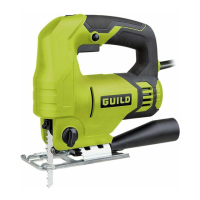
The Guild 710W Jigsaw (model PSJ700G) is a corded power tool designed for sawing various materials such as wood, plastic, metal, and building materials. It is intended for use while resting firmly on the workpiece and is suitable for both straight and curved cuts, as well as bevel cuts up to 45°. The tool emphasizes user safety through various warnings and instructions, including the recommendation to wear eye protection, ear protection, and a dust mask during operation. Double insulation is a key safety feature, and the product is designed for domestic use only.
The jigsaw operates with a 710W motor and features a variable speed control, allowing the user to adjust the cutting speed to suit the material and desired cut quality. This control is managed via a thumb-wheel, which can be adjusted even during no-load operation. The tool is equipped with a pendulum action control, which varies the forward cutting angle of the blade to increase cutting efficiency. This feature is particularly useful for faster cuts in materials like softwood and can also be adjusted during no-load running. The blade cuts on the upward stroke only.
Blade fitting is a crucial aspect of the jigsaw's function. The tool uses an Allen key (stored in the power cable sheath) to loosen and tighten blade set screws on the blade holder. The blade's cutting edge must face forward, and the mounting portion should be inserted into the groove until it touches the bottom of the holder before being firmly tightened. It's important to use a blade suited to the material and desired cut quality. The roller guide ensures the blade is correctly located and runs smoothly, which is essential for proper pendulum function and blade support during cutting.
For enhanced visibility during operation, the jigsaw includes a work light that illuminates when the on/off switch is pressed. A dust blower air hole, located underneath the housing behind the blade guide, helps to continually blow dust away from the cutting area, maintaining clear visibility of the cutting line. The base plate of the jigsaw can be adjusted to enable bevel cutting up to 45°. This adjustment is made by loosening bolts with the Allen key and rotating the base plate to the desired angle. For precise work, it is recommended to use a protractor to set the angle and perform a test cut on scrap material. The base plate must always be held firmly against the material to reduce vibration, blade jumping, or breakage.
The jigsaw also supports dust extraction through a dust tube that mounts into an opening in the base plate. This tube connects to a vacuum system, engaging a plastic tip into a corresponding opening on the housing to collect dust and debris, contributing to a cleaner work environment.
The Guild 710W Jigsaw is designed for ease of use with several operational features. The on/off switch initiates and stops the tool, and a lock-on button allows for continuous operation without needing to hold the switch down. To engage the lock-on feature, the on/off switch is depressed, followed by the lock-on button; releasing the on/off switch first, then the lock-on button, locks the switch for continuous use. To switch off, the on/off switch is simply depressed and released again.
When using the variable speed control, general guidance is provided for different materials: wood typically requires speed settings 5-6, metal 3-4, aluminum 3-5, PVC 3-4, and ceramic 3-5. Prolonged use at very low speeds should be avoided to prevent damage to the motor.
For specific cutting tasks, the manual provides "Working Hints." If the jigsaw becomes too hot, especially at low speeds, it is recommended to set the speed to maximum and run it without load for 2-3 minutes to cool the motor. Always use a blade appropriate for the material and thickness, and ensure the workpiece is firmly held or clamped to prevent movement. Starting cuts at a low speed and then increasing to the correct speed is advised for better control.
When cutting laminates, a fine-tooth blade is recommended. To minimize edge chipping, clamping pieces of waste wood on both sides of the workpiece and cutting through them is suggested. For circle cutting, the pendulum action should not be used. Plunge sawing is possible only on soft materials like wood, aerated concrete, and gypsum plasterboards, using short saw blades. This involves placing the front edge of the base plate on the workpiece, switching on the tool, and slowly plunging the blade into the material until the entire base plate rests on the workpiece, then continuing along the cutting line.
For metal cutting, a finer tooth blade is used for ferrous metals and a coarse tooth blade for non-ferrous metals. When cutting thin sheet metals, clamping wood on both sides of the sheet is advised to reduce vibration and tearing. Forcing the cutting blade when cutting harder metals should be avoided, as this can reduce blade life or damage the motor. Applying a little lubricant along the cutting line can help reduce heat during metal cutting.
A finger protection feature is located in front of the blade holder to help prevent accidental contact with the moving blade during operation.
The Guild 710W Jigsaw is designed for minimal maintenance, with no user-serviceable parts requiring additional lubrication. Before any adjustment, servicing, or maintenance, it is crucial to remove the plug from the socket. The tool should not be cleaned with water or chemical cleaners; instead, it should be wiped clean with a dry cloth.
Proper storage is important: the power tool should always be stored in a dry place. Keeping the motor ventilation slots clean is essential to ensure proper airflow and prevent overheating. Dust should be kept away from all working controls. The manual notes that occasional sparks through the ventilation slots are normal and do not indicate damage to the tool.
In the event of damage to the supply cord, it must be replaced by the manufacturer, its service agent, or similarly qualified persons to avoid hazards. The manual also includes instructions for plug replacement in the UK and Ireland, detailing how to correctly connect the blue (neutral) and brown (live) wires to an approved BS1363/A plug with the correct rated fuse. It warns against connecting live or neutral wires to the earth terminal and emphasizes the safe disposal of severed molded plugs to prevent accidental engagement into a socket.
The overall maintenance philosophy for the Guild 710W Jigsaw is to keep it clean, stored properly, and to address any cord damage professionally, ensuring the tool remains safe and functional over its lifespan.
 General
| Model | PSJ700G |
|---|---|
| Category | Power Tool |
| Type | Jigsaw |
| Power | 700W |
| Bevel Capacity | 45° |
| Dust Extraction | Yes |
| Weight | 2.5kg |
| Power Source | Corded |
| Voltage | 230V |
| Stroke Rate | 3000 spm |
| Orbital Action | 4 settings |

 To Next Page