What is Advance
Timing Light?
6
Product
Description
7
Before describing advance timing light, it might be useful to describe the principle of operation of
an ordinary (non-advance) timing light.
Timing light is a device that works on the stroboscopic principle. That is, a rotating part of an
engine is made to appear stationary by being illuminated by a brief flash of light which occurs once
per revolution (or multiples of a revolution), at the same rate that the engine is rotating.
The particular part of the engine that is made to appear to be stationary when using timing light is a
timing mark (or marks) that the car manufacturer has put on some rotating part of the engine, such
as the fan belt pulley or the engine flywheel. There is also always a fixed mark on the engine, close
by where the moving mark passes, which is used as a reference position for the moving mark.
Timing light takes its cue from the spark plug of No1 cylinder, and flashes each time that spark
plug fires. Non-advance timing light fires at exactly the same instant that the spark plug fires.
The timing mark on the rotating part of the engine therefore appears to be stationary in exactly the
position it has at the time of the spark to No 1 cylinder spark plug. From the apparent position of
the moving mark in relation to the fixed mark the timing of the engine can be determined.
For example, if the rotating mark represents 8° BTDC, and appears to be exactly opposite the fixed
reference mark, then the ignition timing is 8° BTDC.
This is fine if all that the user wishes to do is check that the timing is 8°BTDC. However, maybe
the moving mark is not exactly opposite the fixed mark, and the user still wishes to know what the
timing is. Maybe he wishes to set the timing to some value for which there is no timing mark. Or
maybe he wishes to check the timing at higher RPM, for which the car manufacturer has provided
data in the handbook, but has not provided timing marks on the fan belt pulley. For these jobs a
simple non-advance timing light is not adequate, and the user needs advance timing light.
Advance timing light includes electronic circuitry which can apply a small but precise delay
between the time the spark plug fires, and the time that the timing light flashes. Delaying the flash
of the timing light has the same effect on the apparent position of the timing marks as advancing
the ignition timing by the same amount. This can be seen to be true by considering that, if two
timing marks are brought into conjunction by delaying the timing light flash, then the actual spark
from the spark plug must have occurred some time earlier.
The time of the flash is controlled by the advance knob. Rotating this knob fully in an anticlockwise
direction applies no delay to the flash, and the timing light will behave as an ordinary non-advance
timing light. (The Pointer of the knob lined up with Zero) However, rotating the knob clockwise will
advance the timing light flash (cause a delay between the ignition pulse and the flash) by the angle
indicated by the pointer on the knob.
To illustrate this by an example, consider the example mentioned above, of a “static” timing mark
on a fan belt pulley representing 8°BTDC. This mark would still represent 8°BTDC if the dial on the
timing light was 0, but it would represent 28°BTDC if the knob was rotated to show 20. on the dial.
The use of this timing light is particularly simple where the engine timing marks have an indication
for top dead centre (TDC), which many engines have. Using the TDC marks, the ignition timing is
simply as shown on the rear panel display. For example, if the TDC mark is opposite the fixed mark
when the display shows 00.00, then the timing is TDC, if the display shows 08.00 then the ignition
timing is 8°BTDC, if the display shows 20.00, then the ignition timing is 20°BTDC.
NOTE 1: In practice, the scale can never quite reach 0, the lowest reading being typically 0.20.
NB: A timing light cannot apply a retardation to timing marks (i.e. it can not be used to set timing
After Top Dead Centre (ATDC), where the timing marks are TDC or BTDC), since this would imply
causing the timing light to flash before it received the signal from the spark plug, but there are
other ways round this problem, as described later, should it ever be needed.
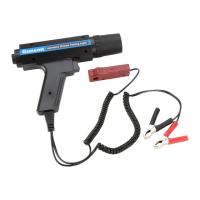
A lightweight plastic case, with a sturdy handgrip and trigger, and with a soft rubber nose
cone which minimizes the danger to the timing light or car from inadvertent contact with
moving parts such as the fan, fan belt or pulley.
When the trigger is depressed, the timing light will flash. The timing of the flash is adjusted by
turning the advance knob.
A Xenon discharge lamp of very high energy output is provided, combined with a lens which
gives a wide beam of brilliant white light, enabling the timing marks to be readily seen even
under conditions of high ambient light. Should the lamp ever need replacing, spares can be
obtained from The Tool Connection Ltd
RED and BLACK clips for connecting to the car battery
RED INDUCTIVE PICKUP, for clipping over the spark plug lead of No1 cylinder, for detecting
the instant of firing of the spark plug, and also for the measurement of engine RPM. Note
that the body of the pickup shows an arrow sign, and the pickup should be attached with this
arrow pointing along the HT lead towards the spark plug (connecting it the other way round
may result in reduced pickup sensitivity).
ADVANCE ADJUSTMENT KNOB
This knob is situated on the control panel at the rear of the instrument. It sets the advance
angle, which is indicated by the pointer on the knob and the dial scale (0 to 60).
Tool Connection Copyright
Tool Connection Copyright
Tool Connection Copyright
Tool Connection Copyright
Tool Connection Copyright
Tool Connection Copyright
Tool Connection Copyright
Tool Connection Copyright
Tool Connection Copyright


 To Next Page
 Loading...