Simple engine tests
with Colortune
10 11
a. TESTING CENTRIFUGAL ADVANCE MECHANISM
This mechanism should cause the ignition timing to advance with increase in engine
speed.
The instructions are as follows:
• Remove vacuum advance/retard connections.
• Observe the timing marks with the engine running at idle.
• Gradually increase the engine speed. The timing mark should remain aligned
initially, and then begin to move in the opposite direction to the pulley/flywheel
rotation, and then stop. (Centrifugal advance usually begins between 500 & 1500
R.P.M. and ends between 4500 & 5500 RPM).
If excessive ignition advance with increase in RPM is observed, the cause is usually due
to wear or broken advance springs.
If the ignition advance is too low, the cause is usually sticking or wear at the pivot point
of the rotating weights.
b. TESTING VACUUM ADVANCE
• Re-connect vacuum advance connection only.
• Observe the timing marks with the engine running at idle.
• Gradually increase the engine speed. Vacuum advance should operate
smoothly from around 800 RPM, reaching a maximum at about 2500 RPM.
This increase in ignition advance will be in addition to that due to the centrifugal
advance.
NB: If the throttle is opened rapidly the vacuum advance will operate and return quickly
as use of the throttle affects the vacuum).
If vacuum advance is operating at idle this may be due to incorrect carburettor setting
on Solex/Weber carburettors which have both throttle “bypass” and “ throttle stop”
adjustment; or this may be due to incorrect air balance on twin carburettors.
If the vacuum advance is too low, the cause is usually due to sticking contact breaker
base plate, punctured diaphragm or blocked vacuum pipe.
If the vacuum advance is too high, the cause may be due to incorrect carburettor
adjustment.
NB: Some distributors are adjustable for vacuum advance (examine the area around the
vacuum advance or retard operating rod).
c. TESTING VACUUM RETARD
This feature may be fitted for emission control, and only operates at idle and during
deceleration.
• Observe the timing mark with the engine running at idle.
• Re-connect the vacuum retard connection.
• Observe the difference in timing.
• The timing mark should move in the same direction as pulley/flywheel rotation.
Some useful Diagnostic
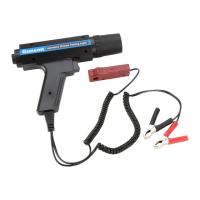
tests using Timing Light
d. DETECTION OF DISTRIBUTOR WEAR OR INACCURACY
Most engines are timed on No 1 cylinder, but other cylinders (No 4 on a 4 cylinder
engine) should also fire when the timing marks are aligned. By connecting to the opposite
lead to No 1 on the distributor cap the difference can be checked.
Alternatively connection can be made to the king lead (the input HT leads to the distributor)
which will give flashes as each cylinder fires. The difference between various cylinders can
then be observed.
These methods can also be used to synchronise double points - stop the engine and adjust
the position of the moveable points with the engine stationary, until the timing is consistent
on appropriate cylinders.
To check other cylinders (2 & 3 on 4 cylinder engines) accurate marking of the pulley at 180°
is required.
A regular error (of more than 2-3 degrees) in the ignition timing between separate cylinders
indicates distributor cam error or wear, bent or worn distributor shaft or large error in points
setting.
Erratic errors in ignition timing on all cylinders indicates wear in distributor drive, shaft or
points base plate. A very erratic idle speed or pitted contact breaker points will also cause
ignition timing “scatter”.
e. EFFECTS OF INCORRECT IGNITION TIMING
Ignition that is too advanced may cause audible “pinking” or detonation and engine
damage, and also causes increased emission of hydrocarbons (HC) in the vehicle’s exhaust.
Ignition is too retarded causes engine overheating, poor economy and performance, and
burnt exhaust valves.
Tool Connection Copyright
Tool Connection Copyright
Tool Connection Copyright
Tool Connection Copyright
Tool Connection Copyright
Tool Connection Copyright
Tool Connection Copyright
Tool Connection Copyright
Tool Connection Copyright


 To Next Page
 Loading...