Mixture enrichment during acceleration is achieved using an oil filled damper which
reduces the rate at which the air valve can rise.
Two types of needle are fitted:
(a) a rigidly fixed needle which should not touch the jet. In some cases afler stripping the
carburettor it is necessary to
centraliselhe needle and jet during re-assembly (this is a
very early type).
(b) A needle which is spring loaded against the side of the jet: when in good condition
this type gives improved accuracy of fuel metering. (Replace at
50,000 miles 180,000
km inte~als).
Note: the needle housing should not be rotated as the direction of spring loading
will be affected. Fuel metering needles are manufactured to within
.0025mm (.000lU)
and should be handled carefully.
SU type HIF and Stromberg CDSE types have a temperature compensating device
fitted but other SU and Stromberg CD types should be set when the carburettor is warm
to the touch but not hot, to achieve maximum setting accuracy.
IDLE ADJUSTMENT
The idle speed screw generally acts on the throttle spindle to which the accelerator
linkage is connected: this will give very fine adjustment of the throttle. The mixture screw
(also affecting mixture at high speeds) is located in different positions on different
types.
SU TYPE
On early versions this is generally a hexagon nut underneath the carburettor and is
screwed up to weaken (clockwise looking from underneath). Othertypes, HSB, HD,
etc.,
have a screw which raises and lowers the jet through a system of levers. HIF types have
a screw which is located behind removable plug in the right hand side of the carburettor:
screwing in clockwise enriches the mixture.
Occasionally adjustment is on the lefl (one left, one right on twins).
CD TYPE
On early versions there is, generally underneath the carburettor, either a large
slotted screw or, in later types a castellated bush which requires a special tool for easy
adjustmentt. It is screwed up to weaken (clockwise looking from underneath). Other
types (adjustable needle) are plugged underneath and have a slot in the air valve (piston)
guide rod. Remove damper and look inside to check for this. (The slot is across the
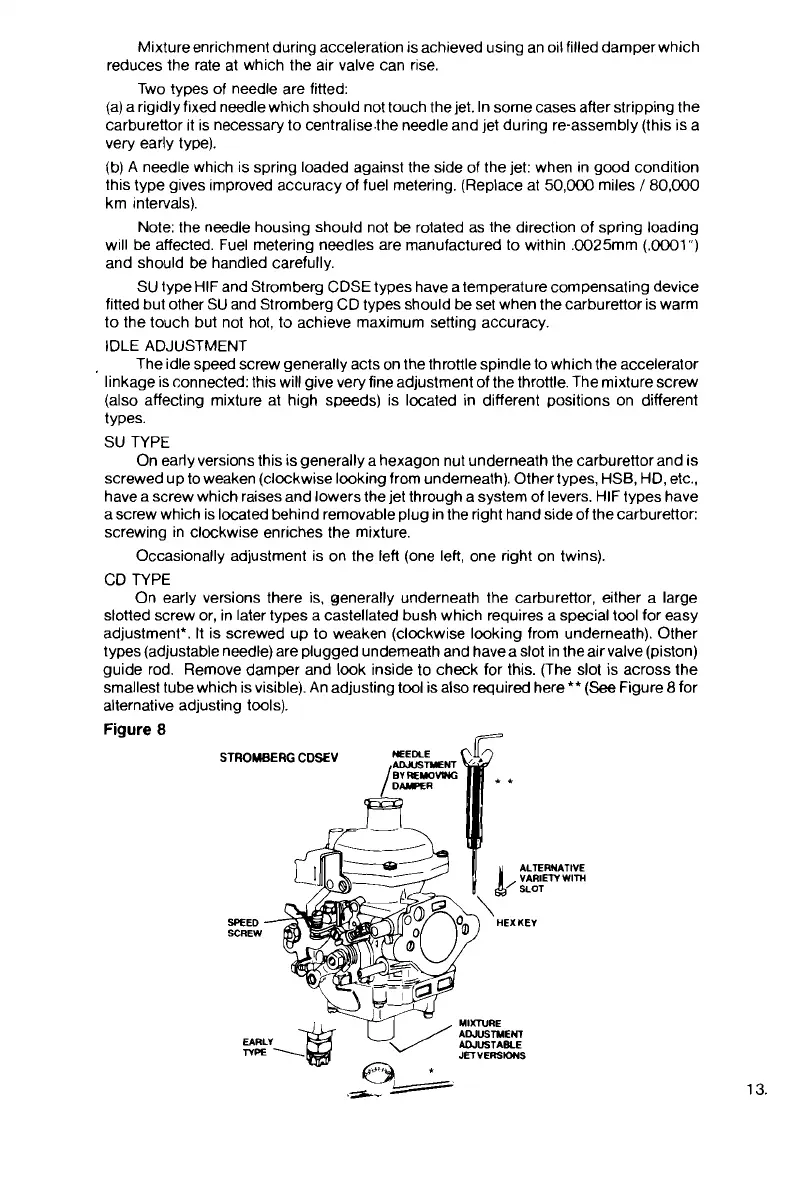
smallest tube which is visible). An adjusting tool is also required here
**
(See
Figure
8
for
alternative adjusting tools).
Figure
8
v
STROWERG
CDSEV


 To Next Page
 Loading...