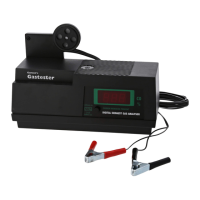
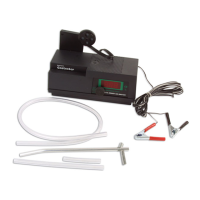
(7)
Wait for a period of 15 seconds for the meter to respond and a further 1 minute to
stabilise. Make a note of the reading of the CO level on the meter scale. If the reading is
not in-between the manufacturer's recommended maximum and minimum, or below
that specified as a legal requirement, then adjustment of the carburettor or fuel injection
system will be required.
(8)
If the indicated CO reading is too high or too low, then make a small adjustment
to the mixture screw, and correct the idle speed by adjusting the idle speed screw (or
throttle bypass screw if fitted
-
see section
9).
Do this repeatedly in small increments,
allowing approximately one minute for the reading to stabilise at each mixture
setting.
6.
FURTHER INFORMATION
(1
)
It should be noted that an engine, even in good overall condition, will show a
fluctuation in idle CO over a period of time, of typically 0.5%. Bearing in mind this
fluctuation, and also errors and drift in the instrument, the user should aim to set the
average CO reading to be midway between the limits set by the manufacturer, or at a
reasonable margin below the prescribed legal limit.
(2) Periodically, during the tests, examine the lowest point of the transparent plastic
pipe to see if it contains water to a degree that might impede the flow of gas, and if it does,
remove the pipe at the pulse pump inlet end and clear the pipe by allowing the water to
drain out, then reconnect the pipe and carryon with the tests. If the transparent pipe falls
continuously from theexhaust to the pump the automatic drain should operate and keep
the pipe clear of water. NOTE; Operation of the pulse pump will usually be audible as the
pulsations in the exhaust cause the internal diaphragm to vibrate. If the instrument
ceases to respond to changes in mixture setting or the sound from the pulse pump
becomes irregular, check the sample pipe for collected water.
(3) Thecalibration of the instrument may bechecked at any time. Simply remove the
exhaust probe and wait at least five minutes, or ten minutes in still air, for exhaust to
disperse from the collector box. If necessary, the calibration may then be adjusted using
the calibration control knob. The user is advised to periodically check the calibration of
the instrument during tests
(4)
Some motor car engines will not readily "tick over" at idle speeds for long
periods. The speed may become erratic, and engine misfiring may occur. With the
prolonged testing of such engines, it may be necessary to occasionally "purge" the
engine by, for instance, increasing the speed to 2000 rpm
-
3000 rpm for 15 seconds.
This may be done at any time during the tests but the exhaust probe should preferably
be removed beforehand.
(5) If the exhaust pipe has a curved inlet it may be necessary to slightly bend the
metal exhaust probe to give better fit. This should be done very carefully using slight
bends in several places rather than a single big bend in order not to kink the pipe.
(6)
Engine fuel systems are usually designed so that the mixture automatically
becomes weaker at speeds above idle, except under rapid acceleration when the
mixture is enriched (see also Section
1
Introduction). Gastester is designed to work at
engine tick-over speeds, however it will also give a reliable reading at higher engine
speeds. VIOLENT FULL
THROTLE ACCELERATION TO HIGH ENGINE SPEED
SHOULD BE AVOIDED WHILE THE PROBE IS IN THE EXHAUST
PIPE AS THIS MAY
DISPLACE THE PULSE PUMP DIAPHRAGM CAUSING IT TO MALFUNCTION.


 To Next Page
 Loading...