Need help?
Do you have a question about the HADEF 62/05 S and is the answer not in the manual?
This document provides installation, operating, and maintenance instructions for the HADEF Electric Chain Hoist, specifically model 62/05. The hoist is designed for vertical lifting and lowering of unguided loads up to its maximum rated capacity. When combined with trolleys, it can also facilitate horizontal movement of loads.
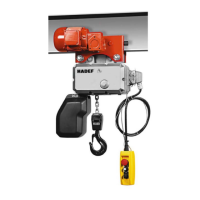
The HADEF Electric Chain Hoist 62/05 is a robust lifting device. Its primary function is to lift and lower loads vertically. Depending on the configuration, it can be equipped with a suspension eye or hook for stationary use, or with a monorail push travel trolley, a monorail hand geared trolley, or a monorail electric trolley for horizontal movement. The lifting and motor-driven trolley movements are controlled via buttons on a control switch. A spring-pressure brake is installed in the electric motor, which prevents the load from lowering when the push button is released. For models with a frequency converter, the speed is infinitely variable. Hand-geared trolleys are moved by pulling one of the two strands of the endless hand chain, while push travel trolleys are moved by pushing or pulling the load or the load chain.
The hoist is designed for operation within a specific ambient temperature range. For manually driven hoists, this is -20°C to +50°C in non-explosive atmospheres and -20°C to +40°C in explosive atmospheres (ATEX certified models). For motor-driven hoists, the range is -20°C to +40°C for both non-explosive and ATEX environments. ATEX certified devices are specially modified and labeled for use in atmospheric pressure ranges from 0.8 bar to 1.1 bar and an oxygen content of approximately 21%. The hoist features a standard 3-phase current motor and a precision spur gear. All gears are fitted with a vent screw. Overload protection is a key safety feature, preventing the hoist from being loaded beyond its capacity. This is achieved through a slipping clutch that activates when the lifting load is too heavy, preventing further lifting. The slipping clutch is designed to have an emergency final limit when the load is at the highest and lowest position. The load chain is typically a highly forged steel chain with a ball bearing. The chain container, if present, is made of unbreakable plastic, plastic-coated fabric, or sheet steel. Different sizes of chain containers are available. The electrical controls are configured for direct current (DC) operation, with a remote control option available. A phase sequence and phase failure monitoring relay is integrated into all devices with low voltage control to prevent damage from incorrect phase sequencing or failure.
The hoist is intended for the appropriate use of vertical lifting and lowering of unguided loads up to the maximum rated load. It is crucial not to exceed the permitted safe working load, except during a load test before initial operation, which must be carried out by a licensed qualified person. The equipment is exclusively for moving goods and must never be used to transport persons. Basic safety measures include observing installation, operation, and maintenance instructions, maintaining safety distances, and ensuring a clear view of the load. The hoist should never be loaded beyond its working load limit. National regulations and accident prevention regulations (UVV) must be followed. Supporting structures and load-attached devices must provide an adequate safety factor. If the equipment has been out of use for a period, a visual check of all main components (chains, load hooks) is required, and any damaged parts must be replaced with new, original spare parts. Defective hoists, or those making abnormal noises, must not be used. Any disturbances or failures must be reported to a supervisor immediately. The lifting tackle or load must be securely attached to the hook, with the safety catch closed. The load chain must not be twisted, and twisted chains must be aligned before attaching a load. The chain links must always be aligned in one direction, identifiable by the weld seams. Bouncing the load or hook against objects is prohibited. Daily brake checks are mandatory. The devices are not suitable for continuous operation; duty cycles of the motors and remaining life time according to FEM group and usage must be observed. Prohibited actions include lifting loads exceeding the nominal safe working load, manipulating the sliding clutch, using elongated or damaged chains/wire ropes, looping the load chain around a load or pulling it over edges, and repairing damaged load hooks.
Regular maintenance is crucial for safe and efficient operation. This includes periodic checks and inspections. The manual provides a detailed table of inspection intervals for various components, including load chain, pulleys, load hook, hoist gear, trolley, and electric motor. Load Chain: Lubrication with special chain lubricant (FUCHS RENOLIN PG 220) is recommended every 3 months. The chain must be aligned and oiled before commissioning. It's important to move the safety note and fixing wire away from the chain. Continuous, thorough lubrication increases the life of the chain considerably. Pulleys: Clean and lubricate the bearings of hooks and pulleys with grease. If bearings are worn, they should be changed. Lubrication with FUCHS RENOLIN PG220 is recommended, with intervals according to demand, typically every 12 months. Load Hook: Check bearings and pulleys yearly. Clean and lubricate the bearings of hooks and pulleys with grease. If bearings are worn, they should be changed. Lubrication with FUCHS RENOLIN PG220 is recommended, with intervals according to demand, typically every 12 months. Hoist Gear: Low maintenance. Oil and grease life of the gear and ball bearings are designed for the first safe operating period (S.W.P.) of the chain hoist. Shorter maintenance intervals are necessary for difficult operating conditions or increased dust and pollution. Lubricant: synthetic, viscosity VG 220. FUCHS RENOLIN PG 220 is recommended, with an exchange interval of every 3 years. Trolley: Trolleys are lifetime lubricated. Refill lubricant is normally not necessary. Lubricate gear rim and pinion drive each ½ year or if required more often, with grease. FUCHS RENOLIT FEP2 is recommended for gear rim and drive pinion every 3 months. SHELL Tivela S320 is recommended for traveling gear, with lifetime lubrication. Electric Motor: It is sufficient to keep the cooling airways clean and monitor the roller bearing and its lubrication status. A high temperature fat must be used if the roller bearing is replaced. Brake linings and surfaces must always be clean and fat-free. Brake Motor: The brake is 85 V DC. Air gap and disc complete new must be checked. The air gap needs to be adjusted by loosening the screws on the magnetic body and moving the magnetic body towards the anchor plate using a feeler gauge. Overload Protection: The factory setting of the overload protection is secured by a seal. Any guarantee becomes invalid if this setting is changed. Maintenance should be performed by a service company. The overload protection serves exclusively to protect against damage due to overloading. Periodic Checks: Independent from the regulations of individual countries, lifting devices must be checked at least yearly by a qualified person or licensed qualified person regarding its functional safety. Replacing the Load Chain: New chains must be installed in an unloaded state. Remove chain from its fastening at the end and attach a chain link which is open at the side. A chain link which is open at the side, can easily be produced by grinding out a small piece. The opening must have the same thickness as the chain link. Hang a new original chain (same size and oiled) in the side opened chain link and insert it. Always run chains into the chain container by using the motor. Never run the chain in by hand, as there is a risk of knotting which can cause malfunctions and damage to the device. Decommissioning: It is essential that the following points are observed to prevent damage or injury during decommissioning: secure the working area, read the "Safety Instructions" chapter, disassemble in reverse order, and ensure all operating material is disposed of in accordance with environmental regulations.
 General
| Brand | HADEF |
|---|---|
| Model | 62/05 S |
| Category | Chain Hoists |
| Language | English |

 To Next Page