Need help?
Do you have a question about the Haier 1U125S2SN2FB and is the answer not in the manual?
Details specific precautions for handling R32 refrigerant, emphasizing cleanliness and dryness.
Details the procedures for performing both vacuum leak tests and pressure leak tests.
Explains the step-by-step process for vacuum drying the system to remove moisture.
Covers precautions and guidelines for opening the refrigerant system, leak testing, and charging.
Provides instructions for complete recharging, including vacuum drying and determining the necessary amount of refrigerant.
Lists crucial precautions for electrical wiring, emphasizing authorized electricians and circuit breakers.
Outlines essential checks to perform before the initial test run, covering wiring, grounding, and refrigerant piping.
Provides specific precautions to follow during the first test run of the unit.
Lists common malfunctions, their diagnosis, and analysis for the outdoor unit.
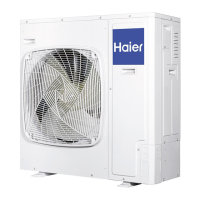
This document is an installation manual for Haier split system air conditioners, specifically covering models 1U105S2SS1FA, 1U105S2SS1FB, 1U125S2SN1FA, 1U125S2SN1FB, 1U125S2SN2FA, 1U125S2SN2FB, 1U140S2SN1FA, 1U140S2SN1FB, 1U140S2SP1FA, 1U140S2SP1FB, 1U140S2SP2FA, 1U140S2SP2FB, and 1U160S2SP1FB. The manual provides comprehensive instructions for the safe and correct installation, maintenance, and eventual disposal of these R32 refrigerant-filled units.
The Haier split system air conditioner is designed to provide cooling and heating for indoor spaces. It operates by circulating refrigerant between an indoor unit and an outdoor unit. The outdoor unit contains the compressor, heat exchanger, and fan, while the indoor unit typically houses another heat exchanger and fan to distribute conditioned air. The system is designed for efficient operation, with specific considerations for refrigerant handling and electrical connections to ensure optimal performance. The use of R32 refrigerant, a fluorinated greenhouse gas, necessitates strict adherence to environmental regulations regarding its containment and disposal. The units are designed to operate within specified pressure ranges, requiring appropriate piping materials and installation techniques to maintain system integrity and prevent leaks.
The air conditioner is intended for use by expert or trained users in various settings, including shops, light industry, farms, or for commercial use by lay persons. It is not designed to be operated by external timers or separate remote-control systems, emphasizing direct user interaction or integrated control. The system includes safety features such as protection against overcurrent, high/low voltage, and abnormal temperatures, which are monitored by the control board and compressor driver module. In case of malfunctions, the outdoor unit's LED3 can indicate specific error codes, aiding in troubleshooting. The system is designed to perform a test run in cooling mode after installation to detect any issues with stop valves or other components. For optimal performance, the manual outlines specific installation site requirements, including ventilation, distance from other objects, and protection from strong winds or heavy snowfall, to ensure efficient air circulation and prevent operational disruptions.
Maintenance of the Haier split system air conditioner requires qualified personnel due to the complexity of the refrigerant system and electrical components. The manual emphasizes the importance of wearing adequate personal protective equipment during installation and servicing. Key maintenance procedures include leak testing and vacuum drying of the refrigerant piping to remove moisture and ensure system tightness. If the refrigerant system needs to be opened, treatment and evacuation of the refrigerant must be done in accordance with applicable legislation. Refrigerant charging, if required, must be performed in the liquid state to maintain the correct composition of the mixed R32 refrigerant. The manual provides detailed instructions for checking insulation resistance, tightening flare nuts to specified torques, and ensuring proper electrical wiring connections. It also highlights the importance of regular checks for refrigerant leaks and ensuring that service ports are handled correctly. For relocation or scrapping, the manual advises contacting the dealer for technical support and ensuring that refrigerant is recycled by qualified enterprises, adhering to environmental regulations. The system's design includes components that can be isolated for servicing, with additional service ports for vacuuming, pressure relief, or pressurizing the circuit.
 General
| Energy Efficiency Ratio (EER) | 3.21 |
|---|---|
| Refrigerant | R32 |
| Compressor Type | Rotary |
| Power Supply | 220-240V/50Hz/1Ph |
| Operating Temperature (Cooling) | 18-43 °C |
| Type | Split |
| Cooling Capacity | 12500 BTU/h |


 To Next Page