Need help?
Do you have a question about the Haier DW-40W255J and is the answer not in the manual?
Explains various safety symbols, warnings, and cautions related to appliance use and potential hazards.
Provides critical safety instructions for handling, disposal, and operation, including warnings about hazardous materials and electrical safety.
Provides critical safety instructions for handling, disposal, and operation, including warnings about hazardous materials and electrical safety.
Provides warnings and cautions for safe operation, including risks of death, injury, or property damage.
Details the required ambient conditions, such as temperature, humidity, dust, vibration, altitude, and input voltage for optimal installation.
Specifies requirements for the installation location, including space, ground, ventilation, sunlight, power socket, and earthing.
Troubleshooting steps for when the freezer fails to operate, covering power connection and supply voltage.
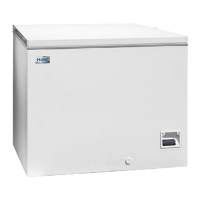
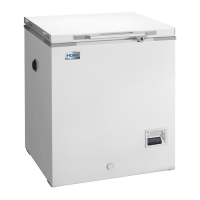
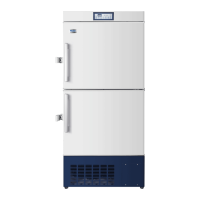
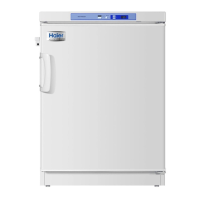
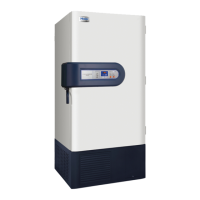
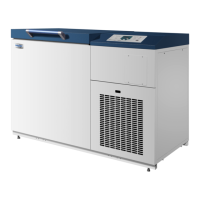
This document serves as an Operation Manual for Haier Deep Freezers, providing essential information for safe and effective use, maintenance, and troubleshooting. The deep freezers are designed for storing high-level ingredients and other goods requiring low-temperature preservation, catering to professional sea fishing enthusiasts, major fishing wholesalers, and specialty food retailers.
The Haier Deep Freezer is a specialized appliance designed for maintaining extremely low temperatures, ranging from -30°C to -60°C for models DW-60W138/258/388, and -20°C to -40°C for models DW-40W100J/255J/380J. This capability allows for the instantaneous quick-freezing and firm locking of original fresh nutrition in stored items. The core of its functionality lies in a subversive innovative cold deep freezing system, which breaks through the limitations of traditional household refrigerators.
The freezer utilizes a computer-based control system that digitally displays the temperature with an accuracy of 0.1°C, ensuring precise temperature management. It incorporates HC hydrocarbon refrigeration technology, which contributes to energy efficiency, saving up to half the power compared to conventional systems.
A robust safety system is integrated into the deep freezer, featuring multiple fault alarms, including overtemperature and sensor fault alarms. These alarms operate in two modes: a sound buzzer and an alarm lamp flickering, providing clear indications of potential issues. Furthermore, all independent parts of the freezer are equipped with safe earthing to prevent electrical hazards.
The deep freezer is designed to retain its operation parameters during power outages. Upon power recovery, it will automatically resume operation based on the previously saved settings, minimizing the risk of spoilage due to temporary power interruptions.
The Haier Deep Freezer is engineered with user-friendly design principles to ensure intelligence without anxiety and adjustment-free operation.
Temperature Control and Display: The electronic digital display thermostat, located on the control panel, shows the actual temperature inside the cabinet after power-on. Users can check the setting temperature by pressing the designated key for more than one second. The thermostat also allows for manual adjustment of control parameters, enabling users to set a new temperature and save it. Generally, it is not necessary to adjust the setting temperature during normal use. However, if adjustments are made, users should be aware that it might trigger high or low-temperature alarms, which can then be adjusted within a range of ±5°C of the setting temperature.
Storage and Withdrawal of Articles: When storing articles, users must first confirm that the article's required storage temperature aligns with the freezer's setting temperature and that the internal temperature of the freezer has already reached the desired setting. Articles should be placed in batches, with the volume of articles put in each time not exceeding 1/3 of the freezer's total volume, to prevent overloading the refrigerating system. To minimize energy consumption and maintain stable internal temperatures, the door closing time should be minimized during both storage and withdrawal. For articles with strict temperature requirements, it is recommended to place them in lower drawers, as the temperature in the topside drawer may be relatively higher.
Test Hole Functionality: The freezer includes a test hole designed for two primary purposes:
Installation Guidelines: For optimal performance, the freezer should be installed in an environment with an ambient temperature between 10°C and 32°C (optimal 18°C to 25°C), and humidity below 85% Rh. It should be kept away from large quantities of dust, mechanical sway, or vibration. The working altitude should not exceed 2000m. The input voltage must be within 220V±10%. It is crucial to avoid installing the freezer in narrow, small, or airtight spaces, and to ensure adequate ventilation. The ground at the installation site must be solid and flat. The power cord should not be distorted or stressed, and the freezer should not share a socket with other equipment. If an extension cord is necessary, its cross-section area should be at least 3mm², and its length should not exceed 3m. The freezer must have reliable earthing, and the power plug should always be accessible for emergency disconnection. After placement, the unit should stand for 24 hours before powering up.
Regular maintenance is crucial for ensuring the longevity and optimal performance of the Haier Deep Freezer.
Cleaning: The freezer should be cleaned once a month to maintain its appearance. Dust on the shell, chamber, and accessories can be wiped with a dry cloth. For heavier dirt, a clean cloth dipped in neutral detergent can be used, followed by a wet cloth to remove residues, and then dried. It is important not to pour water directly onto the shell or into the chamber to prevent damage to electrical insulation. The mechanical compressors are hermetically sealed and do not require lubrication.
Defrosting and De-icing: Over time, frost will accumulate on the inner wall, which can reduce refrigerating efficiency and increase energy consumption. When the frost thickness reaches approximately 5mm, defrosting should be carried out using the attached defrosting shovel. The process involves:
Disposal of Freezer: If the freezer is left unused for an extended period in an unattended area, precautions must be taken to ensure children cannot access it and the door is not completely closed. When disposing of a discarded freezer, it must be handled by relevant personnel. The door should be dismantled to prevent accidents such as suffocation. Electrical appliances should not be disposed of as unsorted municipal waste; separate collection facilities should be used.
Troubleshooting and Alarms: The manual provides a troubleshooting guide for common issues such as the freezer not working, poor cooling, or high noise. Users are advised to check power connections, supply voltage, temperature settings, door closure, ambient temperature, and placement. The freezer's alarm system provides critical alerts:
Safety Precautions: The manual emphasizes numerous safety precautions, including:
 General
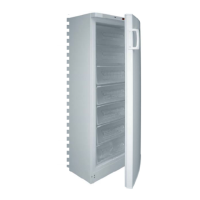
| Type | Upright Freezer |
|---|---|
| Temperature Range | -18°C to -24°C |
| Refrigerant | R600a |
| Defrosting | Manual |
| Power Supply | 220-240V/50Hz |
| Energy Rating | A+ |
| Noise Level | 42 dB |
| Capacity | 255L |


 To Next Page