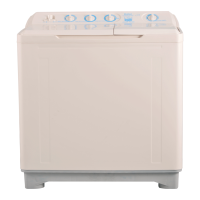
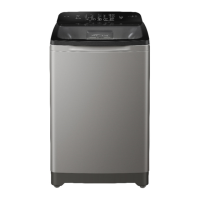
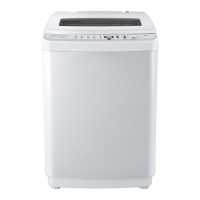
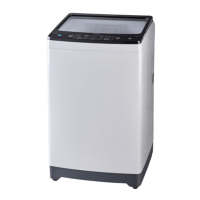
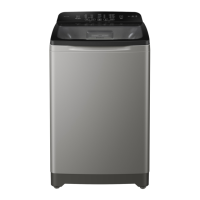
This document describes the Haier Top Load Fully Automatic Washing Machine, models HWM120-B1678S8 and HWM140-B1678S8, providing a user manual for its operation, installation, and maintenance.
Function Description
The Haier Top Load Fully Automatic Washing Machine is designed for washing various types of laundry with ease and efficiency. It features a fully automatic operation, meaning it can handle the entire washing process from filling water to spinning dry, with minimal user intervention once a program is selected. The machine is equipped with a pulsator for effective cleaning and an inner tub where the laundry is placed. It includes a detergent drawer for both liquid and powder detergents, as well as a softener compartment, ensuring proper dispensing during the wash cycles.
The control panel, located at the top of the machine, allows users to select from a variety of washing programs tailored to different fabric types and soil levels. These programs include:
- Cotton: For lightly soiled, dark, or highly dyed natural fabrics.
- Eco: For small, lightly soiled loads with lower energy and water consumption.
- Express: For small, lightly soiled loads that need quick washing.
- Sports: For sports garments like shorts and polo shirts, at maximum capacity.
- Wool: Specifically for woolen laundries.
- Heavy: For durable fabric materials like workwear, at maximum capacity.
- Soft Wash: For fabric materials like T-shirts, at maximum capacity.
- Delicate: For lightly soiled garments and delicate clothes requiring gentle washing.
- Blanket: For large items such as comforters and blankets.
- Towels: For durable fabric materials like towels, at maximum capacity.
- Baby Care: For baby clothes, gently washed at maximum capacity.
- Tub Clean: A self-cleaning cycle for the inner and outer tub to prevent mildew.
The machine also offers several functions and customizable options, such as water level adjustment, soak time, rinse count, spin time, and a delay wash function.
Usage Features
Installation and Setup:
Before operation, the machine requires proper installation. This includes installing a bottom plate to reduce noise, balancing the machine on a level floor using adjustable feet, and correctly positioning the drain hose to prevent blockages or trampling. The water inlet hose must be securely connected to a suitable water tap, ensuring no leaks. The manual provides detailed steps for connecting the water inlet hose jointer to both the water tap and the washer, including instructions for removing the bushing if the tap is too large.
Before Washing:
Users are advised to prepare laundry by clearing pockets, tying straps, buttoning up, and closing zippers. The laundry weight should not exceed the machine's rated capacity, and clothes should be spread out evenly in the tub. For delicate items or to prevent excessive vibration, turning clothes inside out or using a laundry net is recommended. Sorting clothes by color and checking care labels are also important. The manual warns against washing water-proof clothing, as this can affect load balance during spin cycles, and against washing laundry contaminated with flammable or explosive substances.
Loading and Detergent:
The washing capacity is based on the maximum dry weight of laundry, but fabric thickness, size, and type can influence the actual capacity. For loads less than 2.0kg, the "Low" water level is suggested. The use of low suds/high-efficiency washing powder designed for automatic washing machines is recommended. Detergents (liquid or powder) and softeners are added to designated compartments in the drawer. For washing powder, it's suggested to add it directly to the drawer or dissolve it in water first, especially for quick-dissolving types. For liquid detergent, it's poured directly into its compartment. Softener is added to its compartment and dispensed during the rinse cycle. Flushing the detergent drawer with water after each use helps prevent residue buildup.
Operation:
To start, the user presses the "Power" button to switch the machine on. Then, the "Program" knob is turned to select the desired washing program. "Cotton" is the default program. For programs like "Cotton" or "Eco," Fuzzy Logic automatically detects the laundry load and sets a suitable water level. The water level, soak time, rinse count, and spin time can be adjusted based on fabric type and load size. The "Progress" button allows selection of different washing cycles within certain programs. The "Delay" function enables users to set a completion time for the wash cycle between 2 and 24 hours. After selecting the program and desired options, the "Start/Pause" button initiates the wash cycle. During operation, the "Start/Pause" button can also be used to pause and resume the machine. An acoustic signal indicates the end of the wash cycle, and the machine automatically switches off.
Safety Warnings:
The manual emphasizes several safety precautions:
- Ensure the power socket is correctly earthed.
- Do not touch the power plug with wet hands.
- Always hold the plug, not the cable, when unplugging.
- The power plug must be accessible after installation.
- Do not install the appliance in damp environments or spray water directly on the control panel.
- Avoid using multi-plug adapters or extension cables.
- Do not wash with water exceeding 50°C.
- Do not attempt to put hands into the machine during operation.
- Keep children supervised to prevent them from playing with the appliance.
- Do not place hot or heavy items on the lid or control panel.
- Do not attempt to repair, disassemble, or modify the appliance.
- Avoid washing laundry with chemicals or volatile materials like petrol or thinners.
- Keep the washer away from heat sources and direct sunlight.
- The ventilation opening in the base must not be obstructed.
- Do not open the lid when the tub is filling with water.
- Always use the new water inlet hose provided.
- Remove solid objects from clothing before washing.
- Ensure the water tap is open and pipes are connected correctly before operation.
- If the power cord or other parts are damaged, contact a technician for repair.
Maintenance Features
Cleaning and General Maintenance:
To ensure longevity and optimal performance, regular maintenance is crucial. Before any cleaning or maintenance, the machine must be unplugged to avoid electric shock.
Detergent Drawer:
The detergent drawer should be cleaned after each wash. To do this, slightly lift and pull out the drawer, rinse it with water, and brush it clean. Then, reinsert it into its original position.
Lint Filter:
The lint filter must be used during washing and cleaned after each use. To clean, press down the upper area of the filter case to remove it, unlock the front cover, and clean the filter with running water and a brush. After cleaning, reassemble the filter and reinsert it into the filter case, ensuring it fits completely to maintain washing performance.
Water Inlet Valve Filter:
To prevent blockages from dirt and dust, the filter at the water inlet valve should be cleaned by brushing it every two months.
Machine Case:
If the washing machine case is dirty, it should be wiped with a damp cloth. Direct washing with water is not recommended. A soft cloth with soap liquid can be used for cleaning. Harsh solvents, petrol, alcohol, or thinners should not be used to wipe the machine.
Post-Wash Care:
After a washing cycle, the water tap should be turned off (and the water inlet hose removed if desired). Water should not be stored in the tub for long periods without completing a wash cycle; the water should be drained completely. The power cord and drain hose should be hung properly. Water droplets on the machine case should be wiped off with a soft cloth, and the lid left open for an hour to prevent moisture and odors.
Troubleshooting:
The manual includes a troubleshooting guide for common problems, their possible causes, and recommended solutions. This helps users diagnose and resolve minor issues before contacting customer service. Examples include:
- Machine not draining (E1): Check for a blocked drain hose.
- Machine stops running (E2): Ensure the top lid is closed.
- Machine not spinning (E3): Check for uneven laundry load or if the machine is level.
- Water supply issues (E4): Check if the water tap is closed, if the supply is interrupted, if the inlet valve is blocked, or if water pressure is too low.
- Water level sensor failure (FA): Contact customer care.
- Machine not working (power/plug issues): Check power supply, plug insertion, or if the top lid is closed.
- Abnormal sounds: Check for uneven load or foreign objects in the bowl.
- Water tap leakage: Fasten the inlet hose.
- Door lock broken (E8): Contact customer care.
- Communication failure (E9, FC): Contact customer care.
- Water reached critical level (F2): Contact customer care.
The manual advises against attempting to fix the machine oneself if a repair is needed, and to contact a technician. It also explains common occurrences like stopping before spinning (due to uneven load), spin program not working (water drains first), water in the drain hose when unpacked (residue from factory inspection), and operation stopping mid-cycle (machine detected low water level and will add water). The machine is designed to resume operation after power supply is restored if the power plug is properly inserted.



 To Next Page
 General