This document is a user manual for Haier automatic drum washing machines, specifically models HWM60-10866 and HWM70-10866. It provides comprehensive instructions for installation, operation, maintenance, and troubleshooting.
Function Description:
The Haier automatic drum washing machine is designed for domestic use to wash machine-washable garments. It features various wash programs tailored for different fabric types and soil levels, including options for prewash, cotton, synthetics, wool, underwear, sport, quick wash, and rinse/spin cycles. The machine automates the washing process, from water intake and detergent distribution to spinning and draining, aiming for efficient and effective laundry care. It incorporates features to optimize water and energy consumption, and safety mechanisms to ensure reliable operation.
Important Technical Specifications:
The manual provides a "Consumption and Technical Data" table (page 11) detailing key specifications for both models:
- Power Source: 220-240V~/50Hz for both HWM60-10866 and HWM70-10866.
- Max. Working Current: 10A for both models.
- Water Pressure: 0.03≤P ≤1 MPa for both models.
- Nominal Load (kg): 6 kg for HWM60-10866 and 7 kg for HWM70-10866, indicating their respective capacities.
- Spinning Speed (r/min): 1000 rpm for both models, with some programs having lower preset speeds (e.g., 600 rpm for wool).
- Washing Programs: 10 programs available for both models.
- Max Power (W): 2000W for both models.
- Dimensions (HxDxW mm): 840×510×595 mm for both models.
- Net Weight (kg): 65 kg for both models.
The "Consumption Table" (page 11) also lists typical washing times for various programs at a 40°C temperature, such as:
- Prewash: 1:46h
- Cotton: 1:28h
- Synthetic: 1:10h
- Wool: 1:00h (at 30°C)
- Underwear: 1:51h (at 60°C)
- Sport: 0:25h (at 30°C)
- Quick: 0:15h (at 30°C)
- Wash: 0:40h (at 30°C)
Usage Features:
The washing machine offers a user-friendly interface with a control panel (page 8) comprising a power switch, program knob, start/pause button, load selection, intense wash option, extra rinse option, delay button, detergent distribution drawer, washing temperature button, spinning speed setting button, and a display.
- Program Selection: Users can select from 10 predefined programs by turning the program knob. The "Program Modes" table (page 10) details recommended laundry types, maximum and preset temperatures, and preset spin speeds for each program.
- Temperature Control: The washing temperature can be adjusted using the temperature button, allowing users to select a suitable temperature for their laundry or choose no water heating.
- Spin Speed Control: The spinning speed can be adjusted using the spin speed button, with options for various speeds or no spin.
- Load Adjustment: The "Load" button allows manual selection of different programs and power/water-saving features based on the laundry volume (L-1 to L-R, indicating 1 to 6 kg loads).
- Intense Wash: This function increases washing time and rinsing times in the main wash stage for heavily soiled items.
- Extra Rinse: Activates additional rinse operations, with up to three extra rinses (P-1 to P-3).
- Delay Start: The "Delay" button allows users to set a delayed start time for the wash cycle, ranging from 0.5 to 24 hours.
- Detergent Distribution Drawer: Features three compartments for prewash detergent, main wash detergent, and softener/additives (page 9).
- Safety Lock: A combination of the "Start/Pause" and "Delay" buttons can lock all function keys except the power switch, preventing accidental changes during operation.
- Power-off Memory Function: In case of power interruption, the machine saves current settings and resumes operation when power is restored.
- Error Display Codes: The display shows specific codes (Err1 to Err10) to indicate various issues, such as door not shut, drainage error, temperature sensor problems, heater error, water level issues, or motor errors, along with suggested solutions (page 18).
Maintenance Features:
The manual provides detailed instructions for maintaining the washing machine to ensure longevity and optimal performance.
- Cleaning the Detergent Drawer: Regular cleaning of the detergent distribution drawer is recommended by flushing it with water (page 16).
- Cleaning the Machine: The machine case and rubber components should be cleaned with a soft cloth dampened with soap liquid. Organic chemicals or corrosive solvents should be avoided (page 16).
- Cleaning the Filter: The filter should be cleaned monthly. This involves removing the bottom cover, draining excess water via the drain hose, unscrewing the filter counter-clockwise, flushing it with running water, and then reassembling it (page 16). Users are warned to place a container under the filter to collect water and ensure the filter is properly in place to prevent leakage.
- Water Inlet Valve and Inlet Valve Filter: Regular cleaning of these components is advised to prevent blockages from foreign substances (page 17).
- Long Periods of Disuse: If the machine is to be idle for an extended period, users should unplug it, turn off the water supply, and leave the washer door open to prevent moisture and odor buildup (page 17).
- Moving the Machine: Before moving the machine, the transportation bolts (removed during initial installation) should be reinstalled to prevent damage (page 17).
- Troubleshooting Guide: A comprehensive troubleshooting table (page 19) lists common problems, their causes, and corresponding solutions, empowering users to resolve minor issues independently before contacting service.
Safety Instructions:
The manual emphasizes several safety instructions (page 5) to be followed strictly:
- Ensure transport bolts are removed before first use.
- Use a separate earthed socket for power supply.
- Do not touch or use the appliance with wet hands or feet.
- Avoid using flammable detergents or dry cleaning agents.
- Do not allow children or infirm persons to play with the appliance.
- Ensure proper installation, including secure hose connections and correct drainage height (80-100 cm).
- Do not overload the machine.
- Turn off the machine and unplug it after each use.
- Keep the washer door slightly open when not in use to prevent odors.
- Do not force the washer door open; it has a self-lock device.
- Supervise children to ensure they do not play with the appliance.
The manual also includes a "Care Chart" (page 15) with international laundry symbols to guide users on proper garment care, and a "Load Reference" table (page 15) providing approximate weights for common laundry items to help users avoid overloading.

 Need help?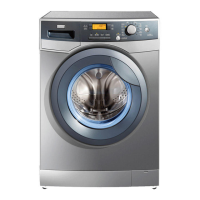

 To Next Page
 General