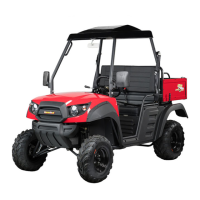
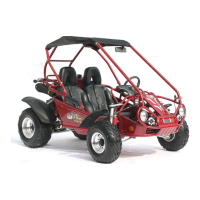
This document is an Owner's Manual and Parts Manual for the UM250 IIR go-kart, manufactured by Hammerhead. It provides comprehensive information regarding the go-kart's operation, maintenance, and a detailed list of its parts.
Function Description:
The UM250 IIR is an off-road go-kart designed for recreational use. It is intended for driving on unpaved surfaces and is not street legal. The go-kart is designed for two people, with a combined maximum weight capacity of 200kg or 440lbs for the driver and passenger. It features a 250cc, water-cooled, 4-stroke engine, providing sufficient power for off-road adventures. The go-kart is equipped with a hydraulic disc brake system for effective stopping and a full independent rear suspension for improved handling and comfort on varied terrain. Safety features include a dual 4-point harness restraint system and a steering wheel lock.
Important Technical Specifications:
- Dimensions:
- Overall Length: 87 in. (2210mm)
- Overall Width: 53.5 in. (1346mm)
- Overall Height: 56.6 in. (1438mm)
- Wheelbase: 66.1 in. (1680mm)
- Front Track: 42.7 in. (1085mm)
- Rear Track: 42.7 in. (1085mm)
- Ground Clearance: 8.5 in. (215mm)
- Engine:
- Type: Water cooled, 4-Stroke
- Engine capacity: 250cc
- Bore x Stroke: 70mm x 60mm
- Displacement: 244ml
- Compressed correction ratio: 10:1
- Carburetor: VEKS4 & CV30
- Output Power: 10.5kw/7000rpm
- Maximum Torque: 17.6N.m/5500rpm
- Starting: Electric
- Ignition: C.D.I.
- Lubrication: Force & Splash
- Transmission: Automatic (C.V.T system)
- Spark Plug: DPR8EA-9(NGK)
- Plug Gap: 0.6-0.7mm
- Fuel Type: RQ90 (unleaded)
- Lubricate oil: SAE 15W-40/SF
- Drive Components:
- Gear box oil: MOS2 & W-2DW-4D
- Capacities:
- Maximum load: Double Seats/400lbs
- Fuel tank: 2.25 Gal
- Engine oil: 30 Oz
- Starting: <3s
- Climbing: -20° - 25°
- Battery: 12V 10Ah
- Head Light: 12V 35W/35W
- Tail Light: 12V 21W/5W
- Fuse: 10A
- Chassis:
- Front, Rear brake: Hydraulic disc, left foot control
- Front tire: 20 x 7-8
- Rear tire: 22 x 10 -10
- Front Suspension: Independent Dual A-Arm
- Rear Suspension: Full Independent Rear Suspension/Oil Damped Shocks
- Restraint System: Dual 4-point Harness
- Final Drive: CV-Shafts
- Tire Pressure:
- Front: 150kPa 1.5kg/cm² 21.3psi
- Rear: 200kPa 2.0kg/cm² 28.4psi
- Weight:
- Net Weight: 280 kg
- Gross Weight: 326 kg
Usage Features:
The go-kart is operated via a right foot pedal for throttle and a left foot pedal for braking. It features an ignition start switch, an engine stop button, and a horn switch. The manual emphasizes the importance of familiarizing oneself with the controls and practicing in a safe, open area before driving on rough terrain. It also highlights the need for appropriate safety gear, including a D.O.T. approved motorcycle helmet, eye protection, sturdy boots, gloves, and protective clothing. The go-kart is not to be operated by individuals under 16 years of age. It is strictly for off-road use only and should never be driven on public roads. Operating the kart at night or under the influence of alcohol or drugs is strongly prohibited due to impaired visibility and judgment. The manual also warns against stunts like wheelies and jumps, and advises against operating the kart in excessively rough, slippery, or loose terrain.
Maintenance Features:
The manual outlines a comprehensive maintenance schedule and repair instructions to ensure the longevity and safe operation of the go-kart.
- Pre-Drive Inspection: A thorough inspection before each drive is crucial. This includes checking the engine oil level, fuel level, brakes, tire pressure, throttle cable, engine stop button, nuts, bolts, fasteners, lights, steering, cables, underbody, exhaust system, air cleaner housing, radiator, and coolant level. Any problems found must be corrected before driving.
- Service Intervals: A periodical check and services table provides recommended intervals for various maintenance tasks, including tire pressure/wear, brake performance, tightness of screws, air cleaner, carburetor, spark plug, coolant, brake oil, gearbox oil, fuel switch/fuel tank, battery, and valve clearance of engine.
- Air Cleaner Service: The air cleaner should be serviced every 20 hours. This involves removing the cover, cleaning the element with a non-flammable cleaning agent, drying it, and checking for cracks or holes. The filter should be replaced if damaged.
- Engine Lubrication: The engine oil in the crankcase should be changed after the first 5 hours of operation and every 10 hours thereafter. This involves draining the old oil, cleaning the oil filter, replacing the drain plug, refilling with SAE 10W40 oil, and checking the oil level. Used oil must be disposed of at a proper collection center.
- Spark Plug Maintenance: The spark plug should be inspected and cleaned every time the oil is changed. Electrodes should be kept clean and free of carbon. The plug gap should be 0.6-0.7mm. If performance issues arise, the spark plug gap should be checked. Before installing, a thin layer of graphite grease should be applied to the threads.
- Carburetor Adjustment: The factory recommended settings should be used for most applications.
- Cleaning Instructions: The go-kart should be kept clean, wiping off spilled fuel and oil. The engine should be checked for debris that could impede cooling.
- Kart Lubrication: The vehicle should be lubricated every 90 days of use.
- Front and Rear Shock Adjustment: The manual describes how to adjust the tension of the shock springs to accommodate different rider weights.
- Storage Instruction: For periods exceeding 30 days, the fuel tank and carburetor should be drained, the engine cylinder lubricated with oil, and the spark plug re-fitted. Old gasoline should not be stored as it can deteriorate and affect engine performance.
- Wheel Replacement: Instructions are provided for front and rear wheel replacement, emphasizing the need to remove lug nuts and cotter pins carefully.
- Front Wheel Alignment: The front wheels should have a toe-in of 1/8 to 1/4 inch. The manual details how to measure and adjust the toe-in by loosening lock nuts on the tie rods and turning the rods to achieve the desired alignment.

 Need help?
 General

 To Next Page