EN
11
short-circuit batteries and other electrical
devices. Sparks can cause explosions.
• Do not smoke. Do not allow sparks or naked
ames to come near the battery or engine.
Batteries emit explosive gas.
SYMBOLS
Read the operating
instructions.
Safety class II.
Only intended for indoor use.
Approved in accordance with
the relevant directives.
Recycle a discarded product
in accordance with local
regulations.
TECHNICAL DATA
Measuring range cold start current 40 – 1200 A
Measuring range voltage 7 – 15 V
Measuring precision* ± 10%, ± 0.1 V
Battery type
VRLA/GEL, AGM SPIRAL, AGM FLAT, REGULAR,
REGULAR LIQUID
Display LCD
Ambient temperature 0 – 50°C
Test wire 80 cm
* Cold start current (%), voltage (V)
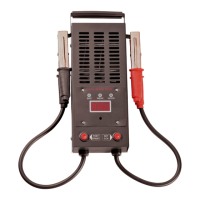
DESCRIPTION
1. Display
2. Button [Enter] to conrm selection.
3. Buttons [+] and [–] for selection and
setting of test parameters.
FIG. 1
SAFETY INSTRUCTIONS
• Working with lead-acid batteries can result
in the risk of personal injury and/or material
damage. Batteries emit explosive gas
during normal use.
• Follow these instructions, the battery
manufacturer’s instructions, and the
instructions for other equipment used in
the vicinity of the battery to reduce the risk
of the battery exploding. Carefully read all
instructions and warnings on the battery
tester, the battery and the product that the
battery will be used for, before using the
battery tester.
• Do not expose the battery tester to rain or
moisture.
• Wear eye protection and protective clothing
when working with lead-acid batteries.
• Ensure that there is always another person
within earshot who can come and help, if
necessary, when working with or near
lead-acid batteries.
• Make sure you have access to plenty of
clean water and soap, in case you get
battery acid on your skin, clothes or in your
eyes. Wash immediately with soap and
water if battery acid comes into contact
with your skin or clothes.
• Avoid touching your eyes when working
with batteries. You can get corrosive acid in
your eyes! If you get battery acid in your
eyes, rinse immediately with cold, running
water for at least 10 minutes. Seek medical
attention immediately.
• Remove all metal objects from your body
(rings, bracelets, necklaces, watch, etc.)
when working with lead-acid batteries. If a
ring or other similar item comes into direct
or indirect electrical contact with the battery
terminals, the lead-acid battery can produce
a short-circuit current that can melt the
metal, which can result in serious burns.
• Do not allow tools or any other metal
object to come into contact with the battery.
Metal objects can cause sparking or


 To Next Page
 Loading...