36
36
If a buffer is not from the last calibration, the buffer tag will be
displayed blinking.
In Standard Mode, Condition and Response gauges are visible on the day of calibration (See
Electrode Condition And Electrode Response Time page 29). If configured in SETUP, a countdown
message displays the number of days remaining until a new Calibration is due.
If using a HI11311 or HI12301 sensor, the glass impedance is
continuously monitored, updated and reported here and the Junction
Condition Gauge is fully visible.
When a pH electrode is connected, the instrument will recognize it
and the “REMOVE PROTECTIVE AND FILLING CAPS” message will be
displayed along with “PH”. Press any key to skip the message. The
instrument will enter measurement mode. Make sure the electrode
has been calibrated before taking measurements.
Rinse the pH sensor with water and a sample if possible. Submerse
the electrode tip approximately 3 cm (1¼”) into the sample to be
tested and stir sample gently. Allow time for the electrode to stabilize.
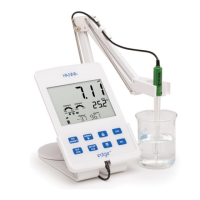
The pH is displayed on the first LCD line and the temperature on the second LCD line. Using the
keys, date, time, battery status and offset with slope can be displayed on the third LCD line.
If the reading is out of measurement range, the closest full scale value will be displayed blinking on
the first LCD line.
If measurements are taken successively in different samples, it is recommended to rinse the electrode
thoroughly with deionized water or tap water and then with some of the next sample to prevent cross‑
contamination. The pH reading is affected by temperature. The temperature effect is compensated
for using the temperature sensor inside the probe. The resulting measurement is the actual pH at the
temperature of measurement.
pH MEASUREMENT
OPERATIONAL GUIDE


 To Next Page
 Loading...