EN
6
3.3. Smoke flue
The draught depends on the difference in density
between the gas in the chimney and the outside
air, as well as the height of the chimney. The hot-
ter the gases in the chimney, the bigger the density
difference between the outside air and the chimney
gases.
Landscape and weather conditions also influence
the draught of the smoke flue. If the building is
located next to high trees or a hill, the chimney
must also be high. It may be difficult to create a
good draught during low pressure due to the small
density difference.
If a stove is replaced with a new one, make sure
that the smoke flue can be used for the new pur-
pose.
If the furnace is altered to use a different fuel (e.g.,
an oil stove is converted into a furnace using solid
fuel), contact a chimneysweep to determine the
suitability and condition of the smoke flue.
Chimney fires, even extinguished ones, must al-
ways be reported to the regional fire brigade control.
3.3.1. Moving the flue connecting piece to the top
or side
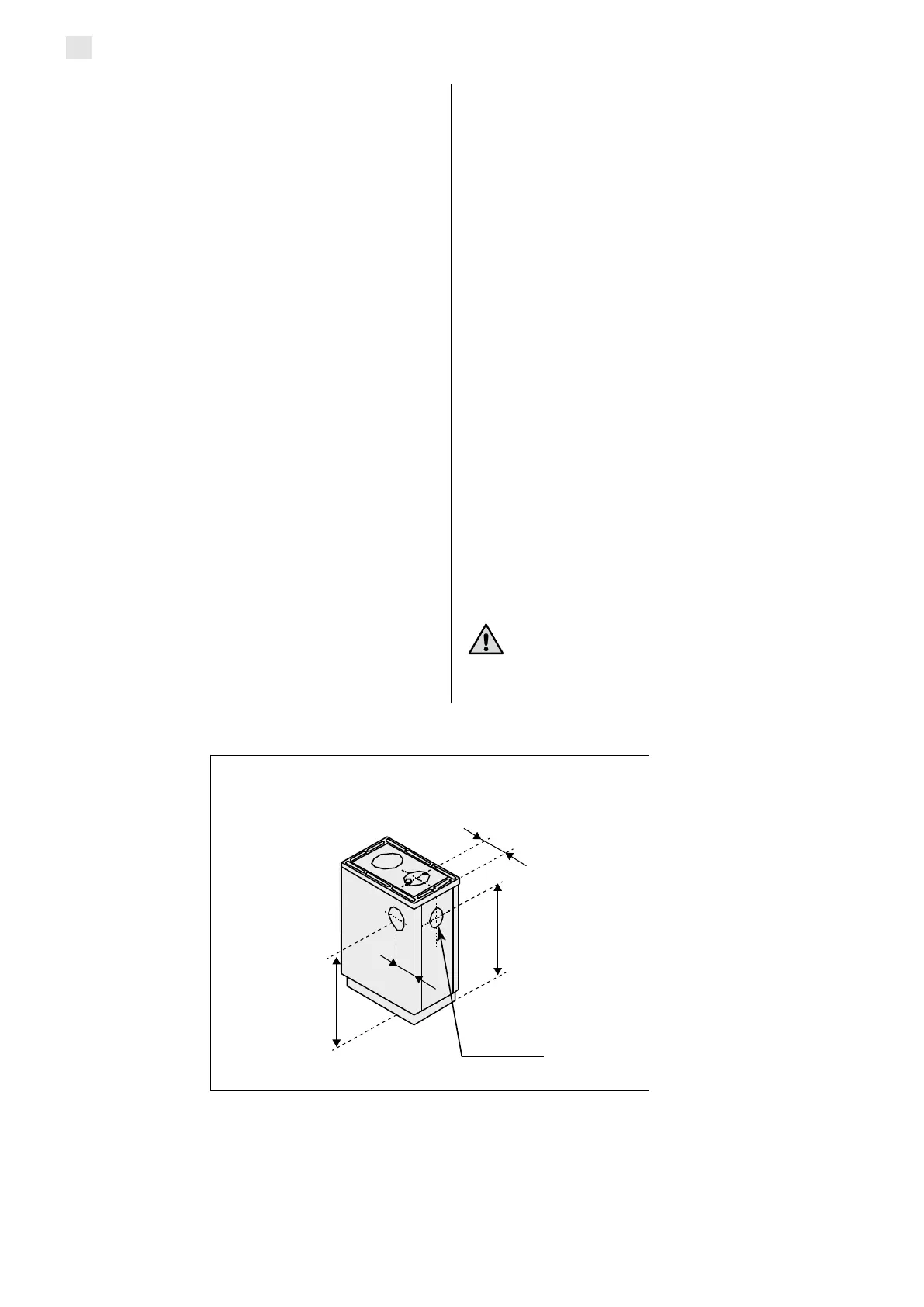
The smoke flue can be connected to the top, back or
sides of Harvia’s iron stoves (figure 2). The stoves
supplied directly from the factory are equipped with
a straight flue pipe and a connection in the back.
If required, exchange the flue connecting piece in
the back of the furnace and the protective cover on
the top or side of it with one another before starting
work on the actual flue connection.
1. Detach the protective cover from the outer
casing by cutting the clamps. This can be done
with, for example, a hacksaw blade.
2. Remove the flue connecting piece located in
the back opening and the screwed-on cover
protecting the flue outlet.
3. Join the flue connecting piece to the opening
located on the top or side of iron stoves.
4. Attach the protective cover to the opening in
the back. Ensure that the flanges fit tightly in
place and that the screws have been properly
tightened.
3.3.2. Connection to a masonry flue
Make a hole for the flue connection in the wall. The
hole should be slightly bigger than the flue connect-
ing pipe. The pipe will later be sealed to the hole in
the wall with, for example, fireproof mineral wool.
A suitable gap around the pipe is ca. 1 cm.
1. First connect the flue connecting pipe to the
connecting piece on the rear of the furnace.
Make sure that the connecting pipe is tightly in
place and tighten, if needed, by hitting the pipe
with a soft hammer. Also ensure the sealing of
the connection.
2. Move the iron stove to the flue outlet and push
it towards the flue.
3. Fill the gap around the pipe with mineral wool
and push the iron stove into place. Leave a
space of approximately 50 mm between the
wall and the back of the furnace.
4. Make sure that the flue connection is tightly
sealed and add more fireproof mineral wool if
necessary.
If the flue connection is not tight, the draught
properties of the furnace will suffer and smoke
may seep into the room.
650
150
650
120
Ø 115
Figure 2. Location of smoke outlet (all dimensions in millimeters)



 To Next Page