3
• at the sides and the back of the stove 500 mm
• in front of the stove 500 mm
• from the top to the ceiling at least 1200 mm
• from stove to the floor: see “Protecting the floor”.
The safety distances to combustible materials may be
decreased, in accordance with regulations, to one-half
when a single light protective cover is used, and to one-
fourth when a double light protective cover is used.
Protecting the walls
If the wooden walls near the stove are closer than what is
required by safety distances and the walls are of combustible
material (panel, board, log, and so on) the wall surfaces must
be protected with, for example, light protective cover.
Single protective cover may be made of non-combustible,
fibre-reinforced concrete plate with thickness of at least 7
mm, or of metal plate with thickness of at least 1 mm. There
should be enough attachment points to make the structure
solid.
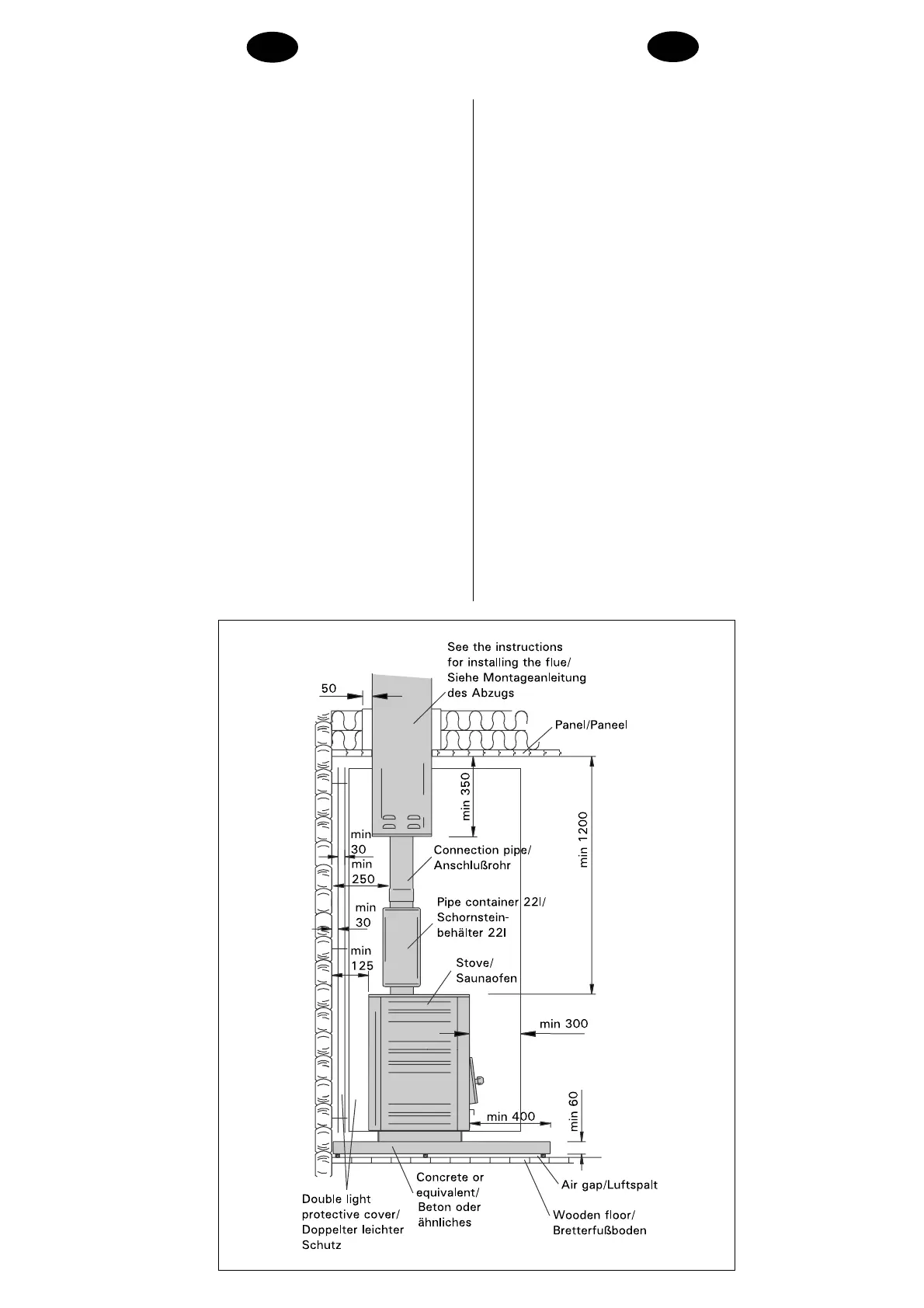
When single protective cover is used, safety distance to the
sides and back of the heater is 250 mm, measured from the
surface of the stove. A gap of about 200 mm should be left
between the stove and the light protective cover.
Double protective cover may be made of the two plates
referred to above. The plates will be attached to the
background and, if necessary, to each other with screws, for
example. An air gap of at least 30 mm should be left between
the surface needing protection and the plate, and the plates,
for example by means of pipe collars used as supports. The
cover should be kept clear of both the floor and the ceiling.
See figure 2.
Single light protective cover is the equivalent of brickwork
whose thickness is at least 55 mm, double light protective
cover is the equivalent of brickwork whose thickness is at
least 110 mm. The
brickwork has to be
open at sides and at
the distance of at
least 30 mm from
the surface to be
protected, extend
600 mm higher
than the top surface
of the stove and,
measured directly
sideways, meet the
requirement of a
safety distance of
500 mm.
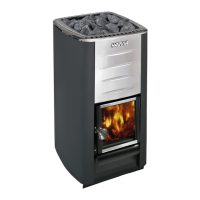
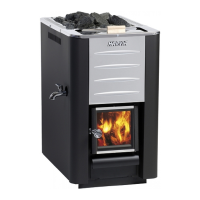
As shown in
Figure 3, the
protective sheath of
Harvia heating
chamber provides
an easy solution to
protecting
combustible wall
materials from the
heat of the stove.
Note! Duct
insulation should
begin from the top
surface of the
protective sheath!
• nach den Seiten des Saunaofens und nach hinten 500 mm
• vor dem Saunaofen 500 mm
• von der Oberfläche des Saunaofens zur Decke
mindestens 1200 mm
• Abstand zwischen Saunaofen und Boden: siehe
“Schutz des Fußbodens”.
Die vorschriftsmäßigen Sicherheitsabstände können auf die
Hälfte durch einen einfachen leichten Schutz und auf ein Viertel
durch einen doppelten leichten Schutz reduziert werden.
Wandverkleidung
Wenn sich Holzwände näher am Saunaofen befinden, als die
Sicherheitsabstände vorschreiben, und aus brennbarem
Material (Paneel, Brett, Bohlem u.s.w.) bestehen, müssen sie
z.B. mit einem leichten Schutz geschützt werden. Ein einfacher
leichter Schutz kann aus einer mindestens 7 mm dicken, nicht-
brennbaren, fiberverstärkten Zementplatte oder einer
mindestens 1 mm dicken Metallplatte hergestellt werden. Die
Verschraubungen des Schutzes müssen dicht beieinander
liegen um einen stabilen Schutz zu gewährleisten.
Bei der Nutzung eines einfachen Schutzes beträgt der
Sicherheitsabstand auf die Seiten und nach hinten (von der
Außenfläche gemessen) 250 mm. Der Abstand zwischen
Saunaofen und dem Schutz sollte ca. 200 mm betragen.
Ein doppelter leichter Schutz kann aus zwei der oben
erwähnten Platten angefertigt werden. Die Platten können
zum Beispiel mit Schrauben an der zu schützenden Fläche
und, wenn erforderlich, aneinander befestigt werden.
Zwischen der zu schützenden Fläche und der Platte sowie
zwischen den Platten sollte ein mindestens 30 mm breiter
Luftspalt freigelassen werden, indem man beispielsweise
Rohrhalter als Zwischenstütze verwendet. Der Schutz darf
auch den Boden und die Decke nicht berühren. Siehe
Abbildung 2.
Ein einfacher leichter Schutz entspricht einer Mauerung
von mindestens 55
mm und ein
doppelter leichter
Schutz einer
Mauerung von
mindestens 110
mm. Die Mauerung
muß an den
Rändern offen sein,
zur zu schützenden
Fläche einem
Abstand von
mindestens 30 mm
haben, mindestens
600 mm über die
Oberfläche des
Saunaofens
hinausragen sowie
in Seitenrichtung
die
Sicherheitsabstands-
vorschrift von 500
mm erfüllen.
Mit dem
Schutzmantel der
Feuerstelle von
Harvia in Abbildung
3 werden die
brennbaren
Wandmaterialien
vor der Wärme des
Saunaofens
problemlos
geschützt.
Achtung! Der
isolierte Teil des
Abzugs sollte auf
Höhe der oberen
Fläche des
Schutzmantels
beginnen.
Figure 2.
Abbildung 2.
EN
DE


 To Next Page
 Loading...