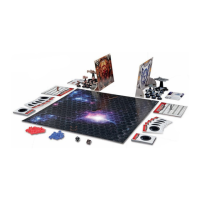
This document describes the "Battleship Galaxies: The Saturn Offensive Game Set," a board game designed for 2-4 players aged 13 and up, focusing on intergalactic battles and strategic missions.
Function Description:
Battleship Galaxies is a strategic board game where players command fleets of spaceships in intergalactic battles. The primary function is to engage in tactical combat, deploy ships, manage energy, and utilize tactic cards to achieve mission objectives. Players choose between two factions: the Intergalactic Space Navy (ISN) from Earth or the invading alien Wretch pirates. The game offers various missions, each with unique setup instructions, victory conditions, and special rules, providing diverse gameplay experiences. The core objective is to outmaneuver and destroy the opponent's fleet or achieve specific mission-based victory conditions.
Important Technical Specifications:
Game Components:
- 20 Ships with Bases and Stands: Each fleet (ISN and Wretch) consists of 10 ships: 4 solo ships and 2 squadrons (made up of 3 ships each). Each ship has a base and a stand for assembly.
- 2 Screens: Used by players to hide their ships and tactic cards from opponents until they are launched.
- 2 Battlefield Gameboards: Missions can utilize either one or two gameboards to create the battlefield.
- 2 Coordinate Dice: Used for attacking enemy ships. These can be rolled together as coordinate dice (e.g., D-4) or separately as letter/number dice.
- 72 Tactic Cards (36 per faction): These cards add strategic depth, offering special powers, additional weapons, and ship upgrades.
- 2 Quick-Reference Cards: Provide quick reminders of the turn sequence and ship card symbols.
- 24 Ship Cards (2 for each solo ship and squadron): Each solo ship and squadron has two double-sided versions (standard, seasoned, veteran) with varying energy costs for inclusion in the fleet and launch.
- 2 Energy Boards & 2 Markers: Used to track energy levels, which are essential for launching ships, activating ships, playing tactic cards, and charging weapons.
- 45 Red (Hull Damage) Pegs: Used to track hull damage. A ship is destroyed when its red pegs equal or exceed its hull value.
- 35 Blue (Shield) Pegs: Used to track shield strength. Shields are removed before hull damage is applied.
- 8 Obstacles (4 debris fields, 4 asteroids) and 8 Discovery Tiles (observation station, orbital market, warp gate, 2 shield regenerators, 2 energy sources, alien artifact): These tiles are used to create unique mission boards and can influence gameplay with special effects.
- 1 Victory Point Tile: Used in missions that incorporate victory points.
Ship Card Specifications:
- Ship Card Name (A): Identifies the ship or squadron. Only one version of a named ship can be in a fleet.
- Size-Solo/Squadron (B): Indicates the ship's size (small, medium, large) and whether it's a solo ship or squadron.
- Class and Experience Level (C): Standard, seasoned, or veteran versions, each with different costs and stats.
- Primary Weapon (D): Base attack with charge cost, range, attacks, and strength.
- Weapon's Name (E): Name of the weapon.
- Weapon's Charge Cost (F): Energy cost to use the weapon's attacks.
- Weapon's Range (G): Number of spaces the ship can shoot.
- Weapon's Attacks (H): Number of attacks per single charge.
- Weapon's Strength (J): Damage dealt per hit.
- Weapon's Additional Info (J): Lists limitations or special abilities.
- Powers (K): Special abilities of the ship card.
- Activate (L): Energy cost to activate (move and attack).
- Move (M): Number of spaces the ship can move.
- Shield (N): Number of blue pegs placed on launch.
- Ship(s) Silhouette (O): Shape of the ship(s).
- Faction Symbol (P): Indicates ISN or Wretch faction.
- Launch (Q): Energy cost to place ship(s) on the board.
- Hull (R): Number of red pegs before destruction.
- Hit Location Chart (S): Grid for determining hits/misses, with critical damage stars.
- Collection Number (T): Card identification.
- Solo/Squadron (U): Icon for attaching non-hero tactic cards.
- Capacity Number (V): Spaces for transporting other ships.
- Ship Upgrade (W): Max number of ship upgrade cards that can be attached.
- Additional Weapon (X): Max number of additional weapon cards that can be attached.
- Hero (Y): Max number of heroes that can be attached.
Tactic Card Specifications:
- Card Name (A): Name of the tactic card.
- Card Type (B): Type of card (e.g., Event, Hero, Ship Upgrade, Additional Weapon, Sabotage).
- Phase (C): Phase during which the card can be played.
- Faction (D): Faction the card belongs to.
- Cost (E): Energy cost to play the card.
- Card Type Symbol (F): Symbol(s) explaining the card's type.
- Power(s) (G): Description of the card's effect.
- Collection Number (H): Card identification.
Usage Features:
Game Setup:
- Component Organization: Unbag all components.
- Ship Assembly: Assemble ships to their bases and stands.
- Battlefield Setup: Place gameboard(s) on the table, optionally elevated by the box bottom. Place coordinate dice, pegs, and quick-reference cards within reach.
- Mission Selection: Choose a mission from the rulebook (starting on page 10) or create a custom mission. First-time players are recommended to start with the "Dead Zone Battle."
- Fleet and Tactic Deck Creation:
- Mission Selected: The mission dictates specific ships and tactic cards.
- Player Selected: Players choose ships and tactic cards based on a given fleet cost (total launch cost limit). Only one copy of any named ship card is allowed per fleet. Tactic card deck size is half the fleet cost (rounded down), with a maximum of 3 copies of any single tactic card.
- Player Screens: Players place their faction's screen, energy board, and marker on their side of the table.
- Hidden Ships/Cards: Ships and ship cards are kept behind screens until launched. Tactic cards are shuffled and placed near screens, with room for a discard pile.
Gameplay Flow (Turn Sequence):
Each turn consists of three phases:
- Energy Phase: Gain 10 energy (5 on turn one for the first player) and draw one tactic card. Players can discard tactic cards for 1 energy each at any point during their turn. Energy cannot go below 0 or above 40.
- Deploy Phase: Pay launch costs to deploy ships from behind screens onto empty spaces in the starting zone or adjacent to a transporting ship. Squadrons must be placed adjacent to other ships in the squadron. Shield pegs are placed on launched ships.
- Action Phase: Activate ship cards one at a time (once per turn per ship card).
- Step 1: Choose Ship Card and Pay Activation Cost: Pay the energy cost to activate a ship.
- Step 2: Move Ship(s): Move any or all ships on the chosen ship card up to their move number. Medium ships lead with one end, trailing the other. Large ships count 3 new spaces as one move. Ships moving adjacent to an enemy ship may take Electronic Countermeasure (ECM) damage (1-3 direct damage based on enemy ship size, on a roll of 5+). Ships cannot end movement on occupied spaces or move through half hexes.
- Step 3: Attack with Ship(s) (Optional):
- Charging Weapons: Pay the charge cost (usually 0) to attack with a weapon.
- Targeting: Target an enemy ship within the weapon's range. Range is counted from an adjacent space to the attacking ship, including occupied spaces.
- Attacking: Roll coordinate dice (letter/number). Opponent checks the attacked ship's hit location chart (gray boxes are hits, white boxes are misses). If hit, deal damage equal to weapon strength.
- Damage: Remove shield pegs first. If shields are down, add hull damage pegs. Critical damage stars on the hit location chart result in immediate destruction if hit while shields are down.
- Squadron Attacks: Each ship in a squadron attacks separately, paying charge costs individually.
Key Concepts:
- Shields Up/Down: Shields are "up" if a ship has shield pegs, "down" if none.
- Dealing Damage: Attacks deal damage by removing shield pegs, then adding hull pegs.
- Direct Damage: Applied directly to shields (Direct Shield Damage) or hull (Direct Hull Damage) as specified by tactic cards or powers.
- Transporting Ships: Some large ships can transport smaller ships, keeping them hidden until launched. Transported ships are destroyed if the transporting ship is taken over or destroyed.
- Obstacles and Discovery Tiles: Placed on the battlefield to add strategic elements.
- Debris Fields: Ships moving onto them roll a die for 1 direct debris damage (on 1-6).
- Asteroids: Small/medium ships adjacent to them gain asteroid cover (6+ roll on number die misses an attack). Ships cannot move through or end on asteroid spaces.
- Discovery Tiles: Can be power-side up or black-side up. Landing on a black-side up tile flips it to power-side up, activating its effect (e.g., Alien Artifact for +7 primary weapon range, Energy Source for +2 energy, Observation Station for +2 primary weapon range, Orbital Market for +1 tactic card, Shield Regenerator for +1 shield peg, Warp Gate for long-range movement).
- Tactic Card Hand Limit: Max 10 cards. Discard for 1 energy if over the limit.
- Tactic Card Deck Runs Out: If a deck runs out twice, the game ends.
- Replacing Attached Tactic Cards: Pay full energy cost for the new card, then discard the old one.
- Taking Control of Opponent's Ship: Gain control of the ship card and attached cards. Transported ships are destroyed. If a hero or named ship is already in your fleet, one must be discarded.
- Breaking the Rules: Ship card and tactic card powers override general rules.
Winning the Game:
- Mission-Specific Victory Conditions: Each mission has unique objectives (e.g., destroy all opponent's ships, earn victory points).
- Victory Clock: If all players' tactic card decks run out twice, the game ends. The player with the highest total launch cost of ships still on the battlefield wins. Ties are broken by the number of ships, then by who ran out of their deck first for the second time.
- Destroying All Opponent's Ships: If a mission specifies this, victory is achieved after the second round of play if the opponent has no ships remaining on the battlefield.
Maintenance Features:
- Component Storage: The game components should be stored in their bags and the game box to prevent loss or damage.
- Assembly/Disassembly: Ships are assembled to bases and stands for play and can be disassembled for storage if desired, though the manual does not explicitly state disassembly.
- Card Handling: Tactic and ship cards should be handled carefully to avoid bending or tearing.
- Peg Management: Keep red and blue pegs organized to ensure accurate damage and shield tracking.
- Rulebook Reference: The rulebook serves as the primary reference for all game rules, setup instructions, and specific mission details. Regular consultation ensures correct gameplay.

 Need help?
 General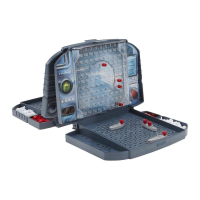


 To Next Page