movement disappears or becomes less
severe, then the wheel hub bearings in the
swivel hub are at fault. Any perceptible
movement at all indicates wear in the hub
bearings, and they should be renewed as
described in Chapter 10.
Swivel hub balljoints
7 Wear of the swivel hub balljoints is fairly
common on Minis and will be quite obvious
on inspection because the whole swivel hub
will appear to move in relation to the
suspension arms as the wheel is rocked. If
this is the case, the balljoints should be
adjusted, or if badly worn, renewed; these
procedures are contained in Chapter 10.
Suspension arm mountings
8 Check for wear of the lower arm inner
mounting bushes where the arm is bolted to
the subframe. If the bushes are worn, the arm
will appear to move in and out as the wheel is
rocked.
9 The upper arm inner roller bearings cannot
be inspected without partially dismantling the
suspension because the rubber cone spring
or displacer unit holds the arm in tension and
any wear will not be evident. It can be
removed for closer inspection if required as
described in Chapter 10; however, wear of the
upper arm and its bearings is uncommon.
10 With the brakes still firmly applied, try to
rotate the wheel back and forth. If any
movement is now felt, examine the tie-bar
between the lower suspension arm and
subframe for wear or deterioration of the
rubber bushes.
Rear suspension
11 To check the rear suspension for wear,
chock the front wheels then jack up the rear of
the car and support it on axle stands (see
“Jacking and vehicle support”).
12 Wear of the rear suspension components
can often be felt when driving the car as a
tendency for the rear of the vehicle to wander
over uneven road surfaces or when cornering.
To isolate the worn components, grasp the
roadwheel at the 12 o’clock and 6 o’clock
positions and try to rock it. If any movement is
felt, it is likely to be in one of the following
areas:
Hub bearings
13 Continue rocking the wheel while an
assistant depresses the footbrake. If the
movement disappears or becomes less
pronounced, then the bearings in the rear hub
are at fault. The bearings should be renewed if
there is any appreciable movement whatsoever.
Radius arm bearings
14 With the footbrake still applied, continue
rocking the wheel and observe the front of the
radius arm. If it can be seen to move
appreciably up and down, then wear has
taken place in the roller or plain bearing in the
radius arm, or on the pivot shaft. If this is the
case, the radius arm should be removed for
overhaul as described in Chapter 10.
6 Underbody and fuel/brake
line check
1
1 With the vehicle raised and supported on
axle stands (see “Jacking and vehicle
support”), or over an inspection pit,
thoroughly inspect the underbody and wheel
arches for signs of damage and corrosion. In
particular, examine the bottom of the side
sills, and any concealed areas where mud can
collect. Where corrosion and rust is evident,
press and tap firmly on the panel with a
screwdriver, and check for any serious
corrosion which would necessitate repairs. If
the panel is not seriously corroded, clean
away the rust, and apply a new coating of
underseal. Refer to Chapter 11 for more
details of body repairs.
2 At the same time, inspect the treated lower
body panels for stone damage and general
condition.
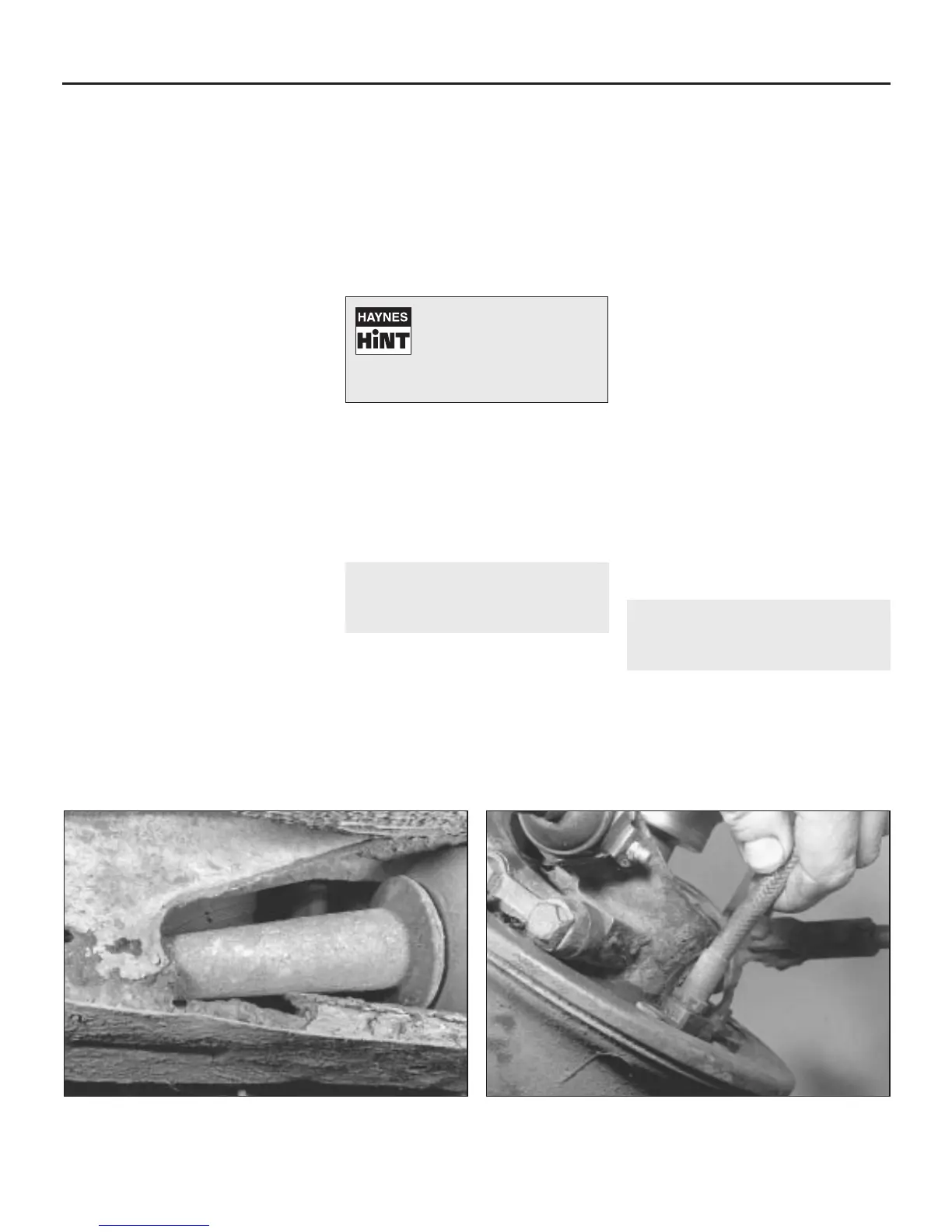
3 Examine the subframes carefully,
particularly the side members of the rear
subframe. Corrosion here is a common
occurrence on Minis, particularly older
models, and is one of the main causes of
MOT test failure on these cars (see
illustration). Where corrosion has reached an
advanced stage, renewal of the subframe is
the only satisfactory cure.
4 Inspect all of the fuel and brake lines on the
underbody for damage, rust, corrosion and
leakage. Also make sure that they are
correctly supported in their clips. The battery
positive cable which runs under the car from
front to rear is a common problem area as it is
prone to damage or chafing if not properly
routed or secured.
5 Inspect the flexible brake hoses in the
vicinity of the backplates or front calipers,
where they are subjected to most movement
(see illustration). Bend them between the
fingers (but do not actually bend them double,
or the casing may be damaged) and check
that this does not reveal previously hidden
cracks, cuts or splits.
7 Exhaust system check
1
1 With the engine cold (at least three hours
after the vehicle has been driven), check the
complete exhaust system, from its starting
point at the engine to the end of the tailpipe.
Ideally, this should be done on a hoist, where
unrestricted access is available; if a hoist is not
available, raise and support the vehicle on axle
stands (see “Jacking and vehicle support”).
1•10 Every 3000 miles or 3 months
6.3 Advanced state of corrosion on rear subframe side member 6.5 Inspect the flexible brake hoses in the vicinity of the
backplates
Wear in the rear hub bearings
can often be confirmed by
slowly turning the wheel with
your hand on the tyre. Worn
bearings usually exhibit a roughness
which can be felt as the wheel is turned.


 To Next Page
 Loading...