2 Check the pipes and connections for
evidence of leaks, severe corrosion, or
damage. Make sure that all brackets and
rubber mountings are in good condition, and
tight; if any of the mountings are to be
renewed, ensure that the replacements are of
the correct type. Failure of the rear mounting
rubber blocks on the rear subframe is a
common problem - check these carefully (see
illustrations). Leakage at any of the joints or in
other parts of the system will usually show up
as a black sooty stain in the vicinity of the leak.
3 At the same time, inspect the underside of
the body for holes, corrosion, open seams,
etc. which may allow exhaust gases to enter
the passenger compartment. Seal all body
openings with silicone or body putty.
4 Rattles and other noises can often be
traced to the exhaust system, especially the
rubber mountings. Try to move the system,
silencer(s) and catalytic converter. If any
components can touch the body or
suspension parts, secure the exhaust system
with new mountings.
8 Fan belt check and renewal
2
Note: If the car is fitted with exhaust emission
control equipment it will first be necessary to
remove the air pump drivebelt as described in
Section 9 to allow access to the fan belt.
Check and adjustment
1 Release the three retaining lugs and remove
the engine ignition shield, if fitted. Rotate the
crankshaft so that the entire length of the fan
belt can be examined. On manual
transmission models, the engine can be
rotated quite easily by engaging top gear and
moving the car backwards or forwards to
allow the belt to be inspected. This should
only be done on level ground; and make sure
that the car cannot run away! An alternative
method, and the method that should be used
on automatic transmission models, is to press
the fan belt midway between the water pump
pulley and dynamo or alternator pulley and
then turn the fan blades.
2 Examine the belt for cracks, splitting,
fraying or damage. Check also for signs of
glazing (shiny patches) and for separation of
the belt plies. Renew the fan belt if worn or
damaged.
3 If the condition of the belt is satisfactory,
check the adjustment as follows.
4 It is most important to keep the fan belt
correctly adjusted; If the belt is too loose it will
slip and wear rapidly, resulting in inefficient
operation of the water pump and dynamo or
alternator. If it is too tight, it will impose
excessive strain on the bearings of the water
pump, dynamo or alternator causing
premature failure of these components.
5 The fan belt tension is correct when there
is 13 mm of fan belt deflection, using light
finger pressure, at a point midway between
the crankshaft and dynamo or alternator
pulleys.
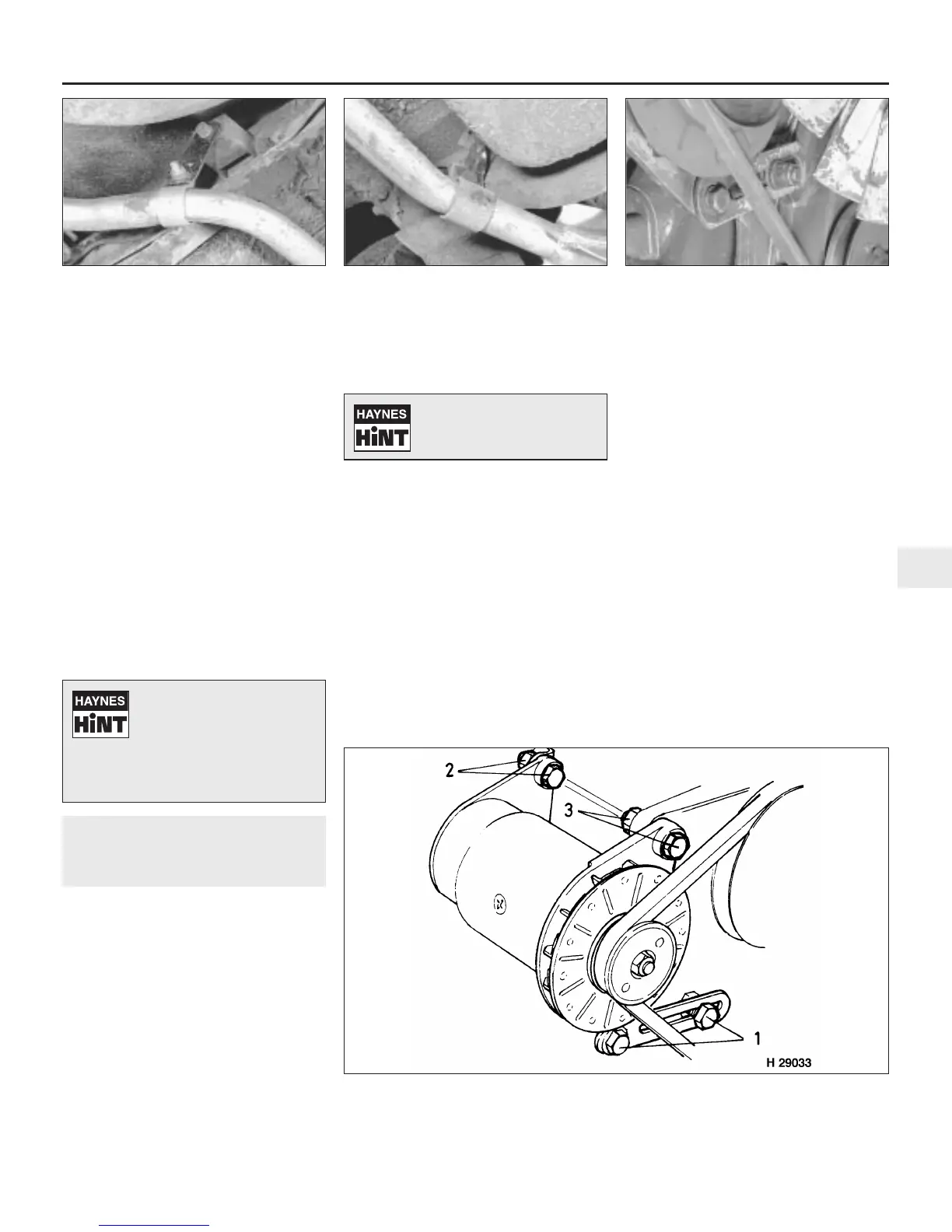
6 To adjust the fan belt, slacken the mounting
bolts of the dynamo or alternator, and also the
nut on the adjusting arm located below the
water pump (see illustration). Now move the
unit either in or out until the correct tension is
obtained. It is easier if the adjusting arm nut is
only slackened a little so it requires some force
to move the dynamo or alternator. In this way
the tension of the belt can be arrived at more
quickly than by making frequent adjustments.
If difficulty is experienced in moving the
dynamo or alternator away from the engine, a
long spanner or bar placed behind the unit and
resting against the block serves as a very good
lever and can be held in position while the
adjusting and mounting bolts are fully
tightened. When levering on an alternator, only
lever on the drive end or damage may occur.
7 When the tension is correct, tighten the
adjusting arm nut first, followed by the
mounting bolts.
Renewal
8 To remove the fan belt, slacken the two
dynamo or alternator upper mountings and
the nut on the adjusting arm below the water
pump (see illustrations).
Every 3000 miles or 3 months 1•11
1
8.6 Dynamo adjusting arm nut located
below the water pump
7.2a Exhaust front mounting block . . . 7.2b . . . and rear mounting block on rear
subframe
8.8a Dynamo mountings and adjustment points
1 Adjustment arm retaining nuts
2 Securing nut and bolt (rear)
3 Securing nut and bolt (front)
When checking the exhaust,
pay particular attention to the
mounting on the transmission.
Movement of the engine
causes this mounting to work loose,
causing an annoying squeak or rattle
when accelerating and decelerating.
Turning the engine will be
easier if the spark plugs are
removed first - see Section 33.


 To Next Page
 Loading...