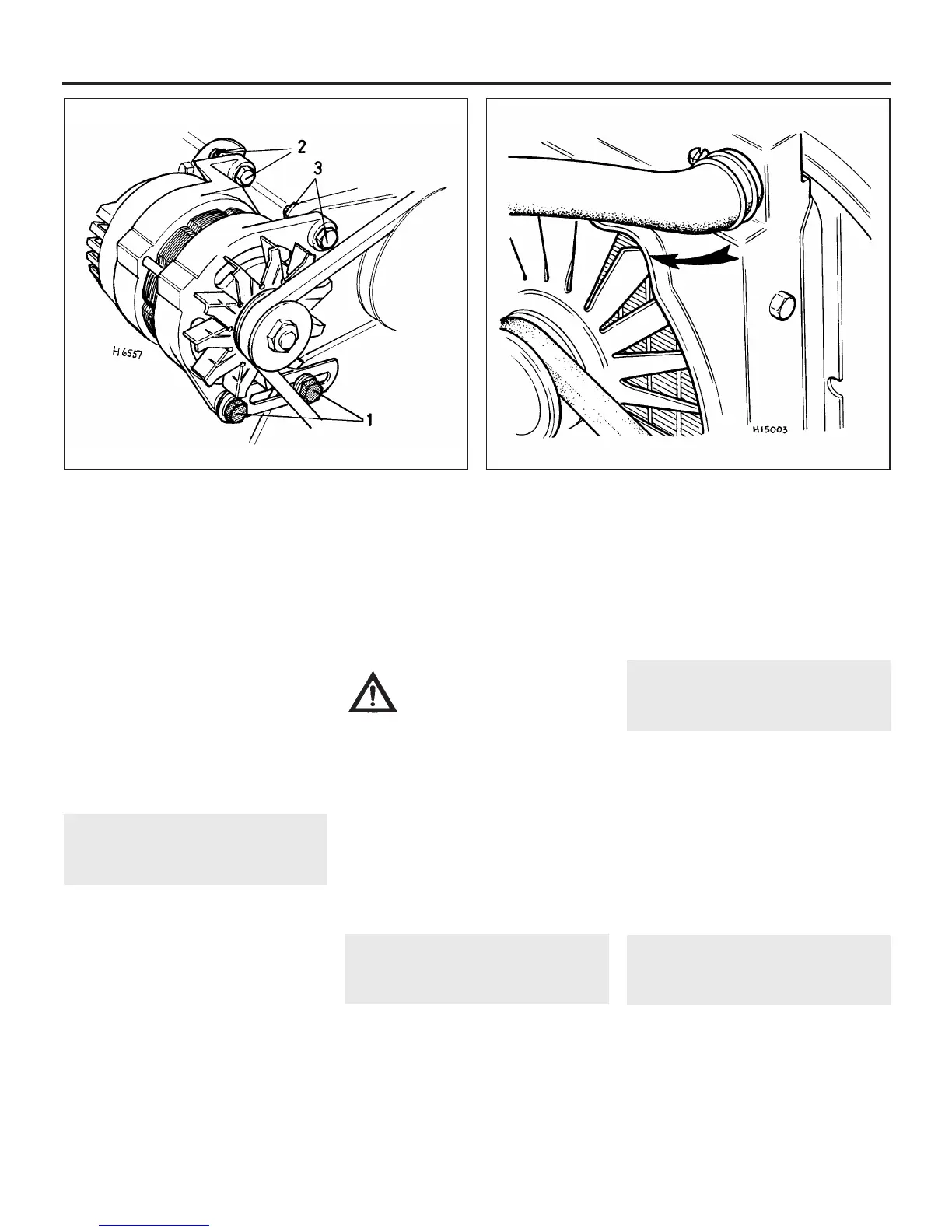
9 Push the dynamo or alternator toward the
engine and lift the old belt off the three
pulleys. Feed the belt over each fan blade in
turn and withdraw it from behind the fan
cowling at the special gap just below the top
hose (see illustration).
10 Fit the new belt over the fan blades in the
same way and then place it in position on the
three pulleys.
11 Adjust the fan belt tension as described
previously then refit the air pump drivebelt,
where applicable, as described in the
following Section. Note: After fitting a new fan
belt, check and if necessary readjust the
tension after 250 miles (400 km).
9 Air pump drivebelt check
and renewal
2
Check and adjustment
1 The checks and adjustment procedure for
the air pump drivebelt are basically the same
as described in Section 9 for the fan belt.
Adjust the tension of the drivebelt so that
there is 13 mm deflection of the belt, using
thumb pressure, at a point midway between
the two pulleys.
Renewal
2 Release the three retaining lugs and remove
the engine ignition shield, if fitted.
3 Undo and remove the two bolts securing
the radiator upper mounting bracket to the
radiator.
4 Unscrew the radiator filler cap and slacken
the top hose securing clips. Carefully ease the
radiator as far as possible toward the wing
valance. Place a container beneath the engine
to catch the small quantity of coolant that will
be lost as the top hose is released.
Warning: If the engine is hot,
take precautions against
scalding.
5 Slacken the air pump pivot and adjusting
link bolts, push the pump in toward the
engine, and slip the drivebelt off the two
pulleys.
6 Feed the belt between the fan blades and
the radiator cowling at the top as the blades
are rotated. Now pull the belt out from
between the fan and radiator.
7 Refitting the drivebelt is the reverse
sequence to removal, adjusting the tension as
described previously. Top up the cooling
system as described in “Weekly Checks” on
completion.
10 Clutch hydraulic check
1
1 Check that the clutch pedal moves
smoothly and easily through its full travel, and
that the clutch itself functions correctly, with
no trace of slip or drag.
2 Apply a few drops of light oil to the clutch
pedal pivot.
3 From within the engine compartment check
the condition of the fluid lines and hoses.
Check for signs of fluid leaks around the slave
cylinder rubber boot or from the feed pipe and
hose. Apply a few drops of oil to the clutch
operating lever clevis pin and the pivot on the
flywheel housing.
11 Seats and seat belt check
1
1 Check that the seats are securely attached
to the floor crossmember and that there is no
sign of corrosion anywhere near the
mountings. Check that the seats release and
then lock in place when the release
mechanism is operated.
2 Check the seat belts for satisfactory
operation and condition. Inspect the webbing
for fraying and cuts. Check that they retract
smoothly and without binding into their reels.
3 Check the seat belt mountings, ensuring
that all the bolts are securely tightened.
12 Headlight beam alignment
check
5
Accurate adjustment of the headlight beam
is only possible using optical beam-setting
equipment, and this work should therefore be
carried out by a Rover dealer or service
station with the necessary facilities.
Basic adjustments can be carried out in an
emergency, and further details are given in
Chapter 12.
1•12 Every 3000 miles or 3 months
8.8b Alternator mounting and adjustment points
1 Adjustment arm fixings
2 Securing nut and bolt (rear)
3 Securing nut and bolt (front)
8.9 The gap in the radiator shroud of early models (arrowed) to
allow removal and refitting of the fan belt


 To Next Page
 Loading...