13 Engine/transmission oil and
filter renewal
2
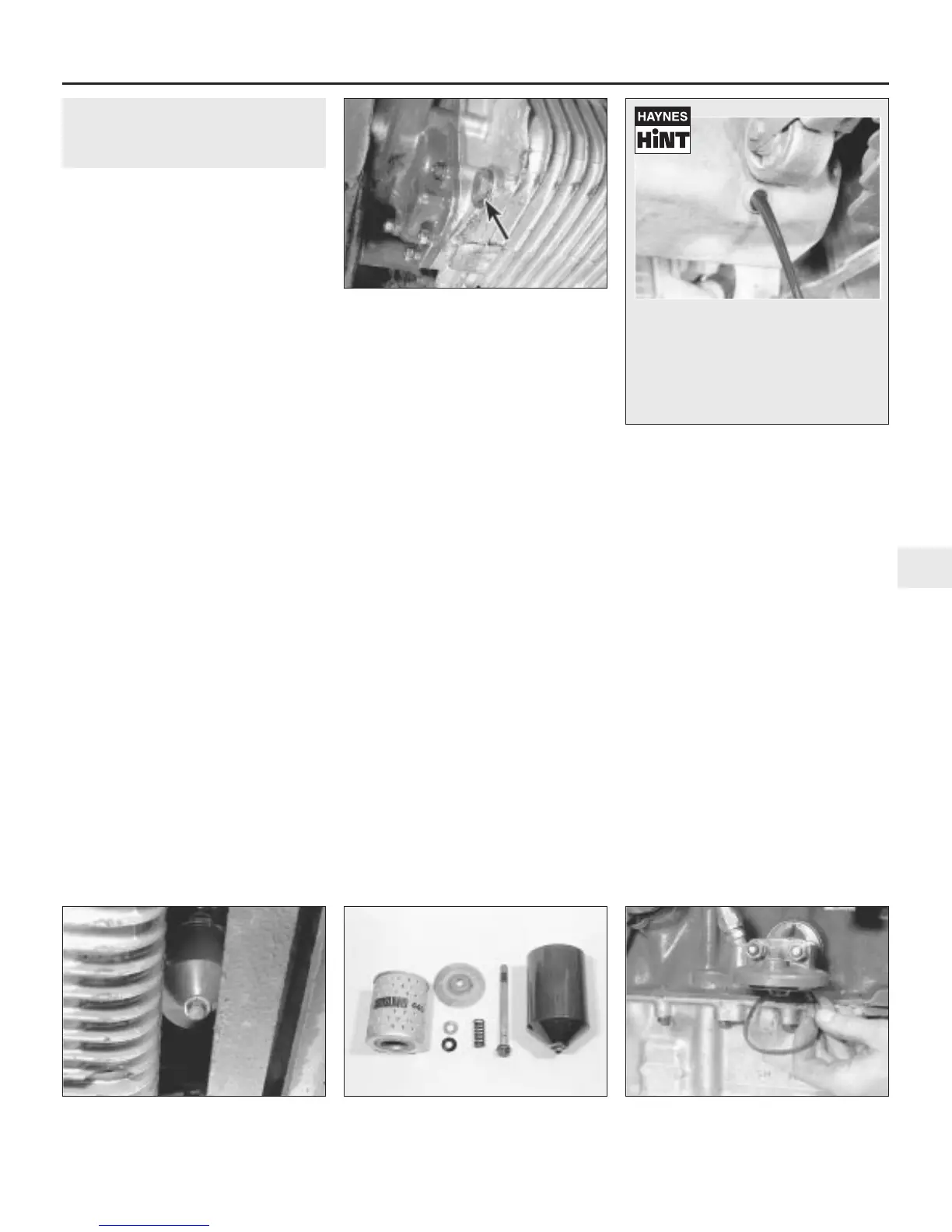
1 Frequent oil changes are the best
preventive maintenance the home mechanic
can give the engine, because ageing oil
becomes diluted and contaminated, which
leads to premature engine wear.
2 Make sure that you have all the necessary
tools before you begin this procedure. You
should also have plenty of rags or newspapers
handy, for mopping up any spills. The oil
should preferably be changed when the
engine is still fully warmed-up to normal
operating temperature, just after a run; warm
oil and sludge will flow out more easily. Take
care, however, not to touch the exhaust or any
other hot parts of the engine when working
under the vehicle. To avoid any possibility of
scalding, and to protect yourself from possible
skin irritants and other harmful contaminants
in used engine oils, it is advisable to wear
gloves when carrying out this work. Access to
the underside of the vehicle is greatly
improved if the vehicle can be lifted on a hoist,
driven onto ramps, or supported by axle
stands. (see “Jacking and vehicle support”).
Whichever method is chosen, make sure that
the vehicle remains level, or if it is at an angle,
that the drain point is at the lowest point.
Oil draining
3 Position the draining container under the
drain plug on the side of the transmission
casing, and unscrew the plug (see
illustration). If possible, try to keep the plug
pressed into the sump while unscrewing it by
hand the last couple of turns.
4 Allow the oil to drain into the container (see
Haynes Hint), and check the condition of the
plug’s sealing washer; renew it if worn or
damaged. Also wipe off any metal particles
that may have accumulated on the magnet.
5 Allow some time for the old oil to drain,
noting that it may be necessary to reposition
the container as the oil flow slows to a trickle;
when the oil has completely drained, wipe
clean the drain plug and its threads in the
transmission and refit the plug, tightening it to
the specified torque.
Oil filter renewal
6 The oil filter is located underneath the
dynamo or alternator on the forward-facing
side of the engine. On early manual
transmission models the filter is of the
disposable cartridge type contained within an
aluminium bowl. On later models a throwaway
canister is used. All automatic transmission
models utilise the cartridge type filter. To
renew the filter proceed as follows.
Cartridge type
7 Reposition the draining container under the
oil filter then undo and remove the long centre
bolt securing the bowl to the housing (see
illustration). On some models it may be
advantageous to remove the grille panel, as
space is rather limited.
8 With the bolts released, carefully lift away
the filter bowl, which contains the filters and
will also be full of oil.
9 Discard the old filter element but first make
sure that the metal pressure plate has not
stuck to the bottom of it. Now thoroughly
clean out the filter bowl, the bolt, and the
parts associated with it, using paraffin or a
suitable solvent (see illustration) Dry with a
lint free cloth
10 A rubber sealing ring is located in a
groove round the head of the filter housing
and forms an effective leak-proof joint
between the housing and the filter bowl. A
new rubber sealing ring is supplied with each
new filter element.
11 Carefully prise out the old sealing ring
from the locating groove. If the ring has
become hard and is difficult to move take
great care not to damage the sides of the
sealing ring groove.
12 With the old ring removed, fit the new ring
in the groove at four equidistant points and
press it home a segment at a time. Do not
insert the ring at just one point and work
round the groove pressing it home as, using
this method, it is easy to stretch the ring and
be left with a small loop of rubber which will
not fit into the locating groove (see
illustration).
13 Reassemble the oil filter assembly by first
passing up the bolt through the hole in the
bottom of the bowl, with a steel washer under
the bolt’s head and a rubber or felt washer on
top of the steel washer and next to the filter
bowl.
14 Slide the spring over the bolt followed by
the other steel washer, the remaining rubber
washer and finally the filter pressure plate
concave face downwards.
15 After fitting the new element to the bowl,
position the bowl on the rubber sealing ring
then insert and hand tighten the bolt. Before
finally tightening the centre bolt, ensure that
the lip of the filter bowl is resting squarely on
the rubber sealing ring and is not offset or
seated off the ring. If the bowl is not seating
properly, rotate it until it is. Run the engine
and check the bowl for leaks.
Every 6000 miles or 6 months 1•13
1
13.3 Engine/transmission oil drain plug
(arrowed)
13.7 Cartridge type oil filter and retaining
bolt as seen from below
13.12 Fitting a new cartridge type oil filter
sealing ring
13.9 Components of the cartridge type oil
filter
Keep the drain plug pressed into the
sump while unscrewing it by hand the
last couple of turns. As the plug
releases, move it away sharply so the
stream of oil issuing from the sump
runs into the container, not up your
sleeve!


 To Next Page
 Loading...