Canister type
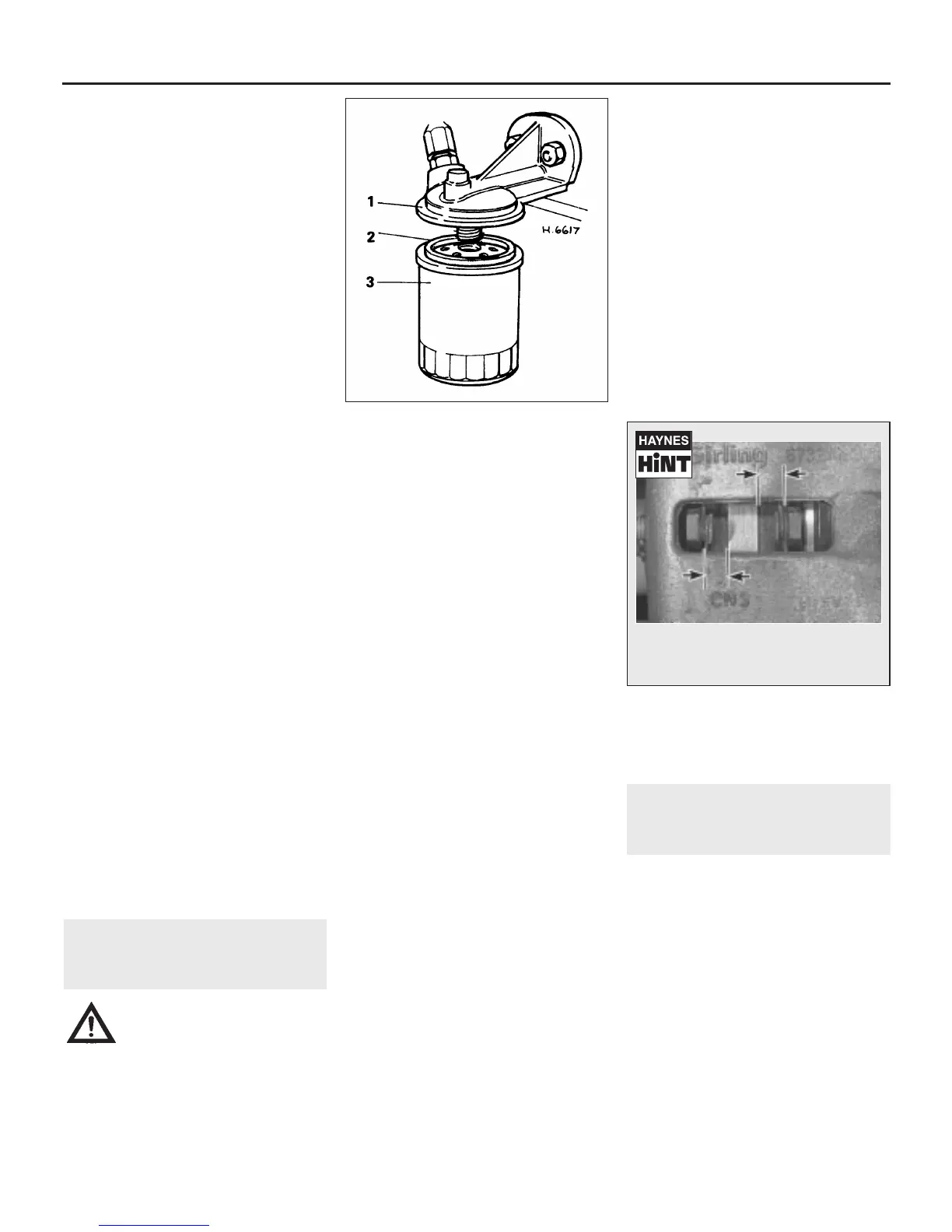
16 Reposition the draining container under
the oil filter then, using a suitable filter removal
tool if necessary, slacken the canister initially,
then unscrew it by hand the rest of the way;
be prepared for some oil spillage (see
illustration). Empty the oil in the old canister
into the container.
17 Using a clean, lint-free rag, wipe clean the
cylinder block around the filter housing.
Check the old canister to make sure that the
rubber sealing ring hasn’t stuck to the filter
housing; if it has, carefully remove it.
18 Apply a light coating of clean engine oil to
the sealing ring on the new canister. Screw
the canister into position on the housing until
it seats, then tighten it firmly by hand only - do
not use any tools.
19 Remove the old oil and all tools from
under the vehicle, then lower the vehicle to
the ground.
Oil filling
20 Remove the dipstick and the oil filler cap
from the engine. Fill the engine with oil, using
the correct grade and type of oil, (see
Specifications). Pour in half the specified
quantity of oil first, then wait a few minutes for
the oil to fall to the transmission casing. Take
care during this operation, particularly in cold
weather as it is all to easy to fill up the rocker
cover before the oil drains down into the
engine, with very messy results as it overflows
out of the filler neck. Continue adding oil a
small quantity at a time, until the level is up to
the lower mark on the dipstick. Adding
approximately 0.5 litres will raise the level to
the upper mark on the dipstick.
21 Start the engine. The oil pressure warning
light will take a few seconds to go out while
the new filter fills with oil; do not race the
engine while the light is on. Run the engine for
a few minutes, while checking for leaks
around the oil filter seal and the drain plug.
22 Switch off the engine, and wait a few
minutes for the oil to settle in the transmission
once more. With the new oil circulated and
the filter now completely full, recheck the level
on the dipstick, and add more oil as
necessary.
23 Dispose of the used engine oil safely and
in accordance with environmental regulations
(see “General repair procedures”).
14 Front brake wear check
1
Warning: The dust created by wear
of the shoes may contain asbestos,
which is a health hazard. Never
blow it out with compressed air,
and don’t inhale any of it. An approved filtering
mask should be worn when working on the
brakes. DO NOT use petrol or petroleum-
based solvents to clean brake parts; use brake
cleaner or methylated spirit only.
Drum brake models
1 After high mileage the friction linings on the
brake shoes will have worn, and it will
therefore be necessary to fit replacement
shoes with new linings.
2 Chock the rear wheels then jack up the
front of the car and support it on axle stands
(see “Jacking and vehicle support”). Remove
the front roadwheels.
3 Slacken off the brake shoe adjuster(s) from
behind the backplate, and then undo and
remove the two brake drum retaining screws.
4 Remove the brake drum from the wheel
hub. If the drum is tight, gently tap its
circumference with a soft-faced mallet.
5 Brush and wipe away all traces of asbestos
dust from the brake shoes, wheel cylinders
and backplate, and also from the inner
circumference of the brake drum.
6 Inspect the friction material and renew the
brake shoes as described in Chapter 9 if they
have worn down to less than the specified
minimum thickness.
7 The brake shoes must also be renewed if
there is any sign of hydraulic fluid
contamination of the linings due to a leaking
brake wheel cylinder. If this is the case, the
cause of the leak must be traced and rectified
before fitting new brake shoes.
8 Brake shoes should always be renewed as
complete sets (four shoes to a set), otherwise
uneven braking and pulling to one side may
occur.
9 It is advisable to check that the brake wheel
cylinders are operating correctly before
proceeding further. To do this hold the brake
shoes in position using two screwdrivers while
an assistant very slowly depresses the brake
pedal slightly. Check that the wheel cylinder
pistons move out as the pedal is depressed,
and return when the pedal is released. If this is
not the case, it is quite likely that one of the
wheel cylinder pistons is seized and the cylinder
should therefore be renewed (Chapter 9).
10 Also check the condition of the brake
drum, If it is deeply scored on its inner
circumference it may be possible to have it
skimmed at an engineering works. If the
scoring is severe, renewal will be necessary
Disc brake models
11 Jack up the front or rear of the vehicle in
turn, and support it on axle stands (see
“Jacking and vehicle support”).
12 For better access to the brake calipers,
remove the roadwheels.
13 Look through the opening in the front of
the caliper, and check that the thickness of
the friction lining material on each of the pads
is not less than the recommended minimum
thickness given in the Specifications (see
Haynes Hint). If any one of the brake pads
has worn down to, or below, the specified
limit, all four pads must be renewed as a set
(ie all the front pads).
14 For a comprehensive check, the brake
pads should be removed and cleaned. The
operation of the brake calipers can then be
checked, and the brake discs can be fully
examined. Refer to Chapter 9 for details.
15 Driveshaft gaiter check
1
With the vehicle raised and securely
supported on stands (see “Jacking and
vehicle support”), turn the steering onto full
lock, then slowly rotate the roadwheel.
Inspect the condition of the outer constant
velocity (CV) joint rubber gaiters, squeezing
the gaiters to open out the folds. Check for
signs of cracking, splits or deterioration of the
rubber, which may allow the grease to
escape, and lead to water and grit entry into
the joint. Also check the security and
condition of the retaining clips. Repeat these
checks on the inner CV joints where offset
sphere type joints are fitted. If any damage or
deterioration is found, the gaiters should be
renewed as described in Chapter 8.
At the same time, check the general condition
of the CV joints themselves by first holding the
1•14 Every 6000 miles or 6 months
13.16 Canister type oil filter
1 Housing
2 Sealing ring
3 Filter
Look through the opening in the caliper
and check the thickness of the friction
lining material on the brake pads


 To Next Page
 Loading...